

 Visa i rummet
 Skicka
 Dela
Dela
 Detaljer
 Studentguide för konstverk

 Ladda ner
 Liknande objekt
 Röntgen
 Bildspel
 Besökstatistik
Nude Study
 Acrylic On Canvas
- WallArt
- High Renaissance
 1515
1515 41.0 x 28.0 cm
 Läs mer
Handgjord oljereproduktion
Handmålad olja på duk i din valda storlek och ram, tillverkad efter beställning av våra konstnärer. ( Byt till tryckta exemplar Byt till digital bildförsäljning)




P118B Skr10

P118H Skr10

P118W Skr10

P438Z Skr10

P508JH Skr12

P508YH Skr12

P805H Skr10

P805Z Skr10

P919BZ Skr10

P919G Skr10

P919XJ Skr10

P959ZH Skr10

P968JZ Skr12

W106C Skr8

W218G Skr10

W218JH Skr8

W218Y Skr10

W307PJ Skr10

W316G Skr10

W316PJ Skr8

W316Y Skr10

W398PJ Skr8

W4111J Skr10

W500HY Skr15

W500JH Skr15

W692G Skr12

W849H Skr8

W940BG Skr15

W953PJ Skr8




Välj bland våra förinställda storlekar som motsvarar konstverkets ursprungliga proportioner.

Ange den bredd och höjd du behöver för att passa din ram eller din vägg. Eftersom detta är handmålat kan konstnären vid en annan form måla lite mer runt bilden eller beskära den något – du väljer själv. Vi skickar en digital mockup för godkännande innan målningen påbörjas. Bilden som visas på denna sida representerar inte det slutgiltiga resultatet — det är endast mockuppen som visar det.
Efter beställning kommer OriginalUniqueArt.com team att mejla kunden för instruktioner och tillhandahålla en skissförhandsvisning
Leverans över hela världen () på 3–4 veckor istället för standard 5 veckor. (21 oktober). Inga kompromisser med kvaliteten.

Fri expressfrakt över hela världen

Högkvalitativ linnecanvas

Fullständig fraktförsäkring

Garantier för återbetalning av tullavgifter

Garantier för exakt färgåtergivning

100 dagars returrätt vid fabrikationsfel

100% pengarna tillbaka-garanti

Mängdrabatt erbjuds
 Glasalternativet är endast tillgängligt i storlekar under 110 cm.

Nude Study
Tryckteknik
Reproduktionsstorlek
-


Totalpris
Skr 2950
A Study in Male Form and Reflection: Raphael’s ‘Nude Study’ (1515)
Raphael’s “Nude Study,” painted in 1515, is more than simply a depiction of two nude male figures; it's a profound meditation on masculinity, power, and the very nature of representation. Emerging from the vibrant artistic crucible of Urbino – a city renowned for its humanist ideals and patronage under Duke Federico da Montefeltro – Raphael’s early works already demonstrated an extraordinary command of anatomy and a nascent ability to imbue his subjects with psychological depth. This particular piece, executed during a period of intense experimentation within his studio, reveals the artist grappling with complex themes through a deceptively simple composition.
The painting immediately draws the eye to the central figures, positioned before an ornate mirror that dominates the background. The mirroring effect creates a captivating visual loop, doubling the presence of the men and subtly suggesting notions of duality – perhaps representing opposing forces or even the artist’s own internal struggles with artistic identity. The figures themselves are rendered with a remarkable sensitivity to light and shadow, characteristic of Raphael's developing style. Notice how he masterfully uses *chiaroscuro*—the dramatic contrast between light and dark—to sculpt their forms, emphasizing musculature and creating a sense of volume that transcends mere representation. The smooth, almost porcelain-like quality of the skin speaks to Raphael’s meticulous study of human anatomy, informed by his father's artistic practice and the prevailing Renaissance interest in classical ideals of beauty.
The Weight of Weapons and Ancient Echoes
Crucially, these are not idealized figures adrift in a timeless realm. Both men are armed – one holding a sword, the other a bow – elements that immediately anchor the scene within a historical context. While the precise narrative remains open to interpretation, the inclusion of weaponry hints at potential allegorical meanings. Some scholars suggest connections to ancient Greek mythology, perhaps referencing scenes from heroic tales where male figures embody strength and martial prowess. Others propose a Roman influence, recalling depictions of gladiators or warriors engaged in battle. The juxtaposition of nudity with weapons creates a tension, suggesting vulnerability alongside power, a delicate balance that is central to the painting’s emotional resonance.
The positioning of the figures – one turned away from the viewer and the other facing forward – further complicates the narrative. This deliberate asymmetry invites speculation about their relationship and intentions. Is there an unspoken dialogue between them? Does the averted figure represent a hidden truth or a concealed emotion? Raphael’s masterful use of space and perspective encourages the viewer to actively participate in constructing the story, transforming the painting into a dynamic invitation to interpretation.
Technique and the Urbino Renaissance
Raphael's technique in “Nude Study” is a testament to his burgeoning skill and the artistic innovations flourishing during the Urbino Renaissance. He employed *sfumato*, a subtle blurring of lines and edges, particularly around the figures’ contours, creating an ethereal quality that softens their forms and imbues them with a sense of grace. The use of oil paint allowed for layering and blending, contributing to the painting's rich textures and luminous colors. The palette is restrained – primarily earthy tones punctuated by subtle highlights – reflecting the refined aesthetic sensibilities of the time.
Furthermore, this work exemplifies Raphael’s early engagement with humanist principles. He wasn’t simply replicating classical forms; he was actively analyzing them, understanding their underlying structure and applying that knowledge to create a distinctly modern interpretation. The attention to detail, the psychological depth conveyed through gesture and expression, and the masterful manipulation of light and shadow all point to a young artist poised to become one of the most celebrated figures in Western art history.
A Timeless Reflection: Reproduction Options
OriginalUniqueArt offers exquisite, hand-painted reproductions of Raphael’s “Nude Study,” meticulously crafted to capture the essence of this captivating masterpiece. Our skilled artisans utilize archival-quality materials and techniques that faithfully replicate the original's luminosity and texture. Whether you seek a stunning addition to your art collection or a sophisticated element for your interior design, our reproductions provide an authentic and enduring representation of Raphael’s profound exploration of human form and reflection. Explore our range of sizes and framing options today – each reproduction is a testament to the enduring power of Renaissance artistry.
Frågor och svar
Vilken är den färgmässiga identiteten hos "Nude Study" av Rafael?
"Nude Study" definieras av en Monochrome-palett med Driftwood (#ab7b6a) som dominerande färg.
Vilken färgmättnad har "Nude Study" av Rafael?
Färgpaletten i "Nude Study" har en mättnad på Muted.
Är "Nude Study" av Rafael ett välkänt konstverk?
"Nude Study" klassificeras som Iconic.
Om konstnären
Raffael: En renässansmästares liv och verk
Raffaello Sanzio da Urbino, mer känd som Raffael, föddes 1483 i den lilla men kulturellt blomstrande staden Urbino. Hans tidiga år präglades av en atmosfär där konstnärlig skicklighet och humanistiskt lärande högt värderades. Fadern, Giovanni Santi, var inte bara en målare utan också en beläst man som aktivt sökte nya idéer från hela Italien. Denna uppväxt i ett hovmiljö, präglad av förfining och intellektuell diskurs, formade den unge Raffael på djupet. Faderns bortgång vid elva års ålder innebar ett stort ansvar, men också en möjlighet att utveckla sina färdigheter i familjeverkstaden under lokala konstnärers ledning. Redan i dessa tidiga verk anades en mild elegans och noggrann detaljrikedom – kännetecken för hans mogna stil.
Från Umbrien till Florens: Att absorbera nya influenser
Raffaels konstnärliga resa var en ständig utveckling, präglad av intensiva studier och anpassning. Hans initiala utbildning under Pietro Perugino i Perugia lade en solid grund i den umbriska stilen – kännetecknad av mjuka former, harmoniska kompositioner och fridfulla religiösa scener. Raffael hade dock en omättlig nyfikenhet som drev honom att söka nya utmaningar och vidga sina konstnärliga horisonter. År 1504 begav han sig till Florens, en stad som vibrerade av konstnärlig innovation. Här mötte han mästerverken av Leonardo da Vinci och Michelangelo, artister som tänjde gränserna för måleriet på ett sätt ingen tidigare gjort. Han studerade deras tekniker noggrant – Leonardos sfumato, hans subtila ljus- och skuggspel, och Michelangelos kraftfulla anatomiska precision och dramatiska kompositioner. Den florentinska perioden blev en smältdegel för Raffael, som tvingades konfrontera nya konstnärliga möjligheter och syntetisera dem till sin egen unika vision. Influensen syns tydligt i den ökade dynamiken och psykologiska djupet i hans verk från denna tid, särskilt i hans serie av madonnamålningar.
Den romerska triumfen: Beställningar och mästerverk
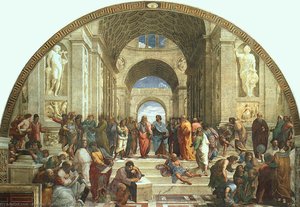
År 1508 mottog Raffael en kallelse som skulle förändra hans karriär – en inbjudan från påven Julius II att komma till Rom. Detta markerade början på hans mest produktiva och hyllade period. Den eviga staden erbjöd honom en oöverträffad möjlighet att visa sin talang i stor skala, genom att pryda de påvliga lägenheterna i Vatikanen med hisnande fresker. Skolan i Aten, kanske hans mest berömda verk, står som ett bevis på hans mästerliga komposition, perspektiv och filosofiska allegori. Inom detta majestätiska rum samlade Raffael figurer från den klassiska antiken – Platon, Aristoteles, Pythagoras, Euklid – och skapade en levande tableau som hyllade det mänskliga förnuftet och strävan efter kunskap. Han fortsatte att arbeta för påföljande påvar, bland annat Leo X, och åtog sig monumentala projekt som dekorationen av Stanze della Segnatura och Stanza d'Eliodoro. Hans fresker i dessa rum är inte bara dekorativa; de är djupa uttalanden om påvlig makt, religiös tro och renässansens ideal.
En syntes av grace och storhet: Raffaels konstnärliga stil
Raffaels konstnärliga stil beskrivs ofta som en harmonisk blandning av grace, klarhet och idealiserad skönhet. Han hade en extraordinär förmåga att syntetisera olika influenser – den umbriska traditionen, florentinska innovationer, klassisk antiken – till ett unikt balanserat estetiskt uttryck. Hans kompositioner är minutiöst planerade, präglade av en känsla av ordning och proportion som återspeglar hans djupa förståelse för renässansens principer. Hans figurer utstrålar en seren värdighet och emotionell expressivitet, vilket förkroppsligar den humanistiska idealen om mänsklig perfektion. Han var också en mästerlig kolorist, som använde rika, lysande nyanser för att skapa verk som är både visuellt fängslande och intellektuellt stimulerande. Till skillnad från Michelangelos ofta dramatiska och turbulenta stil utstrålar Raffaels arbete en känsla av lugn och harmoni – en kvalitet som har gjort honom älskad av publiken i århundraden.
Arvet och det bestående inflytandet
Raffaels tidiga död 1520, vid endast trettiosju års ålder, avbröt en karriär som var full av potential. Ändå består hans arv som en av de mest betydelsefulla figurerna i västerns konsthistoria. Hans verk blev en hörnsten i den högrenässansens estetik och fungerade som en modell för generationer av artister. Medan Michelangelos inflytande senare skulle dominera den konstnärliga diskursen, upplevde Raffaels betoning på klarhet, harmoni och idealiserad skönhet en renässans under nyklassicismen, hyllad av kritiker som Johann Joachim Winckelmann. Idag fortsätter hans målningar att inspirera vördnad och beundran, och fängslar tittarna med sin tekniska briljans, emotionella djup och bestående dragningskraft. Hans inflytande kan ses i otaliga konstverk som följde, vilket befäster hans plats som en sann mästare av renässansen – en målare som fångade inte bara sina motivs fysiska likhet utan också essensen av mänsklig grace och värdighet.

Rafael
1483 - 1520 , Italien
Snabbfakta
- Artistic Movement Or Style: Högrenässans
- Artists Or Movements Influenced By This Artist: ['Neoklassicism']
- Artists Who Influenced This Artist:
- Leonardo da Vinci
- Michelangelo
- Date Of Birth: 1483
- Date Of Death: 1520
- Full Name: Raffaello Sanzio da Urbino
- Nationality: Italiensk
- Notable Artworks:
- Skolmästarnas skola
- Sixtinska madonnan
- Place Of Birth (City And Country): Urbino, Italien
Relaterade artiklar
Michelangelos 25 Mästerverk: Konsthistoriens Största Skönheter – OriginalUniqueArt
Utforska Michelangelos 25 mest ikoniska konstverk – från Pietà till Sixtinska kapellet. Lär känna renässansens mästare och hans tidlösa skulpturer & målningar. Köp museumkvalitativa reproduktioner på OriginalUniqueArt.com.
The Renaissance Trinity: A Comparative Study of Leonardo, Michelangelo, and Raphael
Explore the profound genius of the Renaissance Trinity. Delve into a comparative study of Leonardo da Vinci, Michelangelo, and Raphael, uncovering their unique contributions to art history, technique, and the enduring legacy of Italian High Renaissance mastery.

The Enduring Allure of the Nude: A Historical & Artistic Exploration of the Human Form
Explore the captivating history of nude art! Discover iconic paintings & artists from classical to modern eras. Uncover symbolism, techniques & find museum-quality reproductions at OriginalUniqueArt.
Raphaels 25 Mästerverk: Konsthistoriens Höjdpunkter för Ditt Hem
Utforska Raphaels 25 mest ikoniska mästerverk – en resa genom renässanskonstens guldålder. Lär känna historien, tekniken och skönheten bakom varje tavla. Hitta konsttryck & inspiration för ditt hem på OriginalUniqueArt.com.
Leonardo da Vincis 25 Mästerverk: Konsthistoriens Största Genier – OriginalUniqueArt
Utforska Leonardo da Vincis 25 mest ikoniska verk – från Mona Lisa till Sista måltiden. Upptäck renässansens mästerverk, deras historia och teknik. Köp högkvalitativa konsttryck & reproduktioner på OriginalUniqueArt.com.




![Stanze Vaticane - Utdrivningen av Heliodorus från templet (detalj) [02]](/media/artworks/images-thumb/3a/23/3a2308b63b60b5cb105575e135028d92.jpg)