Högrenässans
Disputa (Rafael)
Rafael (1483–1520) skapade Disputa. Det tillhör Högrenässans-rörelsen. Den är utförd i Fresko.
- Fresko

 Handmålad oljemålning
 Skicka
 Dela
 Guide


 Ladda ner
 Liknande objekt
 Bildspel
 Frågor och svar

 Statistik
Disputa: det viktigaste
- Titel
- Disputa
- Konstnär
- Rafael (1483–1520)
- Konstnär född i
- Urbino, Italien
- Material
- Fresko
- Rörelse
- Högrenässans
- Tidsperiod
- Renässansen
Vad föreställer Disputa?
A Divine Dialogue: Unveiling Raphael’s *Disputa*
Raphael's *Disputa*, painted between 1509 and 1510, is a cornerstone of High Renaissance art, residing within the breathtaking Stanze di Raffaello in the Apostolic Palace at Vatican City. This monumental fresco isn’t merely a painting; it’s a theological statement rendered with unparalleled grace and intellectual depth, inviting viewers into a visual discourse on faith, reason, and divine truth.Subject & Composition: Heaven Meets Earth
The *Disputa* presents a complex yet harmonious composition divided into two distinct realms. The upper portion depicts a celestial gathering of theologians, saints, prophets, and martyrs arranged in a semi-circular formation around Christ and the Virgin Mary. They engage in animated discussion, their gestures conveying reverence and intellectual fervor. Below, on an architectural platform resembling a classical temple apse, earthly theologians – recognizable figures like Saint Augustine, Saint Thomas Aquinas, and Saint Gregory – continue the debate concerning the Holy Sacrament. This deliberate juxtaposition visually represents the convergence of heavenly wisdom and human inquiry. The composition is masterfully structured with a pyramidal form culminating in Christ, drawing the eye upwards towards the divine source.Style & Technique: The High Renaissance Ideal
*Disputa* exemplifies the hallmarks of the High Renaissance: balance, clarity, and idealized beauty. Raphael’s mastery of perspective creates a convincing sense of depth, while his use of *sfumato* – subtle gradations of light and shadow – lends an ethereal quality to the figures. Executed as a fresco, the painting demonstrates Raphael's technical brilliance in applying pigments to wet plaster, resulting in vibrant colors that have endured for centuries. The figures are not static; they possess dynamic poses and expressive faces, conveying a sense of lively intellectual exchange.Historical Context & Symbolism
Commissioned by Pope Julius II as part of the decoration of his private library (the *Stanza della Segnatura*), *Disputa* reflects the humanist spirit of the Renaissance – a renewed interest in classical learning and philosophical inquiry alongside religious faith. The room itself was intended to represent different branches of human knowledge: theology, law, poetry, and philosophy. The painting’s symbolism is rich and layered. The Holy Spirit, represented as a dove emanating light, signifies divine inspiration. The inclusion of prominent theologians underscores the importance of reason and scholarship in understanding religious doctrine. The architectural setting evokes the grandeur of ancient Rome, linking Christian theology to classical tradition.Emotional Impact & Lasting Legacy
*Disputa* transcends its theological subject matter to evoke a profound sense of awe, reverence, and intellectual curiosity. The painting’s harmonious composition and idealized figures inspire contemplation on the nature of truth, faith, and knowledge. It is not merely a depiction of a debate but an invitation to participate in it – to engage with the eternal questions that have occupied humanity for centuries. Raphael's *Disputa* remains a testament to his artistic genius and continues to captivate viewers with its beauty, intellectual depth, and enduring spiritual power.- Explore high-quality reproductions of *The Disputation of the Holy Sacrament* to bring Renaissance grandeur into your space.
- Discover more about Raphael’s life and artistic contributions within the context of the High Renaissance movement.
Disputa i hög upplösning

Allmän egendom: konstnären avled 1520.
Fler storlekar, beskärningar och källhänvisning →Rafael, Disputa. Allmän egendom
Frågor om Disputa
Vilket rum passar bäst ihop med färgerna i "Disputa" av Rafael?
Med tanke på dess Jordnära färger rekommenderas "Disputa" för ett Vardagsrummet.
Vad rekommenderas en reproduktion av "Disputa" av Rafael för?
Vilken konststil och vilken epok kan "Disputa" av Rafael placeras i?
"Disputa" tillhör den Högrenässans rörelsen och dess skapare verkade under Renässansen-eran.
Har "Disputa" starka ljus-mörkerkontraster?
Hur balanserar "Disputa" ljus och mörker?
Vilken känsla förmedlar Högrenässans-verket "Disputa"?
Den Andlig känslan i "Disputa" ackompanjeras av dess Högrenässans-stil.
Vilken placering passar bäst för formatet på "Disputa" av Rafael?
Vilket material har "Disputa" använts med, och i vilken stil är det utfört?
"Disputa" är utförd i Fresko, i Högrenässans-stil.
Vem rekommenderas "Disputa" av Rafael som present till?
"Disputa" föreslås som en gåva till Årsdag.
Om konstnären, Rafael

1483–1520, Italien
Rafael
Livet och identiteten hos Rafael Rafael, som i historien är känd under flera namn, däribland Raffaello Sanzio, Raffaello Santi och Raffaello Sanzio da Urbino, var en central gestalt under den italienska högrenässansen. Hans liv präglades av en dubbel mästerskap inom både måleri och arkitektur, en mångsidighet som gjorde att han sömlöst kunde röra sig mellan porträttets intima skala och de monumentala kraven i påvliga byggnadsprojekt. Han föddes i Urbino, Italien, den 6 april 1483, i en värld som vibrerade av intellektuell och konstnärlig aktivitet. Hans karriär kännetecknades av en enorm produktivitet, vilket krävde ledningen av en stor verkstad för att kunna tillfredsställa sina beskyddares alla behov.
Andra verk av Rafael
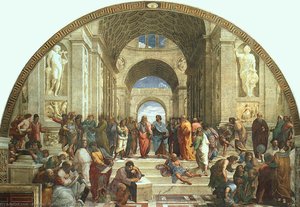 Skolan i Aten1511
 Sextinska Madonnan1513
 Förvandlingen1520
 Jungfrufödelsens Bröllop1504

Essäer om Disputa
 Giotto di Bondone: Revolutionizing Late Medieval Painting through Narrative InnovationExplore the revolutionary art of Giotto di Bondone! Discover his groundbreaking techniques, iconic frescoes like those in the Arena Chapel,…
 Masterpieces of Light: The Top 25 Artworks by Duccio di BuoninsegnaJourney through the divine elegance of Duccio di Buoninsegna. Explore 25 iconic Sienese masterpieces, from the Maestà to the Rucellai Madon…
 Raphaels 25 Mästerverk: Konsthistoriens Höjdpunkter för Ditt HemUtforska Raphaels 25 mest ikoniska mästerverk – en resa genom renässanskonstens guldålder. Lär känna historien, tekniken och skönheten bako…