Byt till tryck
 Visa mer







































 För konstverk eller reproduktioner som är större än 105 cm (cirka 41 tum) på någon sida, levereras ramen som ett isärplockat kit. Denna metod säkerställer en trygg leverans och förhindrar skador under transport.


A Dance of Grey and Blue: Unveiling “Summertime: Number 9A”
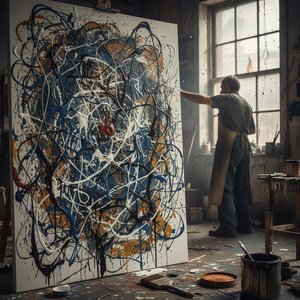
Jackson Pollock’s “Summertime: Number 9A,” painted in 1948, isn't merely a canvas splashed with color; it’s an immersive experience, a visceral representation of the artist’s state of mind captured in a whirlwind of dynamic energy. This seminal work from the heart of Abstract Expressionism embodies Pollock’s revolutionary approach to painting – abandoning traditional form and composition for a process-oriented exploration of gesture, movement, and pure feeling. The piece immediately commands attention with its dense field of interwoven lines and shapes, a chaotic yet strangely harmonious tapestry woven from layers of grey, white, blue, and subtle yellows. It's a visual embodiment of the artist’s “drip technique,” where paint is flung, dripped, and splattered onto the canvas laid flat on the floor, allowing gravity and chance to dictate the final arrangement – a deliberate rejection of control in favor of spontaneous expression.
The Pollock Method: Action Painting Unleashed
Pollock’s method was radical for its time. He wasn't seeking to depict a recognizable subject; instead, he aimed to translate the energy of his subconscious directly onto the canvas. “Summertime: Number 9A” exemplifies this perfectly. The seemingly random application of paint is, in fact, meticulously considered. Notice how the lines build and recede, creating a sense of depth and movement despite the lack of traditional perspective. The layering of colors – often applied with minimal blending – contributes to the painting’s tactile quality, inviting viewers to reach out and almost feel the texture of the paint itself. The use of enamel paints, combined with oil, created a durable surface capable of withstanding the vigorous application techniques Pollock employed.
Symbolism in Chaos: Bicycle Dreams and the American Psyche
While the painting resists straightforward interpretation, whispers suggest that the recurring motif of bicycles – as described in the provided information – might hold symbolic weight. For Pollock, who spent his early years traveling with his father across the vast landscapes of the American West, the bicycle represented freedom, exploration, and a connection to the open road. It’s possible these images were subconsciously embedded within his creative process, manifesting as fleeting shapes amidst the broader abstraction. More broadly, “Summertime: Number 9A” can be seen as a reflection of the anxieties and uncertainties of post-war America – a period marked by rapid social change, technological advancements, and a growing sense of alienation. The painting’s chaotic energy mirrors this feeling of disorientation, while its vibrant colors offer a glimmer of hope amidst the turmoil.
A Legacy of Innovation: Pollock's Enduring Influence
“Summertime: Number 9A” stands as a pivotal work in the development of Abstract Expressionism and profoundly influenced generations of artists. Pollock’s rejection of traditional artistic conventions paved the way for new approaches to painting, emphasizing process over product and prioritizing personal expression above all else. His technique—the “drip” method—became instantly recognizable and continues to inspire artists today. Reproductions of this piece offer a tangible connection to this groundbreaking era in art history, allowing viewers to experience Pollock’s revolutionary vision firsthand. It's a powerful reminder that art can be both visually stimulating and emotionally resonant, inviting us to contemplate the complexities of human experience.
Frågor och svar
Är bilden av "Summertime: Number 9A" av Paul Jackson Pollock fri att återge?
"Summertime: Number 9A" av Paul Jackson Pollock är allmän egendom – upphovsrätten har löpt ut. Denna status avgör hur bilden av verket får återges.
Är Paul Jackson Pollock, skaparen av "Summertime: Number 9A", känd under andra namn?
Andra namn registrerade för Paul Jackson Pollock, skaparen av "Summertime: Number 9A", inkluderar Jackson Pollock.
Hur är färgkompositionen i "Summertime: Number 9A" av Paul Jackson Pollock uppbyggd?
Färgkompositionen i "Summertime: Number 9A" av Paul Jackson Pollock förenar en Gentle kontrast med en Softly Mixed Palette harmoni.
 Förhandsvisa
 Skicka
 Dela
Dela
 Visa detaljer
 Guide
Guide

 Ladda ner
 Liknande objekt
 Röntgen
 Bildspel
 Frågor och svar
 Statistik