Byt till tryck
 Visa mer







































 För konstverk eller reproduktioner som är större än 105 cm (cirka 41 tum) på någon sida, levereras ramen som ett isärplockat kit. Denna metod säkerställer en trygg leverans och förhindrar skador under transport.


The Allure of Introspection: A Study in Marble
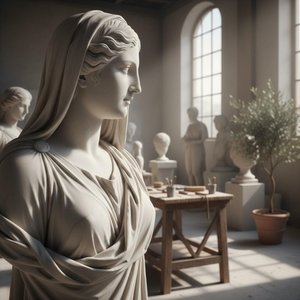
In the quiet stillness of Paul Dubois’s 1867 masterpiece, Narcissus, we encounter a moment frozen in time, captured with the breathtaking precision of 19-century French classical realism. The sculpture presents the mythological figure not as a boastful youth, but as a soul lost in the depths of his own reflection. As he draws a heavy, draped cloth across his body, his gaze is cast downward, directed toward an unseen pool, inviting the viewer into a private world of melancholy and profound contemplation. This work transcends mere stone, transforming cold marble into a living, breathing study of human vulnerability and the weight of self-awareness.
The technical mastery displayed in this piece is nothing short of extraordinary. Dubois, a student of the prestigious École Nationale des Beaux-Arts, utilizes his deep understanding of anatomy to create a figure that feels both monumental and incredibly delicate. The interplay of light and shadow—even when viewed through the lens of photography—reveals a sophisticated command over texture. One can almost feel the contrast between the smooth, polished skin of the subject and the voluminous, undulating folds of the drapery that cascade around him. This meticulous carving creates a sense of three-dimensionality that commands attention, making it an ideal centerpiece for any collection seeking to evoke a sense of classical grandeur.
Symbolism and the Classical Legacy
Beyond its physical beauty, Narcissus serves as a poignant exploration of one of mythology's most enduring themes: the duality of self-love and self-destruction. The act of gazing downward symbolizes the inward turn of the spirit, representing both the beauty of introspection and the danger of vanity. For the discerning collector or interior designer, this piece offers more than just aesthetic pleasure; it provides a narrative depth that can anchor a room with intellectual gravity. The sculpture’s ability to evoke emotion—ranging from quiet peace to a haunting sense of loss—makes it a versatile element for sophisticated spaces, whether in a formal gallery setting or a curated private study.
The historical context of the work further enhances its value. Created during a period when French sculptors were revitalizing the classical traditions of Rome, Dubois’s work carries the prestige of the Légion d'honneur and the rigorous training of the Beaux-Arts tradition. To possess a reproduction of such a significant piece is to hold a fragment of art history. It brings into a contemporary interior the timeless elegance of the 19th century, bridging the gap between the ancient myths of antiquity and the modern appreciation for fine craftsmanship and emotional resonance.
Frågor och svar
Vad förklarar upphovsrättssituationen för "Narcissus" av Paul Dubois?
"Narcissus" av Paul Dubois är allmän egendom – upphovsrätten har löpt ut. Upphovsrätten beräknas utifrån konstnärens dödsår, och Paul Dubois avled år 1905.
Var kan jag hitta konstverk som liknar "Narcissus" av Paul Dubois?
Hitta verk som liknar "Narcissus" på verkets sida Liknande verk.
Hur kan jag få en digital fil av "Narcissus" av Paul Dubois?
"Narcissus" finns tillgänglig som en högupplöst digital bildnedladdning och kan köpas direkt på dess Digital bild i hög upplösning-sida.
More about this painting
 Skicka
 Dela
Dela
 Visa detaljer
 Guide
Guide

 Ladda ner
 Liknande objekt
 Bildspel
 Q&A
Q&A Statistik