Academic Realism
Flowers (Otto Eerelman)
Otto Eerelman (1839–1926) skapade Flowers. Det tillhör Academic Realism-rörelsen. Den är utförd i Oil On Canvas.
- Oil On Canvas

 Förhandsvisa

 Handmålad oljemålning
 Skicka
 Dela
 Faktablad


 Ladda ner
 Liknande objekt
 Röntgen
 Bildspel
 Frågor och svar

 Statistik
Flowers i korthet
- Titel
- Flowers
- Konstnär
- Otto Eerelman (1839–1926)
- Konstnär född i
- Groningen, Nederländerna
- Material
- Oil On Canvas
- Rörelse
- Academic Realism
- Tidsperiod
- 19th Century
- Motiv
- floral arrangement, dutch golden age, botanical art, still life, roses, peonies
Vad föreställer Flowers?
The Subject and Artist of Flowers
Flowers is a painting by the Dutch artist Otto Erelman. This work focuses on a botanical arrangement, presenting a collection of blossoms and foliage. The subject matter consists of a central white peony surrounded by pink roses, pansies, and various smaller floral forms. These elements are positioned against a dark, textured grey-green background, which provides a tonal contrast to the lighter petals of the arrangement.
Otto Erelman was born in 1839 in Groningen, Netherlands. He remained connected to this region throughout his life, eventually passing away in Groningen in 1926. His training included studies at the Academie Minerva and the Royal Academy of Fine Arts in Antwerp. He also received private instruction from Lawrence Alma-Tadema, which influenced his approach to light and color in his various compositions.
While Erelman is frequently associated with the depiction of animals, specifically dogs and horses, this particular work demonstrates his ability to render still life subjects. The composition centers on the organic curves of the petals and the irregular shapes of the leaves. He utilized a layered application of paint to establish the volume and physical presence of the botanical elements within the frame.
Visual Composition and Subject Matter
This still life painting presents a botanical arrangement centered on a large, prominent white peony. The peony occupies the middle of the composition, acting as the primary focal point. Surrounding this central flower are pink roses, pansies, and various smaller blossoms. Green foliage and additional botanical elements are interspersed among the petals, filling the spaces between the larger blooms.
The arrangement is set against a dark, textured grey-green background. This muted backdrop provides a steady contrast to the lighter tones of the white peony and the pink hues of the roses. The composition remains focused on the immediate foreground, utilizing a relatively shallow perspective that emphasizes the physical presence of the floral grouping. The organic lines of the subject follow the natural curves of the petals and the irregular shapes of the leaves.
Artistic Technique and Materials
The work is executed in oil paints on canvas, utilizing a technique of meticulous layering to establish form and texture. This method builds volume within the petals and foliage, creating a sense of physical depth. The style adheres to academic realism, focusing on the precise rendering of botanical structures. Soft brushstrokes define the edges of the white peony and the surrounding pink roses, avoiding harsh lines in favor of gradual transitions.
A muted color palette governs the arrangement, relying on subtle shifts in tone rather than high-contrast hues. The background consists of a dark, textured grey-green surface that provides a steady contrast to the lighter floral elements. Lighting appears soft and diffused across the composition, suggesting an indoor setting where a single light source illuminates the arrangement from above. This controlled light creates gentle shading that defines the rounded shapes of the blossoms and the irregular forms of the leaves.
Högupplösta bilder av Flowers
Allmän egendom: konstnären avled 1926.
Otto Eerelman, Flowers. Allmän egendom
Frågor om Flowers besvarade
Vilket medium är "Flowers" av Otto Eerelman utförd i?
Otto Eerelman använde tekniken Oil On Canvas för "Flowers". Tekniken definierar det ursprungliga verkets materiella karaktär.
Vad föreställer "Flowers"?
Teman som återfinns i "Flowers" av Otto Eerelman inkluderar floral arrangement, dutch golden age, botanical art, still life, roses, peonies, muted colors, delicate beauty. Tillsammans sammanfattar de verkets motiv.
Är "Flowers" av Otto Eerelman fri från upphovsrätt?
"Flowers" av Otto Eerelman är allmän egendom – upphovsrätten har löpt ut. Denna status avgör hur bilden av verket får återges.
Vem har skapat "Flowers"?
"Flowers" tillskrivs Otto Eerelman.
Vilken stil tillhör "Flowers"?
"Flowers" är ett verk inom Academic Realism. Denna stilriktning anger den konstnärliga tradition som verket tillhör.
Vilken period av Otto Eerelmans karriär tillhör "Flowers"?
"Flowers" representerar Otto Eerelmans Mature Period.
Är "Flowers" av Otto Eerelman fri från upphovsrätt, och varför?
Upphovsrättsläget för "Flowers" - allmän egendom – upphovsrätten har löpt ut - baseras på konstnärens dödsår 1926.
Hur förhåller sig "Flowers" till Otto Eerelmans samlade konstnärskap?
"Flowers" tillhör Otto Eerelmans Academic Realism-period, vars dokumenterade teman inkluderar eerelman's signature style, detailed botanical studies, refined academic technique, 18th-century still life, dutch golden age masters, classical composition, floral symbolism (love), vanitas elements (mortality).
Hur förhåller sig "Flowers" till Otto Eerelmans återkommande motiv?
Bland Otto Eerelmans dokumenterade teman – eerelman's signature style, detailed botanical studies, refined academic technique, 18th-century still life, dutch golden age masters, classical composition, floral symbolism (love), vanitas elements (mortality) – har "Flowers" ett eget fokus på floral arrangement, dutch golden age, botanical art, still life, roses, peonies, muted colors, delicate beauty.
Om konstnären, Otto Eerelman
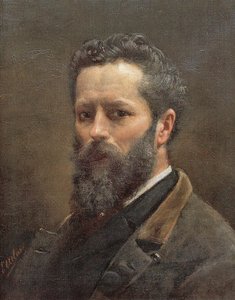
1839–1926, Nederländerna
Otto Eerelman
Otto Eerelman: En nederländsk mästare av djurporträtt Otto Eerelman (1839–1926) står som en betydelsefull gestalt inom den nederländska 1800-talskonsten, särskilt hyllad för sina mästerliga skildringar av hundar och hästar – motiv som resonerade djupt med sin tids estetik och känsloliv. Han föddes i Groningen, Nederländerna, och besatt en medfödd konstnärlig talang som formades under uppväxten i skuggan av sin fars roll som kyrkvaktmästare vid der Aa-kerk. Genom att trotsa föräldrarnas förväntningar sökte han sig till en formell utbildning vid Academie Minerva år 1860, en formativ erfarenhet som gav honom en grundläggande förståelse för konstnärliga principer och cementerade hans hängivenhet till den visuella representationen. Tidiga influenser: Eerelmans konstnärliga resa tog sin början under ledning av J.H.
Andra verk av Otto Eerelman
 Portrait of Cornelisje Eerelman-Pluimker, wife of Samuel Eerelman, mother of the painter1859
 Portrait of Anna Frederica Braak, wife of the painter1881
 Portrait of Fokje van Griffen, wife of Rudolph Jacob Schierbeek1869
 Portrait of Samuel Eerelman, husband of Cornelisje Eerelman-Pluimker, father of the artist1861
Essäer om Flowers
 25 Essential Artworks at Musée de l'Orangerie: Monet’s Water Lilies and BeyondExplore 25 iconic works from Musée de l'Orangerie, including Monet's Water Lilies. Discover the full collection online at OriginalUniqueArt…
 Botanical Precision: The Enduring Nuance of Floral Still LifeExplore the mastery of Dutch and Victorian floral still life through expert analysis. Discover the beauty of botanical art history today.
 The Language of Flowers: A Comprehensive History of Floral Still Life Art and Its Symbolic DepthExplore the deep symbolism and history of floral still life art from Egypt to the Dutch Golden Age. Discover the secrets behind the blooms.