Cubist Sculpture · 1914
Bottlerack (Marcel Duchamp, 1914)
Marcel Duchamp (1887–1968) skapade Bottlerack. Den är från 1914. Det tillhör Cubist Sculpture-rörelsen. Den är utförd i Found Object Art. Måtten är 59 × 37 cm.
- 1914
- Found Object Art
- 59 × 37 cm

 Handmålad oljemålning
 Skicka
 Dela
 Faktablad


 Ladda ner
 Liknande objekt
 Bildspel
 Frågor och svar

 Statistik
Bottlerack i korthet
- Titel
- Bottlerack
- Konstnär
- Marcel Duchamp (1887–1968)
- Konstnär född i
- Blainville-Crevon, Frankrike
- Datum
- 1914
- Material
- Found Object Art
- Mått
- 59 × 37 cm
- Rörelse
- Cubist Sculpture
- Tidsperiod
- Modern
- Motiv
- metal sculpture, industrial art, geometric form, conceptual art, shelf structure, hook arrangement
Vad föreställer Bottlerack?
The Radical Simplicity of the Everyday
In the early twentieth century, a profound shift occurred in the landscape of modern art, one that moved away from the pursuit of traditional beauty toward a deeper, more intellectual engagement with reality. At the heart of this revolution stands Marcel Duchamp’s Bottlerack, a work created in 1914 that continues to challenge our very definition of what an artwork can be. On its surface, the piece presents a deceptively simple subject: a stack of metal shelves or racks, reminiscent of industrial utility rather than high art. Yet, within this mundane structure lies the seed of a conceptual explosion. By selecting a mass-produced object and elevating it to the status of sculpture, Duchamp bypassed the need for traditional virtuosity, instead inviting us to find profound meaning in the most commonplace of items.
The sculpture embodies the rebellious spirit of Dadaism, an avant-garde movement that emerged as a visceral reaction against the chaos and perceived irrationality of the era. Through the lens of this piece, we see the rejection of established aesthetic conventions in favor of a new, provocative logic. The technique employed—primarily the use of steel tubing and hooks—emphasizes a stark, industrial materiality. There is no attempt to hide the object's utilitarian origins; rather, Duchamp celebrates its geometric precision and structural honesty. This deliberate choice underscores his rejection of "retinal art"—art intended only to please the eye—and instead directs our attention toward the intellectual act of selection and the transformative power of the artist's gaze.
Symbolism and the Birth of the Readymade
Beyond its physical presence, Bottlerack carries a heavy symbolic weight that resonates through the decades. It serves as a primary example of the "readymade," a term Duchamp used to describe ordinary manufactured goods that become art through the mere act of choice and repositioning. The stack of hooks acts as a metaphor for the artist’s intervention into the realm of the everyday, asserting that creativity can be found in appropriation and conceptual thought rather than just skillful execution. This piece is not merely a rack; it is a declaration of independence from the constraints of representation, a monument to the idea that art can exist entirely outside the boundaries of beauty or narrative.
For the modern collector or interior designer, a high-quality reproduction of Bottlerack offers more than just a visual accent; it provides a conversation piece that evokes feelings of detachment, curiosity, and intellectual rigor. The sculpture’s stark lines and industrial aesthetic lend themselves beautifully to contemporary spaces, where they can act as a focal point of minimalist sophistication. To display this work is to invite the spirit of Duchamp into one's environment—to celebrate the beauty of structure and to honor the revolutionary moment when the boundaries between life and art were forever dissolved.
Högupplösta bilder av Bottlerack
Upphovsrättsskyddat: dessa filer är för personligt bruk och utgör inte en licens för återpublicering.
Marcel Duchamp, Bottlerack (1914).
Frågor om Bottlerack besvarade
När skapades "Bottlerack" av Marcel Duchamp?
"Bottlerack" dateras till 1914. Datumet placerar verket inom Marcel Duchamps karriär och dess epok.
Vilket medium är "Bottlerack" av Marcel Duchamp utförd i?
"Bottlerack" är utförd i Found Object Art.
Vilka är måtten på originalet av "Bottlerack"?
"Bottlerack" mäter 59 x 37 cm i sin originalform. Originalmåtten är en bra referens när du väljer storlek på en reproduktion.
Vad föreställer "Bottlerack" av Marcel Duchamp?
"Bottlerack" av Marcel Duchamp föreställer: metal sculpture, industrial art, geometric form, conceptual art, shelf structure, hook arrangement, dada aesthetic.
Är "Bottlerack" av Marcel Duchamp fri från upphovsrätt?
När det gäller upphovsrätt är "Bottlerack" fortfarande skyddat av upphovsrätt.
Vem har skapat "Bottlerack"?
"Bottlerack" skapades av Marcel Duchamp. Informationen på denna sida beskriver Marcel Duchamps originalverk.
Vilken konstnärlig inriktning tillhör "Bottlerack" av Marcel Duchamp?
"Bottlerack" av Marcel Duchamp tillhör Cubist Sculpture-rörelsen. Denna rörelse ger det stilistiska sammanhanget för verket.
Vilken fas av Marcel Duchamps konstnärliga utveckling representerar "Bottlerack"?
"Bottlerack" representerar Marcel Duchamps Dada Era.
Hur gammal var Marcel Duchamp när "Bottlerack" skapades år 1914?
När "Bottlerack" skapades år 1914, var Marcel Duchamp – född 1887 – 27 år gammal.
Om konstnären, Marcel Duchamp

1887–1968, Frankrike
Marcel Duchamp
Marcel Duchamps liv och konst Född den 28 juli 1887 i Blainville, Normandie, Frankrike, trädde Marcel Duchamp in i en värld där skaparlusten var djupt rotad i hans eget blod. Han var det fjärde av sju barn till Eugene och Lucie Duchamp. Detta var ett hem fyllt av skapare och tänkare; hans syskon delade denna kreativa rastlöshet, då hans bröder Jacques Villon och Raymond Duchamp-Villon, tillsammans med hans syster Suzanne Duchamp-Crotti, alla levde sina liv som konstnärer. Även om han slutligen skulle bli en fransk-amerikansk gestalt av enorm komplexitet, förblev hans ursprung djupt förankrat i Normandies stillhet.
Andra verk av Marcel Duchamp
 Nudistklättrare nr 21912
 Sad Young Man in a Train1911
 Given: 1. Vattenfallet, 2. Belysningsgasen1966
 Fontänen1917
Essäer om Bottlerack
 Industriell Estetik i Konsten: Topp 10 Verk för Hemmet & InspirationUtforska 10 ikoniska konstverk som fångar industriell estetik – från Munchs dramatik till Turners stormar. Lär känna historien bakom mäster…
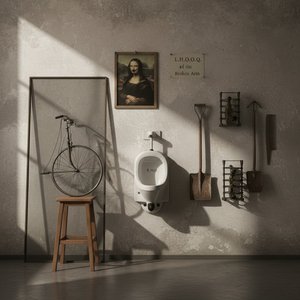 Marcel Duchamp: Challenging Conventions & Redefining Art in the 20th CenturyExplore the revolutionary art of Marcel Duchamp! Discover how his Dadaist readymades challenged artistic conventions & redefined modern art…
 The Radical Evolution of the Bottle in Still Life: From Cubist Deconstruction to Pop Art BoldnessTrace the evolution of bottle still life from Cubism to Pop Art with expert insight. Explore how masters redefined everyday objects now.