

 Visa i rummet
 Skicka
 Dela
Dela
 Detaljer
 Studentguide för konstverk

 Ladda ner
 Liknande objekt
 Röntgen
 Bildspel
 Besökstatistik
Peasant Life
 Oil On Canvas
- WallArt
- Cubism
 1925
1925- High Medieval
 101.0 x 80.0 cm
 Läs mer
Konstverket som visas på denna sida skyddas av upphovsrättslagen, vilket innebär att vi inte lagligt kan skapa eller sälja en identisk reproduktion. Detta skydd upprätthålls genom internationella avtal såsom den Bernkonventionen och genom nationella lagar, inklusive de som fastställs av Amerikansk upphovsrättslag – Titel 17. Alla rättigheter förbehållna. Återgivning av konstverk är förbjuden utan skriftligt tillstånd från WahooArt.
Som ett respektfullt och lagligt alternativ erbjuder vi skräddarsydda, handmålade konstverk inspirerade av originalet. Våra skickliga och professionella konstnärer studerar noggrant originalets stil, stämning och konstnärliga essens för att skapa ett nytt, unikt verk som väcker samma känsla – samtidigt som det förblir en originell skapelse i egen rätt.
Denna metod följer fullt ut upphovsrättsliga regler eftersom den inte innebär kopiering eller duplicering av det skyddade konstverket. Istället är det en kreativ nytolkning – en ny målning som är influerad av originalet men inte identisk med det.
Handgjord oljereproduktion
Handmålad olja på duk i din valda storlek och ram, tillverkad efter beställning av våra konstnärer. ( Byt till tryckta exemplar Byt till digital bildförsäljning)




P118B Skr10

P118H Skr10

P118W Skr10

P438Z Skr10

P508JH Skr12

P508YH Skr12

P805H Skr10

P805Z Skr10

P919BZ Skr10

P919G Skr10

P919XJ Skr10

P959ZH Skr10

P968JZ Skr12

W106C Skr8

W218G Skr10

W218JH Skr8

W218Y Skr10

W307PJ Skr10

W316G Skr10

W316PJ Skr8

W316Y Skr10

W398PJ Skr8

W4111J Skr10

W500HY Skr15

W500JH Skr15

W692G Skr12

W849H Skr8

W940BG Skr15

W953PJ Skr8




Välj bland våra förinställda storlekar som motsvarar konstverkets ursprungliga proportioner.

Ange den bredd och höjd du behöver för att passa din ram eller din vägg. Eftersom detta är handmålat kan konstnären vid en annan form måla lite mer runt bilden eller beskära den något – du väljer själv. Vi skickar en digital mockup för godkännande innan målningen påbörjas. Bilden som visas på denna sida representerar inte det slutgiltiga resultatet — det är endast mockuppen som visar det.
Efter beställning kommer OriginalUniqueArt.com team att mejla kunden för instruktioner och tillhandahålla en skissförhandsvisning
Leverans över hela världen () på 3–4 veckor istället för standard 5 veckor. (24 oktober). Inga kompromisser med kvaliteten.

Fri expressfrakt över hela världen

Högkvalitativ linnecanvas

Fullständig fraktförsäkring

Garantier för återbetalning av tullavgifter

Garantier för exakt färgåtergivning

100 dagars returrätt vid fabrikationsfel

100% pengarna tillbaka-garanti

Mängdrabatt erbjuds
 Glasalternativet är endast tillgängligt i storlekar under 110 cm.

Peasant Life
Tryckteknik
Reproduktionsstorlek
-


Totalpris
Skr 2975
A Window into a Russian Soul: The Genesis of *Peasant Life*
Marc Chagall’s 1925 painting, *Peasant Life*, isn't merely a depiction of rural existence; it’s an immersion into the artist’s deeply personal and profoundly evocative world. Born Moishe Shagal in Vitebsk, Belarus – a region steeped in folklore and layered with cultural influences – Chagall carried within him a potent blend of Jewish tradition and the vibrant energy of his homeland. This painting represents a pivotal moment in his artistic evolution, showcasing a masterful fusion of Cubist fragmentation with Surrealist dreamscapes and a distinctly Russian sensibility. It’s a testament to his ability to distill memory, emotion, and cultural heritage into a single, luminous canvas.
The genesis of *Peasant Life* lies within Chagall's own recollections of Vitebsk – a city that served as the bedrock of his artistic identity. The town’s unique juxtaposition of Orthodox churches and bustling Jewish marketplaces, its blend of Russian and Eastern European influences, became a recurring motif in his work, imbued with a sense of both familiarity and poignant nostalgia. This painting isn't simply a record of a scene; it’s a carefully constructed tapestry woven from fragments of memory, filtered through the lens of Chagall’s imagination.
Cubism Meets Folklore: Deconstructing Reality
While often categorized as Cubist due to its fractured forms and multiple perspectives – elements evident in the way figures are broken down into geometric shapes and viewed simultaneously from different angles – *Peasant Life* transcends simple categorization. Chagall masterfully integrates these Cubist techniques with a distinctly Surrealist approach, creating an atmosphere of dreamlike ambiguity. The scene unfolds not as a realistic portrayal but as a symbolic representation of memory and emotion. Notice how the figures are deliberately distorted, their forms dissolving into vibrant color and movement – a characteristic that aligns perfectly with Chagall’s unique vision.
The composition itself is dynamic and carefully orchestrated. A central focus emerges around the man feeding a horse from his hand, an image brimming with symbolic weight. The surrounding figures—a family gathered at a table, a couple dancing in the field, a cart pulled by horses – are arranged along diagonal lines, creating a sense of movement and energy that draws the viewer into the heart of the scene. The use of color is particularly striking; Chagall employs a rich palette of reds, blues, yellows, and greens, not to represent reality accurately but to evoke mood and emotion. The bright hues contribute significantly to the painting’s overall feeling of joy and vitality.
Symbolism and Cultural Resonance: A Tapestry of Meaning
*Peasant Life* is rich in symbolic detail, inviting multiple interpretations. The red hat worn by the central figure immediately connects him to Russian peasant traditions, while the horse itself represents fertility, strength, and connection to the land. The building with the Cyrillic sign – likely a “lavka” or small shop – subtly references Chagall’s own family history and his roots in Vitebsk. The inclusion of dancing figures hints at the importance of community, celebration, and the rhythms of rural life.
Beyond its formal elements, *Peasant Life* speaks to a deeper cultural resonance. It's a poignant reflection of Chagall’s connection to his Russian heritage and his experience in France – a synthesis of Eastern European folklore and Western artistic innovation. The painting captures the essence of rural life, with its vibrant colors, lively figures, and serene landscape, offering a glimpse into a bygone era filled with both hardship and joy.
A Legacy of Imagination: Chagall’s Enduring Vision
Marc Chagall's *Peasant Life* stands as a testament to his artistic genius and his ability to capture the essence of human experience through art. It is more than just a beautiful painting; it’s a window into the soul of an artist, a celebration of memory, and a powerful expression of cultural identity. Its innovative blend of styles, its rich symbolism, and its emotional depth have ensured its place as a significant work in the history of modern art, continuing to inspire artists and art lovers alike. Reproductions of this masterpiece offer a unique opportunity to bring Chagall’s vibrant world into your own space, allowing you to experience firsthand the magic and wonder of *Peasant Life*.
Frågor och svar
Vad rekommenderas för användning av ett tryck av "Peasant Life"?
Det rekommenderade användningsområdet för "Peasant Life" av Marc Chagall är Statement. Den kan även användas till andra ändamål.
Var placerar sig "Peasant Life" av Marc Chagall i konsthistorien?
"Peasant Life" av Marc Chagall tillhör Cubism-rörelsen, inom High Medieval-perioden. Tillsammans ger de verket dess plats i konsthistorien.
När och med vilka material skapades "Peasant Life"?
"Peasant Life" skapades år 1925 med tekniken Oil On Canvas. Material och datum beskriver hur och när originalet tillverkades.
Om konstnären
A Life Painted in Dreams: The World of Marc Chagall
Marc Chagall, born Moishe Shagal in 1887 in the small Belarussian town of Liozna near Vitebsk, wasn’t merely a painter; he was a poet of color, a weaver of dreams, and a chronicler of memory. His life, spanning nearly a century, mirrored the tumultuous currents of the 20th century, yet his art remained steadfastly rooted in a deeply personal vision—one infused with the folklore of his Hasidic Jewish upbringing and an unwavering belief in the power of imagination. Vitebsk itself was more than just a birthplace; it became the emotional core of his artistic universe, a recurring motif populated by flying figures, whimsical animals, and the vibrant hues of remembered landscapes. The town’s unique blend of cultures—Russian Orthodox churches alongside bustling Jewish marketplaces—forged an aesthetic sensibility that would defy easy categorization throughout his long career. Though he sought formal training first with a local sign painter and later in St. Petersburg under Léon Bakst, and then in Paris at the Académie de la Grande Chaumière, Chagall never fully embraced any single artistic movement. He absorbed elements of Cubism, Symbolism, and Fauvism, but always filtered them through his own intensely personal lens, creating a style that was uniquely, unmistakably Chagall.Early Influences and Artistic Beginnings
Chagall’s formative years were marked by the traditions of Vitebsk’s Jewish community—a world steeped in ritual, storytelling, and vibrant visual culture. These influences would permeate his artistic vision throughout his life. His initial training was modest, focusing on practical skills as a sign painter, but he quickly developed an interest in broader artistic concepts. St. Petersburg provided him with access to influential teachers like Léon Bakst, who encouraged experimentation and challenged conventional stylistic norms. This exposure to theatrical design—particularly Ballets Russes productions—would prove crucial in shaping his approach to composition and visual storytelling. However, Chagall resisted the allure of rigid academic doctrines, prioritizing intuition and emotional expression over technical precision. He sought inspiration from Impressionism and Post-Impressionism, particularly Cézanne and Gauguin, recognizing their ability to capture fleeting moments of beauty and emotion.The Symbolist Vision: Fragments of Memory
Chagall’s early paintings—such as I and the Village (1911)—demonstrate his fascination with Symbolism's exploration of psychological states and subconscious imagery. The village isn’t rendered realistically but as a fragmented collection of recollections, imbued with symbolic meaning. Figures float and dance across the canvas, defying gravity and logic, creating a dreamlike atmosphere that invites viewers into his inner world. This stylistic approach wasn’t accidental; it stemmed from a desire to move beyond mere imitation of reality and capture the essence of feeling, the weight of memory, and the power of folklore. The use of color—bold, non-naturalistic hues—served as a conduit for emotion rather than literal representation. Recurring motifs like birds, apples, and musical instruments reflect Chagall’s preoccupation with themes of flight, fertility, and artistic inspiration. These images are not simply decorative; they carry profound symbolic significance, conveying ideas about identity, spirituality, and the relationship between humanity and nature.Cubism's Influence and Artistic Evolution
Despite his rejection of formal academic movements, Chagall absorbed elements of Cubism, particularly Picasso’s pioneering explorations of fractured perspectives. This influence is evident in works like The Musicians (1917), where figures are depicted simultaneously from multiple viewpoints—a technique that disrupts traditional spatial conventions and emphasizes the multiplicity of experience. However, Chagall skillfully blended Cubist principles with his own distinctive visual language, retaining a lyrical quality and emotional depth that distinguishes him from more intellectually rigorous artists. He continued to experiment with color and form throughout his career, refining his style while maintaining its core expressive power. The Russian Revolution profoundly impacted Chagall’s life and artistic practice, returning him to Vitebsk where he established an art school—a brief but significant endeavor aimed at fostering creativity and cultural renewal amidst the upheavals of the era.International Recognition and Legacy
Chagall's emigration to Paris in 1923 marked a turning point in his artistic trajectory, propelling him onto the international stage. He embraced Surrealism’s fascination with dreams and irrationality, producing canvases that pulsate with imaginative energy—works like *White Crucifixion* (1938) reflecting the anxieties of wartime Europe. His subsequent move to New York City during World War II provided him with a new creative impetus, resulting in monumental paintings inspired by biblical narratives and American landscapes. Chagall’s influence extended far beyond his own lifetime, inspiring countless artists across disciplines—painting, sculpture, theater, and film—who sought to emulate his poetic vision and expressive style. His enduring legacy resides not only in his iconic artworks but also in the profound exploration of human emotion and spiritual yearning that characterizes his oeuvre. Marc Chagall remains one of the most celebrated artists of the twentieth century, a testament to the transformative power of imagination and the unwavering pursuit of artistic truth.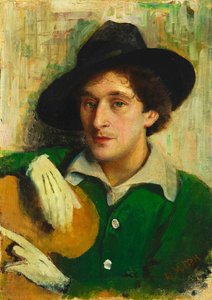
Marc Chagall
1887 - 1985 , Belarus
Snabbfakta
- Artistic Movement Or Style: Modernism, Kubism
- Artists Or Movements Influenced By This Artist: ['Surrealism']
- Artists Who Influenced This Artist:
- Bakst
- Delaunay
- Borovikovsky
- Date Of Birth: 7 juli 1887
- Date Of Death: 28 mars 1985
- Full Name: Marc Chagall
- Nationality: Russisk, senare fransk
- Notable Artworks:
- I och byen
- Den Liggande Poeten
- Valentina
- Place Of Birth: Liozna, Belarus
Relaterade artiklar

The Enduring Power of Painting: A Historical & Contemporary Exploration of Form and Emotion
Explore the rich history & enduring techniques of oil painting with OriginalUniqueArt. Discover masterpieces, learn about art collecting, and find authentic handmade reproductions crafted by skilled artists.

Georges Braques 25 Mästerverk: En Konsthistorisk Resa för Hemmet
Utforska Georges Braques 25 mest ikoniska verk – en resa genom kubismens värld och fransk modern konst. Lär känna historien bakom mästerverken, tekniken & färglärorna. Köp högkvalitativa konsttryck på OriginalUniqueArt.com.

Olja på duk: En tidlös teknik – Historik, process och konstnärliga möjligheter
Utforska oljemålningskonsten! Lär dig om flamländsk teknik, materialval och historisk utveckling. Expertguider för både nybörjare och erfarna konstnärer – bevara dina målningar med bästa praxis.

The Enduring Legacy of Oil on Canvas: Technique, History & Aesthetic Impact
Explore the rich history & techniques of oil painting – from Renaissance masters to Impressionism. Discover pigments, layering methods, and why this timeless medium endures. Expert insights for artists & art enthusiasts.

Ivan Bilibin: A Synthesis of Folklore, Modernism & National Identity in Russian Illustration
Explore the enchanting world of Ivan Bilibin, a master Russian illustrator who synthesized folklore, Art Nouveau & national identity. Discover his iconic fairy tale illustrations and legacy with OriginalUniqueArt.


