Baroque
St. Peter (Giuseppe Ribera)
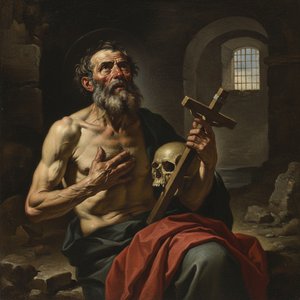
Giuseppe Ribera (1591–1652) skapade St. Peter. Det tillhör Baroque-rörelsen. Den är utförd i Oil On Canvas. Verket finns bevarat på Museo del Prado i Madrid, Spanien.
- Oil On Canvas
- Museo del Prado, Madrid

 Förhandsvisa

 Handmålad oljemålning
 Skicka
 Dela
 Faktablad


 Ladda ner
 Liknande objekt
 Röntgen
 Bildspel
 Frågor och svar

 Statistik
St. Peter i korthet
- Titel
- St. Peter
- Konstnär
- Giuseppe Ribera (1591–1652)
- Konstnär född i
- Xàtiva, Spanien
- Material
- Oil On Canvas
- Utställningsplats
- Museo del Prado, Madrid, Spanien
- Rörelse
- Baroque
- Tidsperiod
- Early Modern
- Motiv
- man, beard, book, keys, cloak, brown
Vad föreställer St. Peter?
The Portrait of St. Peter by Jusepe de Ribera
In this oil painting on canvas, Jusepe de Ribera presents us with a portrait of St. Peter. The subject, a central figure among the apostles of Jesus and recognized as the first Pope, is rendered with a profound sense of presence. Ribera focuses on the man himself, capturing the weight of his role and the character of his lived experience. There is a quiet intensity in the way the figure is presented, inviting a closer look at the weathered details of his countenance.
The work is a significant example of the Baroque style. Through this approach, the artist emphasizes the spiritual and human dimensions of the apostle. The depiction avoids idealization, opting instead for a directness that feels immediate. By focusing on the specific attributes of the saint, Ribera allows the subject to command the space, presenting a figure that is both a religious icon and a man of flesh and bone.
Composition and Visual Elements of the Portrait
The composition is built upon a stable pyramidal structure, with the head of St. Peter forming the apex of the form. He is presented from the waist up, his body turned slightly toward the viewer's left. In his right hand, he holds a book and a set of keys, objects that anchor the figure within the frame. This arrangement directs the eye upward toward his weathered features, creating a sense of quiet, grounded presence.
A strong light source enters from the left, illuminating his face and upper body while casting the rest of the figure into deep shadow. This light creates a sharp contrast against a background that is nearly black, pushing the subject forward into the viewer's space. The color palette is restrained, dominated by warm earth tones—ochre, brown, and gold—which emphasize the textures of his skin and the heavy folds of his clothing.
Technique and Artistic Style of the Work
The work is defined by a profound use of tenebrism, where the subject emerges from a nearly black background into a sharp, focused light. This dramatic chiaroscuro creates a sense of volume, pulling the figure forward and emphasizing the physical presence of the man. Such a heavy interplay of light and shadow reflects the influence of Caravaggio, grounding the religious subject in a palpable, earthly reality. The light source, positioned to the left, carves out the contours of the face and the weathered texture of the skin, casting deep shadows that heighten the emotional weight of the portrait.
Ribera’s approach to the medium is tactile and deliberate. He employs a technique of layering paint to build up depth, allowing the viewer to sense the physical weight of the drapery and the coarse nature of the beard. Visible brushstrokes are not hidden; instead, they contribute to the overall effect, lending a sense of immediacy to the rendering of the fabric and the aged features. Strong, defined lines delineate the eyes, nose, and mouth, providing a structural clarity that balances the more fluid, organic shapes of the figure. The result is a composition that feels both intensely personal and physically substantial.
Other Works by Jusepe de Ribera
The artist's exploration of this particular subject matter is reflected in several other significant pieces within our collection and major institutions. We hold St. Simeon 1 in our catalog, a work that speaks to the same profound human experience found in this portrait. Another notable piece in our collection is The Repentance of Saint Peter, which is currently housed in the Museum of Fine Arts, Lyon.
Beyond our own holdings, Ribera's preoccupation with the themes of remorse and spiritual weight is evident in other historical examples. The work known as Penitent St. Peter, dated about 1630, is held at the Kunsthistorisches Museum in Vienna. This piece shares a similar intensity in its depiction of the apostle's character. Additionally, The Tears of Saint Peter, which dates to 1612, is part of the collection at the Metropolitan Museum of Art in New York. These works collectively illustrate the artist's ability to capture the complexities of faith and the physical reality of the human condition through his characteristic use of light and shadow.
Vilket museum har St. Peter?
Museo del Prado
Madrid, Spanien
Museo del Prados historia Ursprunget till Museo del Prado är djupt sammanflätat med den spanska kungliga samlingen och sträcker sig tillbaka till 1700-talet. Det som en gång tog sin början som en vision för ett naturhistoriskt kabinett under Ferdinand VII, kom så småningom att transformeras till ett heligt fristad för måleri och skulptur. Denna förvandling omvandlade ett vetenskapligt projekt till ett arkiv för den spanska kronans mest betydelsefulla skatter.


Högupplösta bilder av St. Peter
Allmän egendom: konstnären avled 1652.
Giuseppe Ribera, St. Peter, Museo del Prado. Allmän egendom
Frågor om St. Peter besvarade
Var kan man se "St. Peter" av Giuseppe Ribera utställd idag?
Originalet av "St. Peter" av Giuseppe Ribera finns på Museo del Prado, Madrid, Spanien. En reproduktion gör det möjligt att visa verket i hemmet.
Vilken teknik har använts för "St. Peter"?
"St. Peter" är utförd i Oil On Canvas.
Vad föreställer "St. Peter" av Giuseppe Ribera?
Teman som återfinns i "St. Peter" av Giuseppe Ribera inkluderar man, beard, book, keys, cloak, brown, gold, skin. Tillsammans sammanfattar de verkets motiv.
Är "St. Peter" av Giuseppe Ribera fri från upphovsrätt?
Upphovsrättslig status för "St. Peter" av Giuseppe Ribera: verket är allmän egendom – upphovsrätten har löpt ut. Detta avgör om reproduktioner av bilden får framställas fritt.
Vem har skapat "St. Peter"?
"St. Peter" skapades av Giuseppe Ribera. Informationen på denna sida beskriver Giuseppe Riberas originalverk.
Vilken konstnärlig inriktning tillhör "St. Peter" av Giuseppe Ribera?
"St. Peter" av Giuseppe Ribera tillhör Baroque-rörelsen. Denna rörelse ger det stilistiska sammanhanget för verket.
Vilken fas av Giuseppe Riberas konstnärliga utveckling representerar "St. Peter"?
Inom Giuseppe Riberas karriär tillhör "St. Peter" perioden Mature Period. Denna fas underlättar jämförelser med konstnärens övriga verk.
Vad förklarar upphovsrättssituationen för "St. Peter" av Giuseppe Ribera?
Upphovsrättsläget för "St. Peter" - allmän egendom – upphovsrätten har löpt ut - baseras på konstnärens dödsår 1652.
Förvaras "St. Peter" i sin konstnärs hemland?
Ja – konstverket förvaras i konstnärens hemland. "St. Peter" finns i Spanien, medan Giuseppe Ribera föddes i Spanien.
Om konstnären, Giuseppe Ribera

1591–1652, Spanien
Giuseppe Ribera
A Life Forged in Shadow and Light Jusepe de Ribera, känd för många som Lo Spagnoletto – “den spanska”, var en strålande figur i barocktiden, en konstnär vars dukar pulserade med dramatisk intensitet och skoningslös realism. Född i Xàtiva, Spanien, 1591, led hans resa bortom hans valencianska rötter och etablerade honom slutligen som en av de mest betydelsefulla målararna under 1600-talet i Neapel, en stad då under spansk härjerskap. Riberas liv var inte bara en kronik över konstnärlig utveckling; det var en berättelse vävd med motgångar, ambitioner och ett outsläckt engagemang för att porträttera den mänskliga tillståndets råa komplexitet. Även om tidiga biografiska detaljer fortfarande är något dolda i mysteriet, vet vi att han anlände till Italien omkring 1607, först bosatt i Rom och sedan flyttade sig till Neapel 1616 – en stad som skulle bli både hans konstnärliga hem och mullret för hans unika stil.
Andra verk av Giuseppe Ribera
 Magdalena Ventura med sin man och son1631
 Klubbfoten
 St. Onuphrius1637
 The Duel of Women (The Duel of Isabella de Carazzi and Diambra de Pettinella)1636
Essäer om St. Peter
 Mastering the Shadows: The Dramatic Power of Chiaroscuro and Tenebrism in Baroque Fine ArtExplore the profound drama of chiaroscuro and tenebrism. Discover how masters like Caravaggio used light and shadow to sculpt emotion and v…
 Masterpieces of Light: The Top 25 Artworks by Duccio di BuoninsegnaJourney through the divine elegance of Duccio di Buoninsegna. Explore 25 iconic Sienese masterpieces, from the Maestà to the Rucellai Madon…
 Jusepe de Ribera: Dramatic Realism & Spiritual Intensity in the Spanish Golden AgeExplore the powerful Baroque paintings of Jusepe de Ribera, master of tenebrism and dramatic realism. Discover his spiritual intensity, inf…