
 Förhandsvisa
 Skicka
 Dela
Dela
 Visa detaljer
 Guide
Guide

 Ladda ner
 Liknande objekt
 Röntgen
 Bildspel
 Frågor och svar
 Statistik
Casa Amatller


 Visa mer
Giclée / Konsttryck
Giclée- eller canvasprint av museumskvalitet med snabb produktion och flexibla ytbehandlingsalternativ. ( Beställ handmålad reproduktion Byt till digital bild)




P118B Skr10

P118H Skr10

P118W Skr10

P438Z Skr10

P508JH Skr12

P508YH Skr12

P805H Skr10

P805Z Skr10

P919BZ Skr10

P919G Skr10

P919XJ Skr10

P959ZH Skr10

P968JZ Skr12

W106C Skr8

W218G Skr10

W218JH Skr8

W218Y Skr10

W307PJ Skr10

W316G Skr10

W316PJ Skr8

W316Y Skr10

W398PJ Skr8

W4111J Skr10

W500HY Skr15

W500JH Skr15

W692G Skr12

W849H Skr8

W940BG Skr15

W953PJ Skr8




Välj bland våra förinställda storlekar som motsvarar konstverkets ursprungliga proportioner.

Ange den bredd och höjd du behöver för att passa din ram eller vägg. Ett tryck kan endast beskäras, aldrig göras större än originalbilden, vilket innebär att ett format med en annan proportion leder till att en del av bilden går förlorad. Vi skickar en digital mockup för godkännande innan vi påbörjar tryckningen. Bilden som visas på denna sida visar inte den faktiska beskärningen — det är endast mockuppen som gör det.
Leverans över hela världen () på 2 veckor istället för standard 4/5 veckor. (5 november)

Fri expressfrakt över hela världen

Högkvalitativ linnecanvas

Fullständig fraktförsäkring

Garantier för återbetalning av tullavgifter

Garantier för exakt färgåtergivning

100 dagars returrätt (endast vid fel)

100% pengarna tillbaka-garanti

Mängdrabatt erbjuds
 Glasalternativet är endast tillgängligt i storlekar under 110 cm.

Casa Amatller
Giclée / Konsttryck
Storlek på reproduktion
-


Slutgiltigt pris
Skr 810
Casa Amatller: Gaudí’s Bold Experiment in Catalan Modernisme
Josep Puig i Cadafalch’s Casa Amatller stands as an emblem of Barcelona and the broader Catalan Modernista movement—a testament to Antoni Gaudí's audacious vision for architectural innovation. Completed between 1898 and 1900, this building isn’t merely a residence; it’s a meticulously crafted manifesto of artistic principles that would redefine urban landscapes.
- Location: Situated in Barcelona’s Illa de la Discòrdia (“Block of Discord”), alongside Casa Batlló and Casa Lleó Morera, Casa Amatller embodies Gaudí's challenge to conventional architectural norms.
- Architectural Style: The building showcases a distinctive blend of Gothic Revival influences—particularly evident in its soaring tower—with Gaudí’s signature organic forms and geometric precision. This juxtaposition reflects the broader Modernista ethos of reconciling tradition with innovation.
- Material Palette: Constructed primarily from ceramic tiles sourced locally, Casa Amatller utilizes a rich color palette that contributes to its visual dynamism. The terracotta hues evoke Mediterranean warmth and complement Gaudí’s sculptural ornamentation.
A Symphony of Geometry and Organic Forms
Gaudí's genius lies in his ability to translate natural patterns—such as beehive structures—into architectural designs. Casa Amatller exemplifies this approach, featuring a stepped pyramid façade punctuated by intricate tile mosaics that mimic the hexagonal cells of honeycomb. These geometric motifs aren’t simply decorative; they underpin the building’s structural stability and create a mesmerizing visual rhythm.
- Structural Innovation: Gaudí pioneered innovative construction techniques—including cantilevered balconies and flexible arches—that pushed the boundaries of engineering at the time.
- Decorative Ornamentation: The façade is adorned with sculptural reliefs depicting stylized floral motifs and geometric abstractions, reflecting Gaudí’s fascination with natural forms and mathematical proportions.
Symbolism Rooted in Catalan Identity
Casa Amatller carries profound symbolic significance beyond its aesthetic beauty. Antoni Amatller i Rocafort, the building's patron—a wealthy chocolatier—commissioned Gaudí to create a dwelling that would express Catalan cultural pride and artistic aspiration. The tower’s spire, reminiscent of medieval cathedrals, symbolizes Catalonia’s spiritual heritage.
- Catalan Gothic Revival: Gaudí deliberately incorporated elements of Catalan Gothic architecture—such as ribbed vaults and stained glass windows—to reaffirm the region's cultural traditions.
- Representation of Nature: The floral ornamentation reflects Gaudí’s belief in the transformative power of nature, mirroring the Catalan landscape’s vibrant biodiversity.
Emotional Resonance and Artistic Legacy
Casa Amatller continues to inspire awe and admiration for its unparalleled artistry and structural ingenuity. Its bold experimentation with form and material—coupled with Gaudí's masterful orchestration of color and texture—creates an immersive sensory experience that transcends mere visual perception. Today, reproductions of this iconic building offer a captivating glimpse into the heart of Catalan Modernisme and Gaudí’s enduring legacy as one of history’s most visionary architects.
Frågor och svar
Hur hittar jag konstverk som påminner om "Casa Amatller" av Josep Puig i Cadafalch?
Hitta verk som liknar "Casa Amatller" på verkets sida Liknande verk.
Vilken färgharmoni uppvisar "Casa Amatller" av Josep Puig i Cadafalch?
Färgharmonin i "Casa Amatller" beskrivs som Enhetlig palett.
Var kan jag ladda ner "Casa Amatller" av Josep Puig i Cadafalch?
"Casa Amatller" av Josep Puig i Cadafalch kan laddas ner som en högupplöst digital bildnedladdning via verkets sida för Ladda ner digital bild.
Konstnärsbiografi
Josep Puig i Cadafalch: Life and Legacy
Early Life and Education
- Born in Mataró, Spain on October 17, 1867, Josep Puig i Cadafalch was a pivotal figure in the Catalan Modernista movement.
- He received his initial architectural training at the Provincial School of Architecture in Barcelona, demonstrating an early aptitude for design and innovation.
- His education extended beyond technical skills; he possessed a strong interest in history, law, and politics, which would profoundly influence his work throughout his life.
Architectural Development and Influences
- Puig i Cadafalch’s architectural style was deeply rooted in the Modernisme movement, characterized by organic forms, intricate ornamentation, and a revival of Catalan Gothic traditions.
- He drew inspiration from diverse sources including medieval architecture, particularly Gothic and Arabic styles, as well as contemporary movements like Art Nouveau.
- His early works demonstrate a blend of historical references with innovative structural solutions, setting him apart from his contemporaries.
Major Architectural Achievements
- Casa Martí (Els Quatre Gats): Perhaps his most iconic creation, Casa Martí served as a meeting place for artists, writers, and intellectuals, becoming the epicenter of Catalan Modernism.
- Casa Amatller: Located next to Antoni Gaudí’s Casa Batlló on Passeig de Gràcia, Casa Amatller is a stunning example of Puig i Cadafalch's mastery of ornamentation and detail. It showcases his unique blend of Gothic and Modernista elements.
- Other notable works include the Casa Terrades (Casa de les Punxes), the Palau del Baró de Quadras, and various renovations of historical buildings.
Political Career and Cultural Advocacy
- Puig i Cadafalch was not only a celebrated architect but also an active politician deeply committed to Catalan identity and autonomy.
- He served as a Barcelona City Councillor (1901-1903), a member of the Spanish Parliament (1907-1910), and the second President of the Commonwealth of Catalonia (1917-1924).
- From 1942 until his death, he presided over the Institut d'Estudis Catalans, dedicating himself to preserving and promoting Catalan language, culture, and history.
Historical Significance and Legacy
- Puig i Cadafalch played a crucial role in shaping Barcelona’s architectural landscape during its golden age of Modernisme.
- His buildings are not merely structures but cultural landmarks that embody the spirit of Catalan identity and artistic innovation.
- He was a tireless advocate for Catalan culture, actively documenting historical sites and promoting linguistic preservation.
- His work continues to inspire architects and designers today, solidifying his place as one of Catalonia’s most important figures.
Later Life and Death
- Puig i Cadafalch continued his scholarly pursuits and cultural advocacy until his death in Barcelona on December 21, 1956.
- His contributions to architecture, politics, and Catalan culture left an indelible mark on the region’s history and identity.
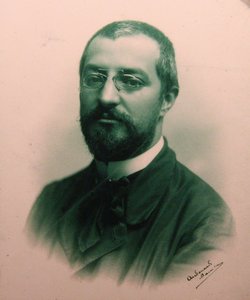
Josep Puig i Cadafalch
1867 - 1956 , Spain
Kortfakta
- Birth Date: 1867-10-17
- Death Date: 1956-12-21
- Influenced: None, 'influenced by': None, 'movement': 'Modernisme (Catalan Modernism)', 'name': 'Josep Puig i Cadafalch', 'nationality': 'Spanish', 'notable works':
- Birth Place: Mataró, Spain
- Date Of Birth: 1867
- Date Of Death: 1956
- Place Of Birth: Mataró, Spain
- Els Quatre Gats: Casa Amatller
Relaterade artiklar

Modernist Art for Commercial Interiors: A Strategic Guide to Transforming Hospitality Spaces with Bold, Scalable Style
Optimize hospitality design with professional Modernist art procurement. APS provides high-volume, hand-painted oil reproductions in scalable sizes for hotels and corporate projects. Benefit from reliable global shipping, bulk ordering, and custom sizing to meet large-scale project demands.
Josep Mompou Dencausse: Exploring Intimacy & Catalan Identity Through Minimalist Expression
Explore the captivating world of Josep Mompou Dencausse, a master of Post-Impressionism whose intimate paintings reflect Catalan identity and minimalist beauty. Discover his life, style & legacy.
Joaquim Mir: A Catalan Visionary – Exploring Symbolism, Landscape & Modernist Aesthetic
Explore the captivating world of Joaquim Mir, a pivotal Catalan Modernisme painter. Discover his vibrant landscapes, symbolic depth & lasting influence on Spanish art history. Learn more at OriginalUniqueArt.

Josep Cusachs i: Exploring Catalan Modernism Through Social Commentary & Artistic Innovation
Explore the captivating world of Josep Cusachs i, a key figure in Catalan Modernism. Discover his realist paintings, social commentary, and influence on 19th-century Spanish art. Hand-painted reproductions available at OriginalUniqueArt.

Charles Sheeler Jr.: Precisionism, Industrial Aesthetics & the American Modernist Vision
Explore the groundbreaking work of Charles Sheeler Jr., a pivotal figure in American Precisionism. Discover his iconic industrial landscapes, photographic studies & lasting influence on modernist art. Expert insights for collectors.
