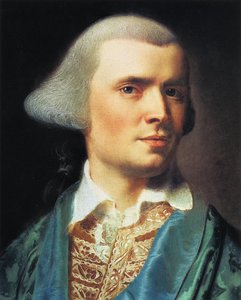
Oljemålning
 Allt om George IV







































 För konstverk eller reproduktioner som är större än 105 cm (cirka 41 tum) på någon sida, levereras ramen som ett isärplockat kit. Denna metod säkerställer en trygg leverans och förhindrar skador under transport.


George IV by John Singleton Copley: A Royal Portrait in Neoclassicism
John Singleton Copley's "George IV," painted in 1809, stands as a monumental example of Neoclassical portraiture. This oil on canvas artwork, measuring an impressive 372 x 318 cm, captures the essence of King George IV during a period of significant political and social change in Britain. The painting is not merely a likeness; it's a carefully constructed representation of royal power, military authority, and aristocratic grandeur.
The Artist and His Style
John Singleton Copley (1738-1815) was a pivotal figure in Anglo-American art. Born in Boston, he developed his skills largely through self-study and observation. His style is characterized by meticulous attention to detail, realism, and a strong sense of composition. Copley's ability to capture the likeness and character of his subjects, combined with his mastery of light and shadow, resulted in portraits that were both technically impressive and psychologically insightful. In "George IV," these qualities are evident in the king’s commanding presence and the intricate rendering of his military uniform.
Composition and Technique
The painting's composition is vertically oriented, emphasizing the King's stature and authority. George IV is depicted on horseback, rearing slightly to convey a sense of dynamism and power. He is clad in a striking military uniform, rich with detail and color, signifying his role as commander-in-chief. Below him, a group of soldiers are portrayed, creating a visual hierarchy that reinforces the king's position at the apex of society. The background features a dramatic sky filled with billowing clouds and trees, adding depth and atmosphere to the scene. Copley’s use of oil paints allows for a remarkable level of detail and texture; visible brushstrokes contribute to a somewhat rough surface quality, enhancing the painting's realism.
Historical Context and Symbolism
Created in 1809, "George IV" reflects the political climate of the Regency era. George IV was Prince Regent at the time, ruling as his father, King George III, suffered from periods of mental illness. The painting served to project an image of strength and stability during a period of considerable social and political upheaval. Symbolically, the king's military attire represents Britain’s power and its role on the world stage. The rearing horse is a classical motif signifying energy and control. The inclusion of soldiers underscores George IV’s authority as commander of the armed forces.
Emotional Impact and Legacy
"George IV" evokes a sense of awe and respect for the monarchy. Copley's skillful rendering of the king's features conveys both confidence and a certain aloofness, reflecting his complex personality. The painting’s grandeur and scale command attention, making it a powerful statement of royal authority. Today, "George IV" remains an important historical document and a testament to Copley's artistic skill, offering viewers a glimpse into the world of 19th-century British royalty.
Frågor och svar
Är George IV handmålat eller tryckt?
Handmålad: en utbildad konstnär kopierar George IV i olja på linnecanvas.
Vilken storlek bör jag välja för George IV?
Originalet har måtten 372 x 318 cm. Storlekarna sträcker sig från 34.2 x 29.3 cm (Skr2448) till 248.1 x 212.3 cm (Skr19240); tabellen på denna sida listar de huvudsakliga storlekarna och deras priser.
Hur lång leveranstid är det?
Leveransen tar 4 till 5 veckor med kostnadsfri expressfrakt över hela världen; ett alternativ för snabbare produktion erbjuds på denna sida. Du kan returnera verket inom 100 dagar för full återbetalning, utan några villkor.
Var finns originalet till George IV?
Originalet finns i samlingen hos Museum of Fine Arts, Boston.
Vilket medium använde John Singleton Copley för George IV?
Oil On Canvas
 Förhandsvisa

 Skicka
 Dela
 Visa detaljer
 Faktablad


 Ladda ner
 Liknande objekt
 Röntgen
 Bildspel
 Frågor och svar

 Statistik