Visa i rummet
 Skicka
 Dela
Dela
 Detaljer
 Studentguide för konstverk

 Ladda ner
 Liknande objekt
 Röntgen
 Bildspel
 Besökstatistik
Bañista

 Läs mer
Konstverket som visas på denna sida skyddas av upphovsrättslagen, vilket innebär att vi inte lagligt kan skapa eller sälja en identisk reproduktion. Detta skydd upprätthålls genom internationella avtal såsom den Bernkonventionen och genom nationella lagar, inklusive de som fastställs av Amerikansk upphovsrättslag – Titel 17. Alla rättigheter förbehållna. Återgivning av konstverk är förbjuden utan skriftligt tillstånd från WahooArt.
Denna metod följer fullt ut upphovsrättsliga regler eftersom den inte innebär kopiering eller duplicering av det skyddade konstverket. Istället är det en kreativ nytolkning – en ny målning som är influerad av originalet men inte identisk med det.
Giclée / Konsttryck
Giclée- eller canvasprint av museumskvalitet med snabb produktion och flexibla ytbehandlingsalternativ. ( Köp handmålat konstverk Byt till digital bildförsäljning)




P118B Skr10

P118H Skr10

P118W Skr10

P438Z Skr10

P508JH Skr12

P508YH Skr12

P805H Skr10

P805Z Skr10

P919BZ Skr10

P919G Skr10

P919XJ Skr10

P959ZH Skr10

P968JZ Skr12

W106C Skr8

W218G Skr10

W218JH Skr8

W218Y Skr10

W307PJ Skr10

W316G Skr10

W316PJ Skr8

W316Y Skr10

W398PJ Skr8

W4111J Skr10

W500HY Skr15

W500JH Skr15

W692G Skr12

W849H Skr8

W940BG Skr15

W953PJ Skr8




Välj bland våra förinställda storlekar som motsvarar konstverkets ursprungliga proportioner.

Ange den bredd och höjd du behöver, för att passa din ram eller din vägg. Ett tryck kan endast beskäras, aldrig göras större än bilden, vilket innebär att ett format med en annan formform leder till att en del av bilden går förlorad. Vi skickar en digital mockup för godkännande innan vi trycker något. Bilden som visas på denna sida visar inte den faktiska beskärningen — det är endast mockuppen som gör det.
Leverans över hela världen () på 2 veckor istället för standard 4/5 veckor. (22 oktober)

Fri expressfrakt över hela världen

Högkvalitativ linnecanvas

Fullständig fraktförsäkring

Garantier för återbetalning av tullavgifter

Garantier för exakt färgåtergivning

100 dagars returrätt vid fabrikationsfel

100% pengarna tillbaka-garanti

Mängdrabatt erbjuds
 Glasalternativet är endast tillgängligt i storlekar under 110 cm.

Bañista
Giclée / Konsttryck
Reproduktionsstorlek
-


Totalpris
Skr 793
A Vision of Catalan Identity and Inner Landscapes
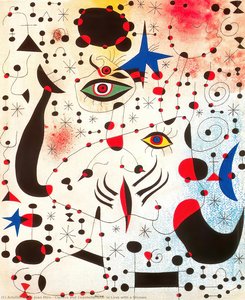
Joan Miró’s “Bañista” (The Bather), painted in 1925, isn't merely a depiction of a figure immersed in water; it’s an immersion into the artist’s deeply personal world—a vibrant collision of Catalan folklore, Surrealist dreamscapes, and a profound exploration of the subconscious. This captivating blue abstraction immediately draws the eye to its central figure: a man seemingly suspended before a luminous moon, his head crowned with a bowl – a potent symbol that anchors the work within a rich tapestry of meaning. The painting pulsates with an energy born from Miró’s unique vision, reflecting both the rugged beauty of his native Catalonia and the turbulent currents of his inner life.
Miró's artistic journey was inextricably linked to his Catalan heritage. Born in Barcelona, he absorbed the spirit of the region—its ancient myths, its distinctive architecture (particularly the organic forms championed by Antoni Gaudí), and a deep-seated sense of identity. “Bañista” is infused with this regionalism; the bowl on the man’s head echoes traditional Catalan hats, while the overall composition evokes the landscapes and textures of his homeland. Yet, Miró transcends mere representation, transforming these familiar elements into symbols open to multiple interpretations.
Surrealist Techniques and a Dreamlike Atmosphere
Technically, “Bañista” exemplifies Miró’s distinctive approach to Surrealism. He eschewed the rigid logic of Freudian dream analysis, instead employing a method he termed "automatism"—a process of spontaneous creation guided by intuition and subconscious impulses. The painting is built upon a foundation of bold, biomorphic shapes—circles, spirals, and amorphous forms—that seem to float weightlessly across the canvas. These aren’t meticulously rendered objects but rather evocative symbols, each imbued with personal significance for Miró.
The use of color is equally crucial. The dominant blues evoke a sense of tranquility and mystery, while contrasting yellows and oranges inject bursts of energy and warmth. Miró's technique involved applying paint directly from the tube, often layering colors in rapid succession to create a textured surface that seems to shimmer with movement. This immediacy reflects his desire to bypass conscious control and tap into the unfiltered flow of his imagination.
Symbolism and Emotional Resonance
The bowl perched atop the man’s head is arguably the most compelling symbol in “Bañista.” It can be interpreted as a representation of the crown, signifying authority or perhaps even a vessel for thoughts and emotions. The moon, positioned to the left, represents intuition, dreams, and the cyclical nature of time—elements deeply intertwined with Miró's artistic process. The birds scattered throughout the composition symbolize freedom and aspiration, while the clock suggests the passage of time and the fleeting nature of existence.
Beyond these specific symbols, “Bañista” resonates with a profound sense of melancholy and introspection. The solitary figure in the water invites contemplation on themes of isolation, vulnerability, and the search for meaning. It’s a painting that doesn't offer easy answers but instead encourages viewers to engage with their own inner landscapes—to confront their dreams, fears, and desires.
A Timeless Masterpiece – Perfect for Reproduction
“Bañista” remains one of Joan Miró’s most iconic works, captivating audiences with its dreamlike quality and symbolic richness. OriginalUniqueArt offers meticulously crafted hand-painted reproductions that faithfully capture the essence of this extraordinary painting. Whether you're an art enthusiast, a collector seeking to expand your collection, or an interior designer searching for a unique statement piece, a reproduction of “Bañista” will bring a touch of Surrealist magic and Catalan spirit into any space. Explore our high-quality reproductions today and experience the enduring allure of Miró’s visionary world.
Frågor och svar
Är "Bañista" fri från upphovsrätt?
Upphovsrättslig status för "Bañista" av Joan Miró: verket är fortfarande skyddat av upphovsrätt. Detta avgör om reproduktioner av bilden får framställas fritt.
Kan jag använda augmented reality för att se "Bañista" av Joan Miró i mitt rum?
Sidan för AR-förhandsvisning av "Bañista" av Joan Miró använder förstärkt verklighet (AR) för att visa konstverket i ditt eget utrymme, på en kompatibel enhet.
Hur kan jag få en digital fil av "Bañista" av Joan Miró?
En digital bild av "Bañista" av Joan Miró kan köpas på dess Digital bild-sida: en högupplöst digital bildnedladdning.
Om konstnären
A Catalan Visionary: The Life and Art of Joan Miró
Joan Miró i Ferrà, born in Barcelona in 1893, stands as one of the most significant figures in 20th-century art. His journey was not merely a progression through styles but an exploration of inner worlds, translating dreams, memories, and Catalan identity onto canvas with a uniquely poetic visual language. From humble beginnings marked by illness and initial parental reservations about his artistic pursuits, Miró persevered, driven by an innate need to express the intangible—the emotions, sensations, and subconscious currents that lie beneath the surface of reality. His early life was steeped in the traditions of Barcelona, a city brimming with architectural marvels thanks to Antoni Gaudí, whose organic forms would subtly influence Miró’s later abstractions. The goldsmithing profession of his father instilled an appreciation for meticulous craftsmanship, while the rugged Catalan landscape became a recurring motif and source of inspiration throughout his career.Early Influences and the Path to Surrealism
Miró's formal artistic training began at La Llotja in Barcelona, where he honed his skills in traditional techniques. However, it was exposure to the avant-garde movements sweeping through Paris that truly ignited his creative evolution. The vibrant colors of Fauvism and the fragmented forms of Cubism resonated deeply, prompting him to move to Paris in 1920. This period proved pivotal as he encountered artists like Pablo Picasso and began experimenting with increasingly abstract compositions. Yet, Miró didn’t simply adopt these styles; he synthesized them, forging a path toward his own distinctive aesthetic. He sought to distill forms to their essence, stripping away representational details in favor of symbolic shapes and evocative colors. This exploration led him to the Surrealist group in 1924, aligning him with artists such as Max Ernst and Salvador Dalí. While embracing the Surrealist interest in the subconscious, Miró maintained a unique sensibility—his work was less about shocking imagery or Freudian symbolism than it was about creating a world of playful forms and poetic suggestion. He famously stated that he wanted to “paint what I see,” but what he saw wasn’t necessarily what others perceived; it resided within the realm of dreams and imagination.The Surrealist Universe: Exploring Symbolism and Imagination
Miró's involvement with Surrealism profoundly shaped his artistic vision. Influenced by Sigmund Freud’s theories on psychoanalysis, Miró sought to tap into the hidden depths of consciousness—to depict not what is visible but what is felt. His canvases became populated with fantastical creatures—birds, insects, amorphous shapes—each imbued with symbolic significance. Recurring motifs like spirals and circles represented cycles of life and death, while biomorphic forms evoked primal instincts and primordial landscapes. Collaborations with fellow Surrealists yielded groundbreaking techniques such as *grattage*, where paint was scraped off the canvas surface to reveal underlying textures—a method he pioneered alongside Max Ernst for designs intended for Sergei Diaghilev’s ballet, *The Firebird*. This experimental approach underscored Miró's commitment to challenging artistic conventions and pushing the boundaries of visual expression.Major Works and Artistic Innovations
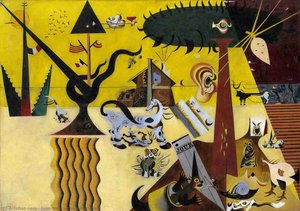
Throughout his prolific career, Miró produced an astonishing array of paintings, sculptures, ceramics, and prints—each reflecting his evolving aesthetic sensibilities. The Farm (1922) stands as a seminal work demonstrating his early embrace of Surrealist principles. Its depiction of Catalan rural life is rendered in vibrant colors and simplified forms, conveying both visual beauty and symbolic depth. The series *Dutch Interiors* (1928-1930), created during his Parisian period, reimagined the interiors of Dutch bourgeois homes through a Cubist lens—a bold departure from traditional representation that prioritized geometric abstraction and expressive color palettes. Miró’s monumental sculpture *Barcelona* (1945) embodies his desire to engage with grand themes—the Catalan spirit and the resilience of human creativity in times of adversity. His ceramic works, particularly those produced during World War II, explored textural surfaces and organic forms—a testament to his versatility as an artist.Legacy and Enduring Influence
Joan Miró’s contribution to modern art is undeniable. He wasn't merely a painter; he was a visionary who redefined the possibilities of artistic expression. His work profoundly influenced subsequent generations of artists, fostering experimentation with abstraction and symbolism—inspiring movements like Abstract Expressionism and Pop Art. Beyond his artistic achievements, Miró championed Catalan culture and identity—a commitment reflected in his lifelong dedication to preserving the traditions of his homeland. He established two foundations—the Fundació Joan Miró in Barcelona (1975) and the Fundació Pilar i Joan Miró in Palma de Mallorca (1981)—ensuring that his legacy would endure, providing spaces for artistic exploration and education. His art continues to captivate audiences worldwide, inviting us to contemplate the mysteries of consciousness and celebrate the transformative power of imagination—a timeless testament to the enduring spirit of a truly exceptional artist.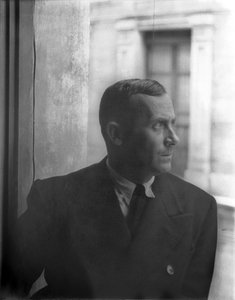
Joan Miró
1893 - 1983 , Spanien
Snabbfakta
- Artistic Movement Or Style: Surrealism
- Artists Who Influenced This Artist:
- Pablo Picasso
- Sergei Diaghilev
- Date Of Birth: 1893
- Date Of Death: 1983
- Full Name: Joan Miró i Ferrà
- Nationality: Spanska
- Notable Artworks:
- Nudebad med Spegel
- La Poetisa
- Målning
- Place Of Birth: Barcelona, Spanien
Relaterade artiklar
Joan Mirós 25 Mästerverk: Konst, Drömmar & Inredning för Hemmet
Utforska Joan Mirós 25 mest ikoniska konstverk! Fördjupa dig i surrealismens värld, katalanska färger och tidlösa målningar. Hitta inspiration & köp museumkvalitativa reproduktioner på OriginalUniqueArt.com – för en unik heminredning.

Serene Blue Backgrounds: Discover Soulful Art to Transform Your Space with Timeless Elegance
Transform your home with soulful blue art. From serene Monet impressions to modern textured sculptures, discover curated masterpieces designed to inspire calm. Explore expert art consultations and bespoke hand-painted reproductions to create your personal sanctuary.

Topp 10 mästerverk inom abstrakt expressionism – konst för ditt hem | OriginalUniqueArt.com
Utforska de 10 mest inflytelserika verken inom abstrakt expressionism – från Rothkos färgfält till Pollocks action painting. Lär känna konstnärerna och deras teknik. Hitta museumskvalitativa tryck på OriginalUniqueArt.com och förvandla ditt hem med tidlös konst!

Kandinskys 25 Mästerverk: En Färgstark Resa i Abstrakt Konst | OriginalUniqueArt
Utforska Wassily Kandinskys 25 mest ikoniska verk – från expressionism till abstrakt konst. Lär känna historien bakom mästerverken och hitta inspiration för din heminredning med OriginalUniqueArt.com. Upptäck hela samlingen online!

De 10 mest ikoniska målningarna i nyansen 'Skifferblått' – Konst & Inredning
Utforska de 10 mest ikoniska målningarna dominerade av nyansen 'skifferblått'. Lär känna Monet, Van Gogh & andra mästare. Hitta inspiration för din inredning och köp museumkvalitativa konsttryck på OriginalUniqueArt.com – din källa till tidlös skönhet.