Byt till tryck
 Visa mer







































 För konstverk eller reproduktioner som är större än 105 cm (cirka 41 tum) på någon sida, levereras ramen som ett isärplockat kit. Denna metod säkerställer en trygg leverans och förhindrar skador under transport.


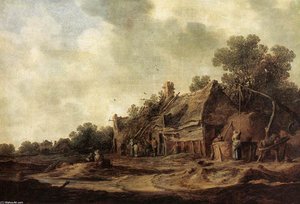
Jan van Goyen: A Pioneer of Atmospheric Landscape Painting
Jan Josephszoon van Goyen (1596 – 1656) stands as an enduring icon of Dutch Golden Age art, celebrated for his masterful depictions of the serene beauty of the Dutch countryside. More than just capturing scenery, Van Goyen achieved a profound emotional resonance through his distinctive style—a quiet contemplation of nature imbued with subtle tonal variations and an unwavering commitment to realism. His legacy continues to inspire artists and captivate audiences today.Early Life and Artistic Training
Born in Leiden on January 13, 1596, Van Goyen’s artistic journey began humbly, apprenticing under Esaias van de Velde in Haarlem. This formative experience instilled in him a foundational understanding of perspective and tonal painting—skills that would become hallmarks of his oeuvre. Unlike many contemporaries who embraced flamboyant color palettes, Van Goyen deliberately eschewed ostentation, prioritizing instead the quiet observation of natural light and shadow to convey mood and space effectively.A Distinctive Style: Simplicity and Atmospheric Perspective
Van Goyen’s artistic style is instantly recognizable for its remarkable simplicity. He rejected elaborate ornamentation, focusing solely on conveying the essence of his subjects—typically Dutch riverscapes—through a restrained palette dominated by grays, browns, and greens. Crucially, he pioneered the technique of atmospheric perspective, skillfully rendering distant landscapes with muted colors and softened contours to simulate the effects of air and haze. This approach wasn’t merely stylistic; it reflected Van Goyen's deep conviction that true beauty resided in capturing the subtle nuances of the natural world.Prolific Output and Notable Works: Reflecting Dutch Identity
Van Goyen was an extraordinarily prolific artist, producing approximately twelve hundred paintings—a staggering output considering the artistic standards of his time. His subjects ranged from expansive forest vistas to tranquil river scenes bathed in golden light, reflecting the cultural values of the Netherlands during the Golden Age. Among his most celebrated works is “A View on the Maas near Dordrecht,” a breathtaking panorama showcasing Van Goyen’s mastery of tonal painting and atmospheric perspective—a testament to his ability to evoke profound emotion through understated visual elements. This piece exemplifies the artist's dedication to portraying Dutch landscapes with unwavering accuracy and sensitivity, cementing his place as one of the foremost landscape painters of his era.Symbolism and Emotional Impact: Capturing Tranquility and Reflection
Beyond mere representation, Van Goyen’s paintings convey a deeper symbolic significance—a celebration of Dutch identity and a contemplation of the sublime beauty inherent in nature. The muted colors and hazy landscapes invite viewers to pause and consider the grandeur of the natural world alongside its quiet serenity. His works resonate with an enduring emotional impact, transporting audiences back to 17th-century Holland and reminding us of the power of art to inspire awe and introspection.Further Exploration: Resources for Art Enthusiasts
For those eager to delve deeper into Jan van Goyen’s artistic legacy, several valuable resources are available:- National Gallery of Art: River Landscape with a Distant Bridge
- Wikipedia Article:Jan van Goyen
Discover more about Jan van Goyen’s life and work at OriginalUniqueArt.
Frågor och svar
Vilken konstnärlig inriktning tillhör "River scene" av Jan van Goyen?
Konststilen som förknippas med "River scene" av Jan van Goyen är Dutch Golden Age Landscape. Denna klassificering placerar verket bland relaterade konstnärer och konstverk.
Finns det verk som liknar "River scene"?
Hitta verk som liknar "River scene" på verkets sida Liknande verk.
Vilken känsla förmedlar "River scene"?
"River scene" av Jan van Goyen förmedlar en Calm emotionell ton.
 Förhandsvisa
 Skicka
 Dela
Dela
 Visa detaljer
 Guide
Guide

 Ladda ner
 Liknande objekt
 Röntgen
 Bildspel
 Q&A
Q&A Statistik