Byt till tryck
 Visa mer







































 För konstverk eller reproduktioner som är större än 105 cm (cirka 41 tum) på någon sida, levereras ramen som ett isärplockat kit. Denna metod säkerställer en trygg leverans och förhindrar skador under transport.


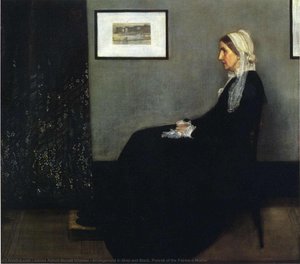
A Study in Shadow and Silence: Whistler’s Self-Portrait of 1858
James Abbott McNeill Whistler's "Self-portrait," etched in 1858, isn’t merely a likeness; it’s a carefully constructed meditation on perception, light, and the very nature of artistic expression. This deceptively simple image, rendered in stark black and white, immediately draws the viewer into a world of quiet contemplation – a world that reflects Whistler's burgeoning aesthetic philosophy. The portrait depicts a man with short hair, gazing downward, his features etched with a subtle melancholy. A neatly trimmed mustache adds to an air of restrained formality, while the tie suggests a connection to the social conventions of the time, yet he subtly resists their full embrace.
- The Etching Technique: Whistler was a pioneer in etching, meticulously controlling every line and tonal value. The delicate lines of this portrait demonstrate his mastery of the medium, creating an astonishingly detailed surface despite its monochrome palette. Notice how he uses hatching – closely spaced parallel lines – to build up areas of shadow, suggesting depth and volume with remarkable subtlety.
- Compositional Restraint: The subject occupies a significant portion of the frame, anchoring the image while allowing ample negative space around him. This deliberate emptiness invites the viewer to focus entirely on the figure itself, fostering a sense of intimacy and solitude.
Echoes of Aestheticism
Whistler’s “Self-portrait” is deeply rooted in the aesthetic movement that was gaining momentum throughout Europe during this period. Rejecting the prevailing Victorian emphasis on moralistic narratives and historical subject matter, aesthetes like Whistler sought to elevate art to its purest form – an end in itself. They believed that art should be judged solely on its beauty and sensory impact, divorced from didactic or narrative content. This portrait embodies that philosophy perfectly; it’s not a story being told, but rather an experience of visual contemplation.
The year 1858 was pivotal for Whistler. He was beginning to establish his artistic identity, experimenting with tonal values and exploring the interplay between light and shadow – techniques he would later refine into his signature “Nocturnes.” This self-portrait can be seen as a preliminary study for these future works, a focused investigation of how color (represented here through value) could evoke mood and atmosphere.
Symbolism in Subtlety
While the portrait avoids overt symbolism, there are subtle clues that enrich its meaning. The downward gaze suggests introspection, perhaps even a degree of sadness or weariness. It’s not a triumphant or assertive pose; rather, it conveys a sense of quiet observation and self-awareness. The tie, while present, isn't overly emphasized – it hints at societal expectations without demanding adherence to them. Whistler was deliberately blurring the lines between art and life, suggesting that beauty could be found in the everyday, even in the act of simply looking.
Furthermore, consider the stark contrast between light and shadow. Whistler masterfully uses chiaroscuro – the dramatic interplay of light and dark – to sculpt the man’s face and create a sense of three-dimensionality. This technique not only enhances the visual impact but also contributes to the overall mood of quiet contemplation.
A Timeless Reflection
Whistler's "Self-portrait" of 1858 remains a powerfully evocative work, offering a glimpse into the mind of an artist grappling with his own identity and artistic vision. It’s a testament to Whistler’s innovative approach to etching and his commitment to aesthetic principles. A reproduction of this piece offers more than just a visual representation; it provides a window into a pivotal moment in art history – a moment when the pursuit of beauty was championed above all else. Its quiet intensity continues to resonate with viewers today, inviting us to pause, reflect, and appreciate the subtle power of a carefully crafted image.
Frågor och svar
Är färgerna i "Self-portrait" av James Abbott McNeill Whistler mättade eller dämpade?
"Self-portrait" av James Abbott McNeill Whistler är återgiven med en Muted mättnad.
Under vilka andra namn är James Abbott McNeill Whistler känd?
James Abbott McNeill Whistler är även känd som Whistler.
Var kan man se "Self-portrait" av James Abbott McNeill Whistler utställd idag?
Originalet av "Self-portrait" av James Abbott McNeill Whistler finns på Smithsonian’s National Museum of Asian Art, Washington D.C., USA. En reproduktion gör det möjligt att visa verket i hemmet.
 Förhandsvisa
 Skicka
 Dela
Dela
 Visa detaljer
 Guide
Guide

 Ladda ner
 Liknande objekt
 Röntgen
 Bildspel
 Q&A
Q&A Statistik