Symbolism
Returning from the Fields (Jacek Malczewski)
Jacek Malczewski (1854–1929) skapade Returning from the Fields. Det tillhör Symbolism-rörelsen. Den är utförd i Oil On Panel.
- Oil On Panel

 Förhandsvisa

 Handmålad oljemålning
 Skicka
 Dela
 Guide


 Ladda ner
 Liknande objekt
 Röntgen
 Bildspel
 Frågor och svar

 Statistik
Returning from the Fields: det viktigaste
- Titel
- Returning from the Fields
- Konstnär
- Jacek Malczewski (1854–1929)
- Konstnär född i
- Radom, Polen
- Material
- Oil On Panel
- Rörelse
- Symbolism
- Tidsperiod
- 19th Century
- Motiv
- rural life, farmer portrait, labor, resilience, landscape, texture
Vad föreställer Returning from the Fields?
The Figure of the Laborer
The oil painting depicts an elderly man positioned centrally against a blurred rural landscape. He is captured in a moment of repose or transit, returning from agricultural work. His face is marked by deep lines and wrinkles, rendered with thick impasto that gives the skin a tactile, weathered quality. He wears a dark, textured hat and rustic clothing that shows the heavy folds of fabric. A walking stick or tool is held in his hand, its surface defined by visible, directional brushstrokes. The lighting is natural, casting shadows that emphasize the contours of his facial structure and the physical toll of his labor. The background consists of muted foliage and a pale sky, creating a shallow depth that keeps the focus on the subject's physical presence.
Technical Composition and Style
The work utilizes a realistic approach with strong elements of impressionism, particularly in the way light and atmosphere are handled through visible brushwork. The artist employs a palette of muted, earthy tones to establish the pastoral setting. The composition relies on organic shapes, such as the rounded form of the head and the irregular lines of the surrounding greenery, to create a sense of naturalism. The following elements define the technical execution of the piece:
- Impasto application on the skin and clothing to create physical texture.
- Layered paint to establish atmospheric perspective in the background.
- Directional brushstrokes to define the texture of the hat and walking stick.
- Naturalistic lighting to accentuate the subject's anatomy and clothing folds.
Symbolic and Historical Context
Created by Jacek Malczewski, this work reflects the themes of the Young Poland movement. The subject matter focuses on the daily routine of rural life, emphasizing the connection between the individual and the land. The depiction of the weary farmer functions as a study of resilience and the physical reality of toil. Malczewski, a central figure of Polish Symbolism, often used such figures to reflect the broader spirit of a nation, though here the focus remains on the specific, quiet dignity of the agrarian worker. The painting captures a sense of fatigue and the quietude of the countryside through its subdued color scheme and heavy, textured surfaces.
Returning from the Fields i hög upplösning

Allmän egendom: konstnären avled 1929.
Fler storlekar, beskärningar och källhänvisning →Jacek Malczewski, Returning from the Fields. Allmän egendom
En digital expert kontrollerar färgerna mot originalmålningen och retuscherar filen så att den är trogen konstnärens penseldrag.
Köp högupplöst bildFrågor om Returning from the Fields
Vilken teknik användes för "Returning from the Fields" av Jacek Malczewski?
"Returning from the Fields" är utförd i Oil On Panel.
Vad föreställer "Returning from the Fields" av Jacek Malczewski?
Teman som återfinns i "Returning from the Fields" av Jacek Malczewski inkluderar rural life, farmer portrait, labor, resilience, landscape, texture, polish art, symbolism. Tillsammans sammanfattar de verkets motiv.
Är bilden av "Returning from the Fields" av Jacek Malczewski fri att återge?
Upphovsrättslig status för "Returning from the Fields" av Jacek Malczewski: verket är allmän egendom – upphovsrätten har löpt ut. Detta avgör om reproduktioner av bilden får framställas fritt.
Vem är konstnären bakom "Returning from the Fields"?
Konstnären bakom "Returning from the Fields" är Jacek Malczewski. Verket är katalogiserat under Jacek Malczewskis namn.
Vilken konstnärlig inriktning tillhör "Returning from the Fields" av Jacek Malczewski?
"Returning from the Fields" av Jacek Malczewski tillhör Symbolism-rörelsen. Denna rörelse ger det stilistiska sammanhanget för verket.
Vilken period av Jacek Malczewskis karriär tillhör "Returning from the Fields"?
"Returning from the Fields" tillhör Jacek Malczewskis Mature Period i konstnärskarriären. Denna klassificering relaterar verket till konstnärens utveckling.
Är "Returning from the Fields" av Jacek Malczewski fri från upphovsrätt, och varför?
Upphovsrättsläget för "Returning from the Fields" - allmän egendom – upphovsrätten har löpt ut - baseras på konstnärens dödsår 1929.
Hur förhåller sig "Returning from the Fields" till resten av Jacek Malczewskis konstnärskap?
"Returning from the Fields" delar med Jacek Malczewskis övriga verk sin Symbolism-stil och de återkommande temana: symbolist landscape, polish rural life, labor and hardship, connection to nature, national identity", melancholy mood, young poland aesthetic, exploring the soul".
Är "Returning from the Fields" typisk för vad Jacek Malczewski vanligtvis skapade?
Bland Jacek Malczewskis dokumenterade teman – symbolist landscape, polish rural life, labor and hardship, connection to nature, national identity", melancholy mood, young poland aesthetic, exploring the soul" – har "Returning from the Fields" ett eget fokus på rural life, farmer portrait, labor, resilience, landscape, texture, polish art, symbolism.
Om konstnären, Jacek Malczewski
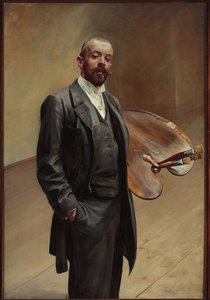
1854–1929, Polen
Jacek Malczewski
En Själ För Polen: Jacek Malczewskis Liv och Konst Jacek Malczewski, född 1854 i Radom, en stad då belägen inom det rysk-kontrollerade Kongresspolen, var mer än bara en målare. Han var en visuell förkroppsligande av polsk nationell identitet och en djupgående röst för ett folk som längtade efter självbestämmande. Hans livs bana och konstnärliga vision var oupplösligt sammanflätade med de romantiska idealen om oberoende, djupt rotade i hans far, Julian Malczewski – en hängiven patriot som odlade hos den unge Jacek en orubblig kärlek till polsk kultur, litteratur och historia. Detta tidiga inflytande blev grundvalen för hans kreativa uttryck, formade honom till den ledande figuren inom polsk symbolism och gav honom den respekterade titeln ”polsk symbolisms fader”.
Andra verk av Jacek Malczewski
 Self-portrait in armor with violin.1908
 Madonna and Children1897
 Portrait of artist's sister Helene with lute1906
 The Artist's death1909

Essäer om Returning from the Fields
 Comparing Dutch Italianate and Dutch Tonal LandscapesMaster the differences between Dutch Italianate and Tonal landscapes through expert technical analysis. Discover the nuances of Golden Age …
 Bovines in Brushstrokes: Capturing the Peaceful Spirit of Pastoral ArtExplore the mastery of pastoral art through Munnings and Cole. Discover the soul of the landscape today.
 19th century Polish painters19th-century Polish art comes alive through the masterpieces of Jan Matejko and Jacek Malczewski. View the full collection online at Origin…