Contemporary Realism · 1957
Falling Warrior (Henry Moore, 1957)
Henry Moore (1898–1986) skapade Falling Warrior. Den är från 1957. Det tillhör Contemporary Realism-rörelsen. Den är utförd i Bronze. Verket finns bevarat på National Museums Liverpool i Liverpool, Storbritannien. Måtten är 48 × 147 cm.
- 1957
- Bronze
- 48 × 147 cm
- National Museums Liverpool

 Handmålad oljemålning
 Skicka
 Dela
 Faktablad


 Ladda ner
 Liknande objekt
 Bildspel
 Frågor och svar

 Statistik
Falling Warrior i korthet
- Titel
- Falling Warrior
- Konstnär
- Henry Moore (1898–1986)
- Konstnär född i
- Castleford, Storbritannien
- Datum
- 1957
- Material
- Bronze
- Mått
- 48 × 147 cm
- Utställningsplats
- National Museums Liverpool, Liverpool, Storbritannien
- Rörelse
- Contemporary Realism
- Tidsperiod
- Modern
- Motiv
- bronze sculpture, female figure, reclining pose, minimalism, organic form, tranquility
Vad föreställer Falling Warrior?
A Symphony of Bronze and Bone: The Essence of Falling Warrior
In the quiet halls of Tate Britain, there exists a moment of profound stillness captured in bronze—a masterpiece that breathes with the weight of history and the lightness of spirit. Henry Moore’s “Falling Warrior,” created between 1956 and 1957, is far more than a mere sculpture; it is a meditation on the very nature of existence. As one approaches this monumental work, the eye is immediately drawn to the fluid, undulating lines that define the female form. The figure lies horizontally, her body a landscape of soft curves and deliberate voids, evoking a sense of both immense strength and heartbreaking vulnerability. It is a piece that does not merely occupy space but commands it, inviting the viewer into a silent dialogue about resilience in the face of inevitable decline.
The brilliance of Moore’s technique lies in his ability to marry the tactile reality of metal with the ethereal quality of movement. Through a masterful process of modeling clay and subsequent bronze casting, Moore achieved a surface texture that feels alive. One can trace the subtle depressions and ridges that mimic the contours of flesh and bone, creating a rhythmic vitality that suggests the figure is caught in a single, breathless moment of transition. His pioneering use of negative space—the intentional piercing of the form—allows light to pass through the sculpture, integrating the surrounding environment into the artwork itself. This interplay of solid mass and hollow void creates a dynamic tension, making the bronze appear deceptively supple, as if the warrior might stir at any moment.
Modernism Rooted in the Earth
To understand the soul of “Falling Warrior,” one must look to the rugged landscapes of Yorkshire, where Henry Moore first learned to see the world. The rolling hills and weathered stones of his youth are echoed in the organic abstractions of this piece. While the sculpture sits firmly within the mid-century movements of Abstract Expressionism and Surrealism, it avoids the coldness often associated with pure abstraction. Instead, Moore utilizes a semi-abstract language to explore deep psychological states. The pose—a female figure with an arm outstretched in what could be interpreted as either defiance or surrender—serves as a universal symbol for the human condition. It captures the duality of our existence: the struggle to remain upright and the eventual, graceful acceptance of our own mortality.
For the discerning collector or interior designer, “Falling Warrior” represents an unparalleled opportunity to introduce a sense of timelessness and intellectual depth into a space. A high-quality reproduction of this work brings with it the prestige of British Modernism and the calming influence of organic form. Whether placed in a sunlit gallery, a sophisticated study, or as a focal point in a contemporary living space, the sculpture’s presence is transformative. It offers more than decoration; it provides a window into a profound aesthetic experience, where the boundaries between the human body and the natural world dissolve into a single, hauntingly beautiful expression of life.
Vilket museum har Falling Warrior?
National Museums Liverpool
Liverpool, Storbritannien
A Legacy Etched in Stone and Canvas: Unveiling National Museums Liverpool Nestled within the vibrant heart of Liverpool, a city pulsating with maritime history, industrial grit, and an undeniable artistic spirit, lies National Museums Liverpool – an institution far more profound than simply a repository for artifacts. It’s a living chronicle, a testament to Merseyside's evolution, and a deeply resonant celebration of human creativity spanning millennia. Unlike the grand, centralized museums often confined to the orbit of London’s cultural sphere, NML thrives on its distinct regional identity, rooted in the Northwest’s resilient spirit and an unwavering commitment to accessibility for all.


Högupplösta bilder av Falling Warrior

Upphovsrättsskyddat: dessa filer är för personligt bruk och utgör inte en licens för återpublicering.
Henry Moore, Falling Warrior (1957), National Museums Liverpool.
Frågor om Falling Warrior besvarade
Vilket museum har originalet till "Falling Warrior"?
Originalet av "Falling Warrior" av Henry Moore finns på National Museums Liverpool, Liverpool, Storbritannien. En reproduktion gör det möjligt att visa verket i hemmet.
När skapades "Falling Warrior" av Henry Moore?
"Falling Warrior" av Henry Moore skapades år 1957.
Vilken teknik användes för "Falling Warrior" av Henry Moore?
Henry Moore använde tekniken Bronze för "Falling Warrior". Tekniken definierar det ursprungliga verkets materiella karaktär.
Vilka är måtten på originalet av "Falling Warrior" av Henry Moore?
Originalet av "Falling Warrior" av Henry Moore mäter 147 x 48 cm.
Vad föreställer "Falling Warrior" av Henry Moore?
Motiven i "Falling Warrior" är bronze sculpture, female figure, reclining pose, minimalism, organic form, tranquility, monumental art.
Är bilden av "Falling Warrior" av Henry Moore fri att återge?
Upphovsrättslig status för "Falling Warrior" av Henry Moore: verket är fortfarande skyddat av upphovsrätt. Detta avgör om reproduktioner av bilden får framställas fritt.
Vem har skapat "Falling Warrior"?
"Falling Warrior" skapades av Henry Moore. Informationen på denna sida beskriver Henry Moores originalverk.
Vilken konststil tillhör "Falling Warrior" av Henry Moore?
Konststilen som förknippas med "Falling Warrior" av Henry Moore är Contemporary Realism. Denna klassificering placerar verket bland relaterade konstnärer och konstverk.
Vilken period av Henry Moores karriär tillhör "Falling Warrior"?
"Falling Warrior" representerar Henry Moores Mature Period.
Om konstnären, Henry Moore

1898–1986, Storbritannien
Henry Moore
A Life Sculpted in Form: The World of Henry Moore Henry Spencer Moore, född i den Yorkshirenska gruvstaden Castleford 1898, blev en av tidens mest betydelsefulla och internationellt erkända skulptörer. Hans resa från enkla rötter till global berömmelse är ett bevis på hans outsläckliga engagemang för konstnärlig utforskning och hans djupa anknytning till den mänskliga formen och naturens former. Moores far, en självutbildad man med en passion för lärande, ledde honom bort från livet som gruvarbetare mot formell utbildning. Även i ung ålder visade Moore en naturlig talang för att modellera lera och skära trä, vilket var ett tidigt tecken på den väg han skulle följa.
Andra verk av Henry Moore
 Reclining Figure
 Sculptural Objects (Cramer 47)
 Sheep 1
 A Miner at Work1942
Essäer om Falling Warrior
 Romantic Realism's Finest: 10 Masterpieces for Your Home | OriginalUniqueArtExplore 10 defining masterpieces of Romantic Realism! Discover Courbet, Millet & Daumier's powerful paintings—capturing emotion and social …
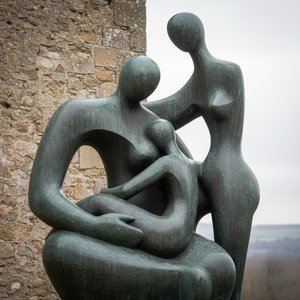 Henry Moore: Sculpting Modernity – Form, Emotion & the Human ConditionExplore the revolutionary sculptures of Henry Moore – abstract forms, reclining figures & powerful expressions of the human condition. Disc…
 Kubismens Mästverk: 10 Verk som Definierade en Epok – Konst & InredningUtforska kubismens och expressionismens 10 mest inflytelserika verk – från Picassos revolutionerande stil till Braques banbrytande former. …