Italian Renaissance · 1550
Pietà (Julije Klović, 1550)
Julije Klović (1498–1578) skapade Pietà. Den är från 1550. Det tillhör Italian Renaissance-rörelsen. Den är utförd i Manuscript. Verket finns bevarat på Galleria degli Uffizi i Florens, Italien. Måtten är 368 × 257 cm.
- 1550
- Manuscript
- 368 × 257 cm
- Galleria degli Uffizi, Florens

 Förhandsvisa

 Handmålad oljemålning
 Skicka
 Dela
 Faktablad


 Ladda ner
 Liknande objekt
 Röntgen
 Bildspel
 Frågor och svar

 Statistik
Pietà i korthet
- Titel
- Pietà
- Konstnär
- Julije Klović (1498–1578)
- Konstnär född i
- Grižane, Kroatien
- Datum
- 1550
- Material
- Manuscript
- Mått
- 368 × 257 cm
- Utställningsplats
- Galleria degli Uffizi, Florens, Italien
- Rörelse
- Italian Renaissance
- Tidsperiod
- Renaissance
- Motiv
- virgin mary, jesus christ, religious iconography, renaissance art, classical composition, emotional depth
Vad föreställer Pietà?
A Testament to Sorrow and Divine Grace
In the quiet, hallowed corridors of art history, few images resonate with the profound emotional gravity found in Giulio Clovio’s Pietà. Created around 1550, this masterpiece serves as a breathtaking bridge between the fading echoes of the Gothic tradition and the luminous dawn of the High Renaissance. The scene captures the quintessential moment of Christian sorrow: the Virgin Mary cradling the lifeless body of Jesus Christ following his crucifixion. It is not merely a depiction of death, but a profound meditation on compassion—the very meaning of the word Pietà. Through Clovio’s masterful hand, the heavy weight of mortality is balanced by an ethereal sense of divine grace, inviting the viewer into a space of deep, contemplative mourning.
The composition is a masterclass in Renaissance balance and narrative depth. At the heart of the work, Mary sits as a pillar of strength and grief, her blue cloak—a color traditionally symbolizing her heavenly connection—draped with a weight that mirrors her sorrow. The figure of Christ, depicted with a serene, almost peaceful countenance despite his recent agony, rests heavily in her lap, creating a poignant focal point that draws the eye through its sheer vulnerability. Surrounding this central tragedy, celestial beings and saints emerge from the shadows; angels with active, reaching gestures and observers in prayerful poses create a sense of a cosmic event unfolding. This layering of figures ensures that the viewer’s gaze wanders through a complex web of devotion, from the intimate touch of a mother to the collective mourning of the heavens.
Technique and the Radiance of Light
What truly distinguishes Clovio’s work is his unparalleled ability to manipulate light and color, a skill honed during his time as one of history's greatest manuscript illuminators. Though this piece possesses the scale and grandeur of a monumental painting, it retains the meticulous, jewel-like precision of a miniature. Clovio employed a sophisticated technique of layering translucent glazes over gold leaf, a method that allows light to penetrate the surface and reflect back, creating an inner luminosity that seems to emanate from within the figures themselves. The use of ultramarine blue, derived from the precious stone lapis lazuli, provides a depth of color that is both regal and somber, anchoring the composition in a palette of earth tones and celestial blues.
The interplay of light and shadow—chiaroscuro—is used here not just for anatomical realism, but to direct the emotional narrative. Light strikes Mary’s face from the side, carving her features out of the darkness and highlighting the subtle lines of grief and devotion. This dramatic contrast creates a sculptural quality, giving the figures a tangible presence that commands the room. For the discerning collector or interior designer, such a work offers more than mere decoration; it provides a focal point of immense character. A high-quality reproduction of this Pietà brings with it an atmosphere of timelessness and intellectual depth, making it an exquisite addition to a curated space that values historical resonance and the profound beauty of the human spirit.
Vilket museum har Pietà?
Galleria degli Uffizi
Florens, Italien
Historien och ursprunget till Galleria degli Uffizi Galleria degli Uffizi ligger i hjärtat av Florens, Italien. Institutionen grundades år 1560, under en tid då byggnaden ursprungligen utformades av Giorgio Vasari för de florentinska magistraterna. Konstruktionen av denna storslagna struktur ägde rum mellan 1560 och 1580, och dessa administrativa kontor var avsedda att centralisera stadens olika kommittéer och myndigheter.


Högupplösta bilder av Pietà

Allmän egendom: konstnären avled 1578.
Andra storlekar, beskärningar och citering →Julije Klović, Pietà (1550), Galleria degli Uffizi. Allmän egendom
Frågor om Pietà besvarade
Vilket museum har originalet till "Pietà"?
"Pietà" av Julije Klović visas på Galleria degli Uffizi, Florens, Italien. Museilistan avser originalverket, inte reproduktioner.
När skapades "Pietà" av Julije Klović?
"Pietà" dateras till 1550. Datumet placerar verket inom Julije Klovićs karriär och dess epok.
Vilket medium är "Pietà" av Julije Klović utförd i?
"Pietà" av Julije Klović är utförd i Manuscript. Reproduktionerna strävar efter att återge teknikens särpräglade utseende.
Vilka är måtten på originalet av "Pietà"?
Originalet av "Pietà" av Julije Klović mäter 368 x 257 cm.
Vad föreställer "Pietà"?
"Pietà" av Julije Klović föreställer: virgin mary, jesus christ, religious iconography, renaissance art, classical composition, emotional depth, medieval influence.
Är "Pietà" fri från upphovsrätt?
Upphovsrättslig status för "Pietà" av Julije Klović: verket är allmän egendom – upphovsrätten har löpt ut. Detta avgör om reproduktioner av bilden får framställas fritt.
Vilken konstnär tillskrivs "Pietà"?
Konstnären bakom "Pietà" är Julije Klović. Verket är katalogiserat under Julije Klovićs namn.
Vilken konststil tillhör "Pietà" av Julije Klović?
Konststilen som förknippas med "Pietà" av Julije Klović är Italian Renaissance. Denna klassificering placerar verket bland relaterade konstnärer och konstverk.
Vilken fas av Julije Klovićs konstnärliga utveckling representerar "Pietà"?
"Pietà" representerar Julije Klovićs Mature Period.
Om konstnären, Julije Klović

1498–1578, Kroatien
Julije Klović
En kroatisk lysande stjärna under den italienska renässansen Giulio Clovio, född Juraj Julije Klović år 1498 bland de böljande kullarna i Grižane, Kroatien, framstår som en avgörande gestalt som överbryggade den senmedeltida gotiska traditionen av manuskriptillumination med den spirande högrenässansen. Trots att hans rötter fanns inom det kroatiska kungadömet, var det i Italien som Clovios konstnärliga geni verkligen blomstrade, vilket gav honom ryktbarhet som möjligen sin eras främsta illuminatör och den sista betydande mästaren i en släktlinje som sträck sig århundraden tillbaka. Hans historia är en berättelse om exceptionell talang, klokt mecenatskap och en orubblig hängivenhet till att förvandla miniatyren till en bjudande sofistikerad konstform. De tidiga åren av Clovios liv förblir höljda i mystik.
Andra verk av Julije Klović
 The Rape of Ganymede
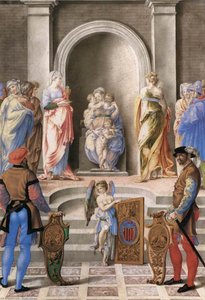 The Three Theological Virtues
 Holy Family with Santa Isabel and San Juanito1556
 Pages from the Farnese Hours1538
Essäer om Pietà
 Masterpieces of Giotto: The Top 25 Essential Artworks of the Renaissance PioneerExplore Giotto's greatest masterpieces and his role in the Renaissance. Discover the full collection online at OriginalUniqueArt.com.
 Mastering Color and Light: The Timeless Brilliance of Titian's Venetian MasterpiecesExplore the luminous mastery of Titian. Discover how the Venetian master revolutionized color and light through breathtaking Renaissance te…
 Michelangelo Buonarroti: A Renaissance Titan – Life, Works & Enduring LegacyExplore the life, works & enduring legacy of Michelangelo Buonarroti, a Renaissance titan. Discover his iconic sculptures, frescoes, and ar…