Baroque Landscape
Landscape (Gillis Van Coninxloo)
Gillis Van Coninxloo (1544–1607) skapade Landscape. Det tillhör Baroque Landscape-rörelsen. Den är utförd i Oil On Copper. Verket finns bevarat på Museo del Prado i Madrid, Spanien. Måtten är 24 × 19 cm.
- Oil On Copper
- 24 × 19 cm
- Museo del Prado, Madrid

 Förhandsvisa

 Handmålad oljemålning
 Skicka
 Dela
 Faktablad


 Ladda ner
 Liknande objekt
 Röntgen
 Bildspel
 Frågor och svar

 Statistik
Landscape i korthet
- Titel
- Landscape
- Konstnär
- Gillis Van Coninxloo (1544–1607)
- Konstnär född i
- Antwerpen, Belgien
- Material
- Oil On Copper
- Mått
- 24 × 19 cm
- Utställningsplats
- Museo del Prado, Madrid, Spanien
- Rörelse
- Baroque Landscape
- Motiv
- landscape, flemish style, baroque art, forest scene, castle architecture, atmospheric perspective
Vad föreställer Landscape?
A Flemish Master’s Woodland Reverie: Gillis van Coninxloo's “Landscape”
Gillis van Coninxloo’s “Landscape,” a captivating oil on copper panel, transports the viewer to a realm of serene contemplation within a meticulously rendered Flemish forest. Painted around 1598, this work stands as a pivotal example of the artist’s mastery in capturing the atmospheric depth and intricate detail characteristic of the early 16th-century Golden Age. More than just a depiction of nature, it's an invitation to lose oneself within a carefully constructed world of light, shadow, and subtle symbolism – a testament to van Coninxloo’s profound understanding of both landscape painting and the human experience.
The scene unfolds before us with remarkable realism. A dense thicket of trees dominates the foreground, their leaves rendered with an almost obsessive attention to detail; each vein, each curl of bark, is painstakingly observed and faithfully reproduced. These trees aren’t merely static elements; they create a palpable sense of depth, drawing the eye into the heart of the forest. Beyond them, a modest collection of buildings – likely farmhouses or small dwellings – nestles amongst the foliage, suggesting a quiet rural existence. The architecture is understated yet solid, reflecting a pragmatic approach to building within this natural setting. In the distance, a formidable castle rises above the horizon, its imposing silhouette anchoring the composition and hinting at notions of power, protection, and perhaps even isolation.
The Alchemy of Light and Shadow: Technique and Style
Van Coninxloo’s technical skill is immediately apparent in his masterful use of oil on copper. This medium allowed for a remarkable level of detail and luminosity – the surface retains a subtle sheen that enhances the richness of the colors and creates an almost three-dimensional effect. The artist employs a technique known as “chiaroscuro,” skillfully manipulating light and shadow to sculpt the forms and create a dramatic sense of depth. Notice how the sunlight filters through the trees, dappling the ground in pools of brightness while simultaneously casting deep shadows beneath the foliage. This interplay of light and dark isn’t merely decorative; it imbues the scene with a palpable atmosphere – a feeling of both tranquility and mystery.
Stylistically, “Landscape” aligns itself with the Flemish tradition of landscape painting, yet van Coninxloo departs from some of the more rigid conventions of the time. While influenced by the Northern Mannerist style—characterized by its emphasis on detail and symbolic imagery—he introduces a greater sense of naturalism and emotional resonance. The composition is carefully balanced, creating a harmonious whole that invites contemplation. The muted color palette – dominated by greens, browns, and grays – contributes to the overall feeling of serenity and timelessness.
A Window into 16th-Century Life and Belief
To fully appreciate “Landscape,” it’s important to consider its historical context. Painted during a period of religious upheaval and political instability in the Netherlands, this work reflects both the anxieties and the enduring values of the era. The castle, for instance, can be interpreted as a symbol of authority – whether representing secular power or divine protection. The humble dwellings nestled within the forest suggest a connection to the land and a reverence for rural life. Furthermore, the dense woodland itself has long been associated with themes of solitude, introspection, and the spiritual realm.
Interestingly, this painting was originally housed in the Museo del Prado in Madrid, Spain, a testament to its enduring appeal across national boundaries. The artist’s biography reveals a fascinating journey – from Antwerp to Germany and eventually Amsterdam—reflecting the shifting political landscape of the time. His work served as a bridge between artistic styles, incorporating elements of Mannerism while embracing the burgeoning realism of the Dutch Golden Age.
A Timeless Masterpiece: Reproduction and Inspiration
Reproductions of “Landscape” capture only a fraction of its original impact. The subtle nuances of light, texture, and atmosphere are difficult to replicate fully, but OriginalUniqueArt’s hand-painted reproductions strive to honor the artist's vision with remarkable fidelity. This piece offers an exceptional opportunity for interior designers seeking to evoke a sense of tranquility and connection to nature – imagine it adorning a study or a living room, providing a focal point that invites contemplation. Collectors will find “Landscape” to be a valuable addition to any art collection, representing a significant moment in the history of Flemish landscape painting.
For further exploration, we encourage you to visit the linked resources:
Vilket museum har Landscape?
Museo del Prado
Madrid, Spanien
Museo del Prados historia Ursprunget till Museo del Prado är djupt sammanflätat med den spanska kungliga samlingen och sträcker sig tillbaka till 1700-talet. Det som en gång tog sin början som en vision för ett naturhistoriskt kabinett under Ferdinand VII, kom så småningom att transformeras till ett heligt fristad för måleri och skulptur. Denna förvandling omvandlade ett vetenskapligt projekt till ett arkiv för den spanska kronans mest betydelsefulla skatter.


Högupplösta bilder av Landscape
Allmän egendom: konstnären avled 1607.
Gillis Van Coninxloo, Landscape, Museo del Prado. Allmän egendom
Frågor om Landscape besvarade
Var kan man se "Landscape" av Gillis Van Coninxloo utställd idag?
Originalet av "Landscape" av Gillis Van Coninxloo finns på Museo del Prado, Madrid, Spanien. En reproduktion gör det möjligt att visa verket i hemmet.
Vilken teknik användes för "Landscape" av Gillis Van Coninxloo?
"Landscape" av Gillis Van Coninxloo är utförd i Oil On Copper. Reproduktionerna strävar efter att återge teknikens särpräglade utseende.
Vilka är måtten på originalet av "Landscape"?
De registrerade måtten för "Landscape" av Gillis Van Coninxloo är 24 x 19 cm. Reproduktioner kan beställas i andra storlekar med bibehållna proportioner.
Vad föreställer "Landscape" av Gillis Van Coninxloo?
"Landscape" av Gillis Van Coninxloo föreställer: landscape, flemish style, baroque art, forest scene, castle architecture, atmospheric perspective, detailed rendering.
Är "Landscape" fri från upphovsrätt?
Upphovsrättslig status för "Landscape" av Gillis Van Coninxloo: verket är allmän egendom – upphovsrätten har löpt ut. Detta avgör om reproduktioner av bilden får framställas fritt.
Vem har skapat "Landscape"?
"Landscape" tillskrivs Gillis Van Coninxloo.
Vilken konstnärlig inriktning tillhör "Landscape" av Gillis Van Coninxloo?
"Landscape" är ett verk inom Baroque Landscape. Denna stilriktning anger den konstnärliga tradition som verket tillhör.
Vilken period av Gillis Van Coninxloos karriär tillhör "Landscape"?
"Landscape" representerar Gillis Van Coninxloos Late Baroque.
Är "Landscape" av Gillis Van Coninxloo fri från upphovsrätt, och varför?
"Landscape" av Gillis Van Coninxloo är allmän egendom – upphovsrätten har löpt ut. Upphovsrätten beräknas utifrån konstnärens dödsår, och Gillis Van Coninxloo avled år 1607.
Om konstnären, Gillis Van Coninxloo
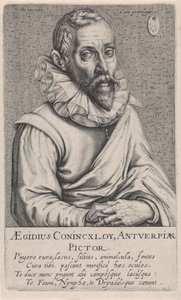
1544–1607, Belgien
Gillis Van Coninxloo
En mästare av det gröna riket Gillis Van Coninxloo står som en central gestalt i utvecklingen av nordligt landskapsmåleri, och fungerar som en livsviktig bro mellan de intrikata manieristiska traditionerna och den framväxande atmosfäriska djupet i den tidiga barocken. Han föddes i Antwerpen, Belgien, och hans liv var djupt sammanflätat med de lågländers rika konstnärliga arv. Som son till en målare växte han upp i en värld där hantverksskicklighet och naturobservation var av yttersta vikt. Hans tidiga utbildning under mästare som Pieter Coecke van Aelst den yngre och Lenaert Kroes gav honom en rigorös grund, men det var tiden i Gillis Mostaerts verkstad som verkligen lät hans talang blomstra, vilket gjorde det möjligt för honom att bidra till professionella verk samtidigt som han förfinade sin unika vision.
Om Gillis Van Coninxloo Betydande verk av Gillis Van Coninxloo
Andra verk av Gillis Van Coninxloo
 Jonah Preaching to the Ninevites1583
 Woodland with Saint Jerome1583
 Landscape with the judgment of Midas1598
 Landscape with the Judgement of Paris1610
Essäer om Landscape
 Masterpieces of Jan van Goyen: Top 25 Iconic Dutch LandscapesExplore 25 iconic Jan van Goyen landscapes from the Dutch Golden Age. Discover these tonal masterpieces on OriginalUniqueArt.com.
 Chiaroscuro & Shadows: The High-Impact Power of Moonlight in Masterpiece LandscapesMaster the drama of chiaroscuro and moonlight in classical landscapes. Explore the power of light and shadow now.
 Masterpieces of Nature: The Top 25 Artworks by Jacob van RuisdaelExplore 25 iconic Jacob van Ruisdael landscapes. Discover the soul of Dutch Golden Age art. Explore the full collection online at OriginalU…