

 Förhandsvisa
 Skicka
 Dela
Dela
 Visa detaljer

 Ladda ner
 Liknande objekt
 Röntgen
 Bildspel
 Statistik
James Monroe
 Oil On Canvas
- WallArt
- Neoclassical
 1820
1820- 19th Century
 102.0 x 81.0 cm
 Metropolitan Museum of Art
 Visa mer
Handgjord oljereproduktion
Handmålad olja på duk i din valda storlek och ram, tillverkad efter beställning av våra konstnärer. ( Byt till tryck Byt till digital bild)




P118B $10

P118H $10

P118W $10

P438Z $10

P508JH $12

P508YH $12

P805H $10

P805Z $10

P919BZ $10

P919G $10

P919XJ $10

P959ZH $10

P968JZ $12

W106C $8

W218G $10

W218JH $8

W218Y $10

W307PJ $10

W316G $10

W316PJ $8

W316Y $10

W398PJ $8

W4111J $10

W500HY $15

W500JH $15

W692G $12

W849H $8

W940BG $15

W953PJ $8




Välj bland våra förinställda storlekar som motsvarar konstverkets ursprungliga proportioner.

Du kan ange egna mått för att passa en specifik ram eller yta. Om den valda storleken inte matchar originalbildens proportioner kommer vi antingen att beskära konstverket eller utöka målningen med ytterligare handmålade element. En digital skiss skickas till dig för godkännande innan produktionen påbörjas.
Observera att förhandsvisningen på skärmen inte återspeglar den faktiska beskärningen eller utökningen. Endast skissen visar den slutgiltiga kompositionen korrekt.
Även om anpassade storlekar är möjliga, rekommenderar vi att du väljer en dimension från den fördefinierade listan för att bevara originalproportionerna.
Efter beställning kommer OriginalUniqueArt.com team att mejla kunden för instruktioner och tillhandahålla en skissförhandsvisning
Leverans över hela världen () på 3–4 veckor istället för standard 5 veckor. (8 september). Inga kompromisser med kvaliteten.

Fri expressfrakt över hela världen

Högkvalitativ linnecanvas

Fullständig fraktförsäkring

Garantier för återbetalning av tullavgifter

Garantier för exakt färgåtergivning

100 dagars returrätt (endast vid defekter)

100% pengarna tillbaka-garanti

Mängdrabatt erbjuds
 Glasalternativet är endast tillgängligt i storlekar under 110 cm.

James Monroe
Reproduktionsmedium
Storlek på reproduktion
-


Slutgiltigt pris
$ 300
A Portrait of American Statesmanship: James Monroe
To gaze upon this portrait of James Monroe is to encounter not merely a likeness, but an embodiment of early American political gravitas. Gilbert Stuart Newton captured the fifth President of the United States in a moment that feels both intensely personal and monumentally public. The composition itself speaks volumes about the era's reverence for its leaders; it is a carefully constructed tableau designed to convey authority, intellect, and enduring national character. Monroe, depicted here with his characteristic beard and formal attire, sits amidst symbols of governance—the scattered books and papers upon the desk suggest a mind perpetually engaged in weighty matters of state.
The Allure of Stuart's Technique and Style
Newton masterfully channels the grand tradition established by his celebrated forebear, Gilbert Stuart. The technique employed here is one of polished realism blended with an almost theatrical grandeur. Notice the handling of the drapery; the billowing fabric, particularly the strong, pure red curtain behind him, serves as more than mere backdrop—it is a dramatic foil that pushes the figure forward into the viewer's space. This strategic use of color, coupled with Stuart’s signature ability to capture the sitter in a three-quarter pose, gives the portrait an immediate sense of dynamism despite its formal setting. It is a visual echo of the grand Neoclassical style, updated for the burgeoning American republic.
Historical Resonance and Symbolism
The year 1820 places this work at a pivotal juncture in American history. Monroe’s career was marked by significant diplomatic achievements, culminating shortly after this painting's completion with the issuance of the famous Monroe Doctrine. The inclusion of these elements—the scholarly clutter, the statesmanlike bearing—are not accidental details; they are symbolic anchors rooting the man to his historical moment. The portrait invites us to contemplate the weight of presidential duty and the intellectual currents that shaped a young nation’s destiny. It is an artifact steeped in the narrative of American self-determination.
Bringing History Home: Decorating with Legacy
For the discerning collector or interior designer, this reproduction offers more than just wall art; it offers a conversation piece imbued with cultural weight. The rich tones, dominated by that commanding red, pair beautifully with traditional library settings, formal drawing rooms, or executive offices seeking an infusion of historical elegance. Owning this piece allows one to curate an environment that speaks of enduring taste and deep appreciation for the arts and history. It is a timeless statement, bridging the formality of 19th-century portraiture with the sophisticated demands of modern interior design.
Konstnärsbiografi
Gilbert Stuart Newton: Life & Legacy
Early Life and Family Background
- Birth and Origins: Gilbert Stuart Newton was born on September 2, 1795, in Halifax, Nova Scotia. He was the youngest of twelve children.
- Family Connections: His father, Henry Newton, was a customs official, and his mother, Ann, held a significant artistic lineage – she was the daughter of Gilbert Stuart, the renowned American portrait painter.
- Early Years & Return to America: The family initially resided in Boston but returned to Charlestown near Boston in 1803 following his father’s death.
Artistic Training and Influences
- Initial Path & Uncle's Guidance: Though initially intended for a commercial career, Newton was apprenticed to his uncle, Gilbert Stuart, marking the beginning of his artistic journey.
- European Studies: He traveled to Europe with an elder brother and studied painting in Florence. Later visits to Paris (1817) introduced him to artists like Charles Robert Leslie, Washington Allston, and David Wilkie.
- Royal Academy & Formal Training: Newton continued his education at the Royal Academy in London after a period spent in the Netherlands.
Artistic Style and Major Themes
- Romantic Sensibilities: Newton’s work is generally categorized within the Romantic movement, characterized by emotional intensity and dramatic narratives.
- Literary & Poetic Inspirations: He became particularly known for paintings inspired by literature and poetry. Subjects drawn from works like *Don Quixote* and Shakespeare were prominent in his oeuvre.
- Portraiture & Genre Scenes: While he painted portraits, including those of notable figures such as Washington Irving, Newton also excelled in genre scenes depicting moments from literary narratives.
Key Achievements and Recognition
- Royal Academy Affiliation: Newton was elected an Honorary Academician of the National Academy of Design (1827), an Associate of the Royal Academy (1829), and a full Academician in 1832.
- Exhibitions & Patronage: He regularly exhibited at the Royal Academy from 1818 onwards, gaining recognition and attracting patrons like the Marquis of Lansdowne.
- Public Collections: His works found their way into prominent public collections, including the National Gallery and the South Kensington Museum (now V&A).
Later Life and Legacy
- Mental Health & Final Years: Shortly after his election to the Royal Academy, Newton began to suffer from mental illness. He was admitted to an asylum at Chelsea where he continued to paint until his death on August 5, 1835.
- Burial Site: He is buried in St Mary’s Church Wimbledon, London.
- Historical Significance: Though overshadowed by his uncle Gilbert Stuart, Newton carved a niche for himself as a skilled and imaginative artist of the Romantic period. His literary-inspired paintings offer insights into the cultural tastes and artistic trends of 19th-century Britain.

gilbert stuart newton
1795 - 1835
Kortfakta
- Birth_Date: 1795
- Birth_Place: Halifax, Nova Scotia
- Death_Date: 1835
- Influenced_By: Gilbert Stuart (uncle)
- Movement: Romanticism
- Name: Gilbert Stuart Newton
- Nationality: British
- Notable_Works:
- Don Quixote in his Study
- Captain Macheath upbraided by Polly and Lucy
- Yorick and the Grisette
- The Window or the Dutch Girl
- Portia and Bassanio
Relaterade artiklar

Grant Wood & American Regionalism: Identity, Myth & the Rural Landscape
Explore the world of Grant Wood & American Regionalism with OriginalUniqueArt. Discover the symbolism behind 'American Gothic', recurring themes, and the movement's lasting impact on art history. High-quality reproductions available.

Georges Braques 25 Mästerverk: En Konsthistorisk Resa för Hemmet
Utforska Georges Braques 25 mest ikoniska verk – en resa genom kubismens värld och fransk modern konst. Lär känna historien bakom mästerverken, tekniken & färglärorna. Köp högkvalitativa konsttryck på OriginalUniqueArt.com.

Charles Willson Peale: Portraiture, Enlightenment Ideals & Shaping American Identity
Explore the life & art of Charles Willson Peale – Revolutionary portraitist, scientist, and founder of America’s first museum. Discover his iconic paintings of Washington & the Enlightenment ideals that shaped a nation.

Georges Seurat: Topp 25 mästerverk – Impressionismens ljus och vetenskap i din konstsamling
Utforska Georges Seurats 25 mest ikoniska verk! Fördjupa dig i impressionismens ljus, pointillismens teknik och fransk konsthistoria. Hitta inspiration & museumkvalitativa konsttryck för ditt hem på OriginalUniqueArt.com.
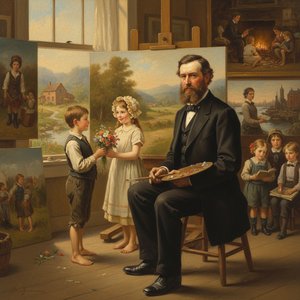
John George Brown: Capturing American Life & Sentiment in 19th-Century Genre Painting
Explore the captivating genre paintings of John George Brown, celebrated for his realistic depictions of 19th-century American life. Discover his legacy & find museum-quality reproductions at OriginalUniqueArt.