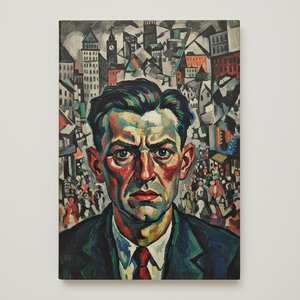
Oljemålning
 Allt om Moritz







































 För konstverk eller reproduktioner som är större än 105 cm (cirka 41 tum) på någon sida, levereras ramen som ett isärplockat kit. Denna metod säkerställer en trygg leverans och förhindrar skador under transport.


The Ethereal Gaze: Unveiling Gerhard Richter’s Moritz
In the vast landscape of contemporary art, few works possess the haunting, quiet power of Gerhard Richter’s Moritz. Painted in 2000, this masterpiece serves as a profound meditation on the fragility of existence and the elusive nature of memory. At first glance, the viewer is met with the intimate image of a young child, whose open mouth and expressive features suggest a moment of raw, unfiltered emotion—perhaps a cry or a sudden gasp of wonder. Yet, to look at Moritz is to realize that we are not merely observing a portrait, but rather witnessing a dissolution of reality itself. The subject does not sit firmly within the frame; instead, he seems to emerge from and recede into a dreamlike haze, inviting the observer into a space where the boundaries between the tangible world and the subconscious begin to blur.
The brilliance of this work lies in Richter’s unparalleled mastery of his signature "photographic painting" technique. By utilizing a photograph as his foundational source, Richter bridges the gap between the objective truth of the lens and the subjective emotion of the brush. He applies multiple layers of translucent oil washes, meticulously scraping and smudging the surface to create a mottled, atmospheric texture. This deliberate blurring mimics the visual phenomenon of "white noise" or the way a memory loses its sharp edges over time. For the discerning collector or interior designer, this technique offers a unique aesthetic versatility; the painting possesses a soft-focus elegance that brings a sense of depth and sophisticated mystery to any curated space, acting as a focal point that rewards prolonged, contemplative study.
A Symphony of Contrast and Historical Resonance
Beyond its technical virtuosity, Moritz is steeped in a complex historical and emotional subtext. Richter’s life, shaped by the fractured landscapes of post-war Germany and the shadows of the National Socialist regime, informs the very soul of his practice. There is an inherent tension within this piece—a struggle between the vividness of the child's presence and the encroaching abstraction that threatens to swallow him. The striking use of a deep red background provides a dramatic, visceral contrast to the soft, pale tones of the infant’s skin, injecting a pulse of vitality into the composition. This color choice does more than provide depth; it evokes a sense of warmth, passion, and perhaps even the underlying vulnerability of life itself.
For those seeking to integrate fine art into a modern living environment, Moritz offers an unparalleled emotional resonance. It is a work that transcends mere decoration, functioning instead as a window into the human condition. It speaks to the universal experiences of innocence, change, and the inevitable passage of time. Whether placed in a minimalist gallery setting or a richly textured study, this reproduction captures the essence of Richter’s ability to turn a fleeting moment into an eternal inquiry. To own a piece of this caliber is to possess a fragment of art history—a profound invitation to pause, to look closer, and to find beauty within the beautiful uncertainty of being.
Frågor och svar
Är Moritz handmålat eller tryckt?
Handmålad: en utbildad konstnär kopierar Moritz i olja på linnecanvas.
Vilken storlek bör jag välja för Moritz?
Originalet har måtten 62 x 52 cm. Storlekarna sträcker sig från 34.5 x 28.9 cm (Skr1978) till 240.1 x 201.2 cm (Skr17524); tabellen på denna sida listar de huvudsakliga storlekarna och deras priser.
Hur lång leveranstid är det?
Leveransen tar 4 till 5 veckor med kostnadsfri expressfrakt över hela världen; ett alternativ för snabbare produktion erbjuds på denna sida. Du kan returnera verket inom 100 dagar för full återbetalning, utan några villkor.
Vilket medium använde Gerhard Richter för Moritz?
Oil On Canvas
 Förhandsvisa

 Skicka
 Dela
 Visa detaljer
 Faktablad


 Ladda ner
 Liknande objekt
 Röntgen
 Bildspel
 Frågor och svar

 Statistik