- Hem

- Tryck på duk
- Gerard van Honthorst
- The steadfast philosopher
 Preview
 Beställ målning Köp högupplöst digital bild
 Skicka
 Dela
Dela
 Visa detaljer
 Lägg till i favoriter

 Ladda ner
 Liknande objekt
 Röntgen
 Bildspel
The steadfast philosopher


 Visa mer
Giclée / Konsttryck
Giclée- eller canvasprint av museumskvalitet med snabb produktion och flexibla ytbehandlingsalternativ.




P118B $10

P118H $10

P118W $10

P438Z $10

P508JH $12

P508YH $12

P805H $10

P805Z $10

P919BZ $10

P919G $10

P919XJ $10

P959ZH $10

P968JZ $12

W106C $8

W218G $10

W218JH $8

W218Y $10

W307PJ $10

W316G $10

W316PJ $8

W316Y $10

W398PJ $8

W4111J $10

W500HY $15

W500JH $15

W692G $12

W849H $8

W940BG $15

W953PJ $8




Välj bland våra förinställda storlekar som motsvarar konstverkets ursprungliga proportioner.

Du kan ange egna mått för att passa en specifik ram eller yta. Om det valda måttet inte överensstämmer med originalbildens proportioner kommer vi antingen att beskära konstverket eller utöka bilden med en speglad eller enfärgad kant. En digital mockup skickas för ditt godkännande innan produktionen påbörjas.
Vänligen notera att förhandsvisningen på skärmen inte återspeglar den faktiska beskärningen eller utökningen. Endast mockuppen visar den slutgiltiga kompositionen korrekt.
Även om anpassade storlekar är möjliga, rekommenderar vi att du väljer ett mått från den fördefinierade listan för att bevara de ursprungliga proportionerna.
Leverans över hela världen () på 2 veckor istället för standard 4/5 veckor. (23 juli)

Fri expressfrakt över hela världen

Högkvalitativ linnecanvas

Fullständig fraktförsäkring

Garantier för återbetalning av tullavgifter

Garantier för exakt färgåtergivning

60 dagars returrätt (endast vid fabrikationsfel)

100% pengarna tillbaka-garanti

Mängdrabatt erbjuds
 Glasalternativet är endast tillgängligt i storlekar under 110 cm.

The steadfast philosopher
Giclée / Konsttryck
Storlek på reproduktion
-


Slutgiltigt pris
-
Beskrivning av samlarobjektet
The Steadfast Philosopher: A Window into Honthorst's Baroque Intimacy
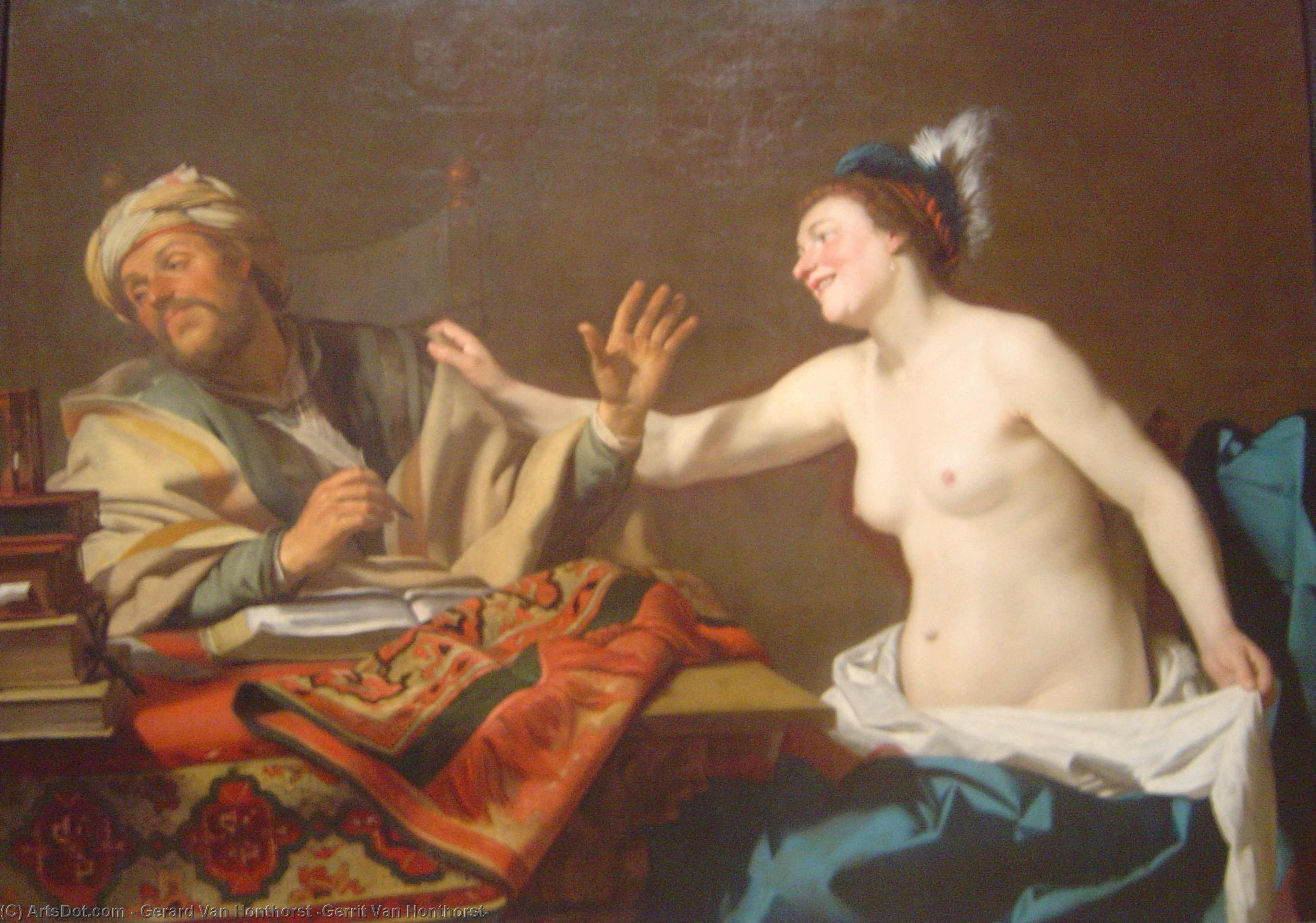
Gerard van Honthorst’s “The Steadfast Philosopher” is not merely a portrait; it’s an immersion into the heart of 17th-century Dutch life, rendered with a dramatic intensity that speaks to the era’s fascination with light and shadow – a hallmark of what became known as ‘Gherardo delle Notti,’ or Gerard of the Nights. This captivating scene depicts a private moment of intellectual exchange between a man and woman, their figures bathed in a carefully orchestrated chiaroscuro that draws the viewer into their intimate world. The painting’s power lies not just in its subject matter – a conversation potentially blossoming into something more – but in Honthorst's masterful manipulation of light to evoke a palpable sense of desire and contemplation.
Honthorst, deeply influenced by Caravaggio’s revolutionary use of tenebrism, employed this technique with precision. Notice how the strong directional light illuminates the man’s turbaned head and beard, drawing immediate attention to his intellectual presence, while simultaneously casting the woman in a softer, more ambiguous glow. This deliberate contrast heightens the scene's dramatic tension and underscores the painting’s sensual undertones. The inclusion of scattered books – open to specific pages – subtly reinforces the theme of knowledge and discourse, suggesting that this is not simply a depiction of physical attraction but also an exchange of ideas.
A Masterclass in Baroque Composition
The composition itself is meticulously constructed, reflecting the prevailing principles of Baroque art. The figures are arranged within a shallow space, creating a sense of immediacy and drawing the viewer into the scene. The table acts as a visual anchor, grounding the composition while simultaneously suggesting a space for interaction and reflection. Honthorst’s use of perspective – subtly employed to create depth – further enhances the illusion of realism, making the figures appear almost tangible. The woman's pose, with her hand resting lightly on the table, invites the viewer into this intimate tableau, fostering a sense of voyeuristic curiosity and admiration for the scene’s quiet drama.
Symbolism and Context: Utrecht Caravaggisti
“The Steadfast Philosopher” is a prime example of Honthorst's work within the Utrecht Caravaggisti school. This group, centered in Utrecht, was profoundly influenced by Caravaggio’s dramatic style, particularly his use of dark backgrounds and intense lighting. Their paintings often depicted scenes of everyday life – brothel scenes, philosophical discussions, and intimate gatherings – imbued with a heightened sense of emotion and realism. The inclusion of the blue cloth covering the woman's breasts is significant; while potentially provocative in its time, it also aligns with Baroque artistic conventions that frequently explored themes of beauty, sensuality, and the human form. The books themselves symbolize knowledge, wisdom, and perhaps even the pursuit of enlightenment – elements central to the philosophical nature of the scene.
Emotional Impact & Reproduction Value
Ultimately, “The Steadfast Philosopher” transcends a simple portrait; it’s an evocative exploration of human connection, intellectual curiosity, and the allure of the unknown. Honthorst's ability to capture such nuanced emotion through light and composition is what makes this painting so enduringly captivating. A hand-painted reproduction of this artwork offers a unique opportunity to bring this Baroque masterpiece into your home or office – a stunning addition that will undoubtedly spark conversation and inspire contemplation, mirroring the original’s profound emotional impact.
Konstnärsbiografi
A Master of Light and Shadow: The Life and Art of Gerard van Honthorst
Gerard van Honthorst emerged from Utrecht in 1592, a pivotal figure poised to illuminate the Dutch Golden Age with his dramatic artistry. Initially guided by his father, a decorative painter, young Gerard’s talent blossomed under the tutelage of Abraham Bloemaert, establishing a solid foundation in draftsmanship and composition. However, it was a transformative journey to Rome that irrevocably altered the course of his artistic development. There, amidst the fervent energy of the Italian Baroque, he encountered the groundbreaking work of Caravaggio – an encounter that would define his signature style and earn him the evocative nickname “Gherardo delle Notti,” or Gerard of the Nights. The dramatic use of *tenebrism*, a technique employing stark contrasts between light and dark, became Honthorst’s hallmark, imbuing his canvases with a palpable sense of drama and emotional intensity. He wasn't merely imitating Caravaggio; he was translating the Italian master’s innovations into a distinctly Dutch sensibility, focusing on intimate scenes illuminated by artificial light sources – candles, lamps, and fires – creating an atmosphere both realistic and deeply theatrical. This mastery over light wasn’t simply technical skill; it was a means of revealing character, of drawing the viewer into the emotional core of each scene. Honthorst's early works in Rome showcased this talent brilliantly, capturing the bustling streets and shadowy interiors with remarkable realism and psychological insight.Early Life and Artistic Training
Gerard van Honthorst was born in Utrecht, the son of a decorative painter, and received his initial artistic training from his father. This foundation provided him with a strong grounding in draftsmanship and composition – essential skills for any aspiring artist. However, it was Abraham Bloemaert, a respected master painter in Utrecht, who truly nurtured Honthorst’s talent, guiding him through the intricacies of perspective, color theory, and anatomical accuracy. Bloemaert's influence shaped Honthorst’s early style, characterized by a meticulous attention to detail and a classical sensibility. Yet, it was the decision to travel to Italy around 1616 that proved to be the catalyst for his artistic transformation. This journey marked a pivotal moment in his career, exposing him to the revolutionary techniques of the Italian Baroque and setting him on a path toward developing his unique style. The vibrant colors, dramatic lighting, and emotionally charged scenes of Caravaggio’s paintings profoundly impacted Honthorst's approach to art.The Roman Period: Influence and Innovation
Honthorst’s time in Rome was marked by considerable success and patronage. He quickly established himself as a talented painter, attracting the attention of wealthy collectors and influential figures within the city’s artistic circles. Notably, he found favor amongst Vincenzo Giustiniani, for whom he created the powerful “Christ Before the High Priest,” a work that exemplifies his masterful command of light and shadow. This painting, now residing in London’s National Gallery, showcases not only his technical skill but also his ability to convey profound psychological depth within his figures. Honthorst's exposure to Caravaggio’s radical style—particularly his use of *chiaroscuro*—was transformative. He didn’t simply copy Caravaggio; he adapted and refined the Italian master’s innovations, imbuing them with a distinctly Dutch sensibility. His paintings often featured intimate scenes illuminated by candlelight or lamplight, creating an atmosphere of both realism and theatrical drama. This period saw Honthorst develop his signature style—a blend of classical restraint and Baroque dynamism—that would define his career.Return to the Netherlands and Royal Commissions
Upon returning to Utrecht around 1620, Honthorst quickly established himself as a leading portrait painter in the Dutch Republic. His ability to capture not just physical likeness but also the character and social standing of his sitters made him highly sought after by wealthy merchants, nobles, and even royalty. He became president of the Guild of St. Luke in Utrecht in 1623, a testament to his growing influence within the artistic community. This period saw a flourishing of commissions, allowing Honthorst to refine his style and establish a distinctive voice within Dutch painting. He also undertook significant projects for the court, including elaborate ceiling paintings depicting allegorical scenes—a skill that demonstrated both his technical prowess and his understanding of symbolism. His willingness to collaborate with other artists, such as Rembrandt van Rijn, further solidified his position as a leading figure in the Dutch art world.Legacy and Artistic Significance
Gerard van Honthorst’s influence resonated far beyond his lifetime. He was a key figure in the *Utrecht Caravaggisti* movement – a group of Dutch painters who embraced Caravaggio's dramatic realism and *tenebrism*. Alongside artists like Hendrick ter Brugghen and Dirck van Baburen, he helped to establish a distinctly Dutch interpretation of Italian Baroque style. His emphasis on genre scenes illuminated by artificial light, his masterful portraits, and his ability to convey emotional depth through skillful use of chiaroscuro left an indelible mark on the development of Dutch Golden Age painting. Even his brother, Willem van Honthorst, followed in his footsteps, though often with works initially misattributed to Gerard due to stylistic similarities. His paintings continue to captivate audiences today, offering a glimpse into the dramatic and emotionally charged world he created. He cemented his place as a pivotal figure in art history, demonstrating how artistic influences can be both transformative and uniquely adapted to a new cultural context.
Gerard van Honthorst
1590 - 1656 , Nederländerna
Kortfattad information
- Artistic Movement Or Style: Barock, Caravaggism
- Artists Or Movements Influenced By This Artist: ['Utrechts Caravaggisti']
- Artists Who Influenced This Artist: ['Caravaggio']
- Date Of Birth: 1590
- Date Of Death: 1656
- Full Name: Gerard van Honthorst
- Nationality: Nederländsk
- Notable Artworks:
- Kristus för Hövdingen
- Födelsen i Florens
- Place Of Birth: Utrecht, Nederländerna


