

 Visa i rummet
 Skicka
 Dela
Dela
 Detaljer
 Studentguide för konstverk

 Ladda ner
 Liknande objekt
 Röntgen
 Bildspel
 Besökstatistik
Convival Fellow
 Oil On Canvas
- WallArt
- Baroque
 1624
1624 84.0 x 67.0 cm
 Ermitaget
 Läs mer
Handgjord oljereproduktion
Handmålad olja på duk i din valda storlek och ram, tillverkad efter beställning av våra konstnärer. ( Byt till tryckta exemplar Byt till digital bildförsäljning)




































Välj bland våra förinställda storlekar som motsvarar konstverkets ursprungliga proportioner.

Du kan ange egna mått för att passa en specifik ram eller yta. Om den valda storleken inte matchar originalbildens proportioner kommer vi antingen att beskära konstverket eller utöka målningen med ytterligare handmålade element. En digital skiss skickas till dig för godkännande innan produktionen påbörjas.
Observera att förhandsvisningen på skärmen inte återspeglar den faktiska beskärningen eller utökningen. Endast skissen visar den slutgiltiga kompositionen korrekt.
Även om anpassade storlekar är möjliga, rekommenderar vi att du väljer en dimension från den fördefinierade listan för att bevara originalproportionerna.
Efter beställning kommer OriginalUniqueArt.com team att mejla kunden för instruktioner och tillhandahålla en skissförhandsvisning
Leverans över hela världen () på 3–4 veckor istället för standard 5 veckor. (12 oktober). Inga kompromisser med kvaliteten.

Fri expressfrakt över hela världen

Högkvalitativ linnecanvas

Fullständig fraktförsäkring

Garantier för återbetalning av tullavgifter

Garantier för exakt färgåtergivning

100 dagars returrätt vid fabrikationsfel

100% pengarna tillbaka-garanti

Mängdrabatt erbjuds
 Glasalternativet är endast tillgängligt i storlekar under 110 cm.

Convival Fellow
Tryckteknik
Reproduktionsstorlek
-


Totalpris
Skr 2910
A Master of Light and Shadow: The Life and Art of Gerard van Honthorst
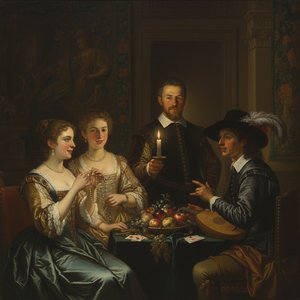
Gerard van Honthorst arrived on the artistic stage of Utrecht in 1592, a young man already imbued with an innate talent destined to become synonymous with the brilliance of the Dutch Golden Age. His father’s influence as a decorative painter instilled him with foundational skills in draftsmanship and compositional planning – a grounding that would prove invaluable as he pursued his own artistic vision. Yet, it was a pilgrimage to Rome that truly catalyzed his creative evolution, propelling him into the epicenter of Baroque fervor and introducing him to the revolutionary aesthetic championed by Caravaggio. This encounter proved transformative, etching onto Honthorst’s artistic psyche the indelible mark of tenebrism – a technique characterized by breathtaking contrasts between illumination and darkness – forever shaping his distinctive style and earning him the memorable moniker “Gherardo delle Notti,” or Gerard of the Nights. The influence of Caravaggio was profound; Honthorst wasn't merely attempting to emulate his predecessor’s dramatic flair but absorbing its core principles, prioritizing emotional impact above all else. He skillfully harnessed tenebrism, layering light and shadow with meticulous precision to generate an atmosphere brimming with palpable drama and psychological depth. This stylistic choice wasn’t arbitrary; it reflected the broader artistic currents of the era – a desire to convey profound emotion through visual representation—a pursuit that resonated deeply within Honthorst's artistic sensibilities.- Subject Matter: The artwork depicts a young man passionately engaged in playing the violin, capturing a moment of focused concentration and artistic expression.
- Style: Honthorst’s style firmly anchors itself within Baroque realism, prioritizing meticulous detail and an unwavering commitment to portraying human likeness with remarkable accuracy.
- Technique: Employing smooth brushstrokes and masterful blending techniques, he achieved a stunning illusion of volume and texture—a testament to his technical prowess. Oil paints were applied to canvas, creating a rich surface that faithfully reproduces the nuances of light and shadow.
Frågor och svar
Vilken form och vilka mått har "Convival Fellow" av Gerard van Honthorst?
"Convival Fellow" av Gerard van Honthorst har proportionerna hos ett Portrait-verk på 84 x 67 cm.
Hur laddar jag ner bilden av "Convival Fellow" av Gerard van Honthorst?
En nedladdning finns tillgänglig för "Convival Fellow": verkets Ladda ner-sida erbjuder en högupplöst digital bildnedladdning.
Hur förhåller sig stilen i "Convival Fellow" till sin skapares epok?
"Convival Fellow" av Gerard van Honthorst placeras inom Baroque-rörelsen, under sin skapares Tidig modern tid-era.
Vilken är den emotionella tonen i "Convival Fellow" av Gerard van Honthorst?
"Convival Fellow" förknippas med en Dramatic känsla. Den emotionella tonen beskriver det intryck som verket förmedlar.
Kan jag beställa en oljereproduktion av "Convival Fellow"?
Du kan beställa en handmålad reproduktion av "Convival Fellow" av Gerard van Honthorst direkt på denna sida: en handmålad oljereproduktion på linneväv, tillverkad efter beställning.
Vilka är måtten på originalet av "Convival Fellow" av Gerard van Honthorst?
"Convival Fellow" mäter 84 x 67 cm i sin originalform. Originalmåtten är en bra referens när du väljer storlek på en reproduktion.
Vem är konstnären bakom "Convival Fellow"?
"Convival Fellow" skapades av Gerard van Honthorst. Informationen på denna sida beskriver Gerard van Honthorsts originalverk.
Vilken stil tillhör "Convival Fellow"?
"Convival Fellow" är ett verk inom Baroque. Denna stilriktning anger den konstnärliga tradition som verket tillhör.
Om konstnären
A Master of Light and Shadow: The Life and Art of Gerard van Honthorst
Gerard van Honthorst emerged from Utrecht in 1592, a pivotal figure poised to illuminate the Dutch Golden Age with his dramatic artistry. Initially guided by his father, a decorative painter, young Gerard’s talent blossomed under the tutelage of Abraham Bloemaert, establishing a solid foundation in draftsmanship and composition. However, it was a transformative journey to Rome that irrevocably altered the course of his artistic development. There, amidst the fervent energy of the Italian Baroque, he encountered the groundbreaking work of Caravaggio – an encounter that would define his signature style and earn him the evocative nickname “Gherardo delle Notti,” or Gerard of the Nights. The dramatic use of *tenebrism*, a technique employing stark contrasts between light and dark, became Honthorst’s hallmark, imbuing his canvases with a palpable sense of drama and emotional intensity. He wasn't merely imitating Caravaggio; he was translating the Italian master’s innovations into a distinctly Dutch sensibility, focusing on intimate scenes illuminated by artificial light sources – candles, lamps, and fires – creating an atmosphere both realistic and deeply theatrical. This mastery over light wasn’t simply technical skill; it was a means of revealing character, of drawing the viewer into the emotional core of each scene. Honthorst's early works in Rome showcased this talent brilliantly, capturing the bustling streets and shadowy interiors with remarkable realism and psychological insight.Early Life and Artistic Training
Gerard van Honthorst was born in Utrecht, the son of a decorative painter, and received his initial artistic training from his father. This foundation provided him with a strong grounding in draftsmanship and composition – essential skills for any aspiring artist. However, it was Abraham Bloemaert, a respected master painter in Utrecht, who truly nurtured Honthorst’s talent, guiding him through the intricacies of perspective, color theory, and anatomical accuracy. Bloemaert's influence shaped Honthorst’s early style, characterized by a meticulous attention to detail and a classical sensibility. Yet, it was the decision to travel to Italy around 1616 that proved to be the catalyst for his artistic transformation. This journey marked a pivotal moment in his career, exposing him to the revolutionary techniques of the Italian Baroque and setting him on a path toward developing his unique style. The vibrant colors, dramatic lighting, and emotionally charged scenes of Caravaggio’s paintings profoundly impacted Honthorst's approach to art.The Roman Period: Influence and Innovation
Honthorst’s time in Rome was marked by considerable success and patronage. He quickly established himself as a talented painter, attracting the attention of wealthy collectors and influential figures within the city’s artistic circles. Notably, he found favor amongst Vincenzo Giustiniani, for whom he created the powerful “Christ Before the High Priest,” a work that exemplifies his masterful command of light and shadow. This painting, now residing in London’s National Gallery, showcases not only his technical skill but also his ability to convey profound psychological depth within his figures. Honthorst's exposure to Caravaggio’s radical style—particularly his use of *chiaroscuro*—was transformative. He didn’t simply copy Caravaggio; he adapted and refined the Italian master’s innovations, imbuing them with a distinctly Dutch sensibility. His paintings often featured intimate scenes illuminated by candlelight or lamplight, creating an atmosphere of both realism and theatrical drama. This period saw Honthorst develop his signature style—a blend of classical restraint and Baroque dynamism—that would define his career.Return to the Netherlands and Royal Commissions
Upon returning to Utrecht around 1620, Honthorst quickly established himself as a leading portrait painter in the Dutch Republic. His ability to capture not just physical likeness but also the character and social standing of his sitters made him highly sought after by wealthy merchants, nobles, and even royalty. He became president of the Guild of St. Luke in Utrecht in 1623, a testament to his growing influence within the artistic community. This period saw a flourishing of commissions, allowing Honthorst to refine his style and establish a distinctive voice within Dutch painting. He also undertook significant projects for the court, including elaborate ceiling paintings depicting allegorical scenes—a skill that demonstrated both his technical prowess and his understanding of symbolism. His willingness to collaborate with other artists, such as Rembrandt van Rijn, further solidified his position as a leading figure in the Dutch art world.Legacy and Artistic Significance
Gerard van Honthorst’s influence resonated far beyond his lifetime. He was a key figure in the *Utrecht Caravaggisti* movement – a group of Dutch painters who embraced Caravaggio's dramatic realism and *tenebrism*. Alongside artists like Hendrick ter Brugghen and Dirck van Baburen, he helped to establish a distinctly Dutch interpretation of Italian Baroque style. His emphasis on genre scenes illuminated by artificial light, his masterful portraits, and his ability to convey emotional depth through skillful use of chiaroscuro left an indelible mark on the development of Dutch Golden Age painting. Even his brother, Willem van Honthorst, followed in his footsteps, though often with works initially misattributed to Gerard due to stylistic similarities. His paintings continue to captivate audiences today, offering a glimpse into the dramatic and emotionally charged world he created. He cemented his place as a pivotal figure in art history, demonstrating how artistic influences can be both transformative and uniquely adapted to a new cultural context.
Gerard van Honthorst
1590 - 1656 , Nederländerna
Snabbfakta
- Artistic Movement Or Style: Barock, Caravaggism
- Artists Or Movements Influenced By This Artist: ['Utrechts Caravaggisti']
- Artists Who Influenced This Artist: ['Caravaggio']
- Date Of Birth: 1590
- Date Of Death: 1656
- Full Name: Gerard van Honthorst
- Nationality: Nederländsk
- Notable Artworks:
- Kristus för Hövdingen
- Födelsen i Florens
- Place Of Birth: Utrecht, Nederländerna
Relaterade artiklar
Gerard van Honthorst: Illuminating the Dutch Golden Age with Caravaggism & Courtly Grace
Explore the captivating world of Gerard van Honthorst, a Dutch Golden Age master renowned for his dramatic chiaroscuro & courtly portraits. Discover his life, art, and lasting influence on Baroque painting.

Nederländsk Guldålder: Topp 10 mästerverk som definierade epoken – konst & heminredning
Utforska de 10 ikoniska mästerverken från den nederländska guldåldern! Lär känna Rembrandt, Vermeer och Hals – deras teknik & berättelser. Hitta konsttryck och inspiration för din heminredning på OriginalUniqueArt.com. Upptäck hela samlingen online!

Golden Age Reflections: Dutch Baroque Painting & Cultural Innovation
Explore the Dutch Golden Age of painting! Discover key artists like Vermeer & ter Borch, their innovative techniques, and the rich cultural context behind these Baroque masterpieces. Learn about collecting & appreciating this iconic art period.

Nederländsk Barock: Topp 10 Mästerverk som Definierade Epoken – Konst & Inredning
Upptäck de 10 ikoniska mästerverken som definierade nederländsk barock! Lär känna Rembrandt, Vermeer och andra stora konstnärer. Hitta inspiration & museumkvalitativa reproduktioner på OriginalUniqueArt.com – för ditt hem eller din samling.

Golden Light & Dutch Skies: The Timeless Magic of Dutch Golden Age Landscapes
Discover the breathtaking beauty of Dutch Golden Age landscapes. Explore the mastery of light, chiaroscuro, and 17th-century realism through an expert art history lens, celebrating the enduring legacy of the Dutch Masters for discerning collectors and art lovers.
