
 Förhandsvisa
 Skicka
 Dela
Dela
 Visa detaljer
 Guide
Guide

 Ladda ner
 Liknande objekt
 Röntgen
 Bildspel
 Frågor och svar
 Statistik
Landscape

- 45.0 x 38.0 cm


 Visa mer
Giclée / Konsttryck
Giclée- eller canvasprint av museumskvalitet med snabb produktion och flexibla ytbehandlingsalternativ. ( Beställ handmålad reproduktion Byt till digital bild)




P118B Skr10

P118H Skr10

P118W Skr10

P438Z Skr10

P508JH Skr12

P508YH Skr12

P805H Skr10

P805Z Skr10

P919BZ Skr10

P919G Skr10

P919XJ Skr10

P959ZH Skr10

P968JZ Skr12

W106C Skr8

W218G Skr10

W218JH Skr8

W218Y Skr10

W307PJ Skr10

W316G Skr10

W316PJ Skr8

W316Y Skr10

W398PJ Skr8

W4111J Skr10

W500HY Skr15

W500JH Skr15

W692G Skr12

W849H Skr8

W940BG Skr15

W953PJ Skr8




Välj bland våra förinställda storlekar som motsvarar konstverkets ursprungliga proportioner.

Ange den bredd och höjd du behöver för att passa din ram eller vägg. Ett tryck kan endast beskäras, aldrig göras större än originalbilden, vilket innebär att ett format med en annan proportion leder till att en del av bilden går förlorad. Vi skickar en digital mockup för godkännande innan vi påbörjar tryckningen. Bilden som visas på denna sida visar inte den faktiska beskärningen — det är endast mockuppen som gör det.
Leverans över hela världen () på 2 veckor istället för standard 4/5 veckor. (4 november)

Fri expressfrakt över hela världen

Högkvalitativ linnecanvas

Fullständig fraktförsäkring

Garantier för återbetalning av tullavgifter

Garantier för exakt färgåtergivning

100 dagars returrätt (endast vid fel)

100% pengarna tillbaka-garanti

Mängdrabatt erbjuds
 Glasalternativet är endast tillgängligt i storlekar under 110 cm.

Landscape
Giclée / Konsttryck
Storlek på reproduktion
-


Slutgiltigt pris
Skr 810
A Window on the Soul: George Howland Beaumont’s ‘Landscape’
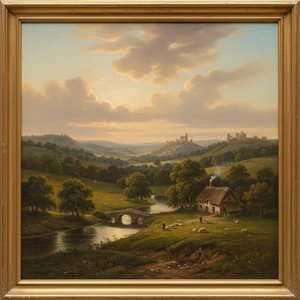
George Howland Beaumont's “Landscape,” painted in 1825, isn’t merely a depiction of a rural scene; it’s an invitation into a world steeped in Romantic sensibility and a profound appreciation for the natural world. This oil on canvas transports us to a tranquil valley, bathed in the soft light of a late afternoon, where the subtle interplay of color and form speaks volumes about the artist's vision and his deep connection to the English countryside.
Beaumont, a prominent figure in British art during the early 19th century, was more than just an amateur painter; he was a dedicated collector and connoisseur. His journey through Italy ignited a passion for the Old Masters, particularly the landscapes of Claude Lorrain and other Baroque masters. This influence is strikingly evident in “Landscape,” where the composition echoes classical principles – a balanced arrangement of elements, a sense of depth achieved through atmospheric perspective, and an emphasis on harmonious color palettes. The painting’s roots lie firmly within the Romantic movement, but Beaumont tempered its more dramatic tendencies with a refined elegance and a meticulous attention to detail.
The Language of Light and Color
Beaumont masterfully employs light as his primary tool, creating a sense of luminous serenity. Notice how he captures the diffuse glow filtering through the trees, casting long shadows that dance across the foreground. The color palette is restrained yet rich – predominantly blues and greens dominate, punctuated by earthy browns and ochres in the distant hills. These colors aren’t applied with brute force; instead, they are layered delicately to build depth and atmosphere. The artist's use of glazing techniques—thin layers of translucent paint—allows light to penetrate through the surface, giving the scene an almost ethereal quality.
A key element is the subtle rendering of texture. The rough bark of the central tree, the undulating contours of the hills, and even the suggestion of grass beneath the figures are all conveyed with remarkable sensitivity. Beaumont’s brushstrokes aren't overtly expressive; they are controlled and deliberate, contributing to the painting’s overall sense of quiet contemplation.
Figures in a Pastoral Setting
Two figures, positioned near the base of the large tree, add a touch of human presence to this otherwise solitary landscape. Their postures suggest an activity—perhaps a simple task or a moment of shared observation—but their identities remain deliberately ambiguous. They aren’t presented as heroes or protagonists; rather, they are integrated seamlessly into the scene, serving as reminders of humanity's place within the vastness of nature. This subtle inclusion invites viewers to contemplate their own relationship with the natural world.
The placement of these figures also contributes to the painting’s sense of depth and perspective. They appear smaller in scale than the towering tree, reinforcing the impression of a distant horizon and emphasizing the grandeur of the landscape. The composition guides the eye through the scene, drawing us into the heart of the valley.
A Legacy of Romantic Vision
“Landscape” stands as a testament to George Howland Beaumont’s artistic skill and his profound appreciation for the beauty of the English countryside. It embodies the core tenets of the Romantic movement—a reverence for nature, an emphasis on emotion and imagination, and a fascination with the sublime. Beaumont's work continues to resonate today, offering viewers a moment of tranquility and a reminder of the enduring power of art to capture the essence of our world.
Reproductions of this piece offer a wonderful opportunity to bring this evocative landscape into your home or office, allowing you to experience its beauty and serenity firsthand. Consider framing it in a classic style to complement its timeless appeal.
Frågor och svar
Är "Landscape" av George Howland Beaumont fri från upphovsrätt?
När det gäller upphovsrätt är "Landscape" allmän egendom – upphovsrätten har löpt ut.
Vilket rum rekommenderas för "Landscape" av George Howland Beaumont, med tanke på dess färger?
De Earthy färgerna i "Landscape" av George Howland Beaumont harmonierar med det rekommenderade rummet: ett Living Room.
Vilken känsla förmedlar färgerna i "Landscape" av George Howland Beaumont?
Den Earthy färgpaletten i "Landscape" av George Howland Beaumont harmonierar med dess Melancholic emotionella ton. Färg är ett av de sätt som ett verk förmedlar känsla på.
Konstnärsbiografi
A Life Dedicated to Art: The World of George Howland Beaumont
Sir George Howland Beaumont, born in 1753 amidst the tranquil Essex countryside of Great Dunmow, was a figure whose life embodied the evolving tastes and passions of late 18th and early 19th-century Britain. Inheriting both a baronetcy and an estate at a young age, Beaumont’s path wasn't immediately destined for artistic pursuits. However, his education at Eton College included initial training in landscape painting under Alexander Cozens, sparking a lifelong fascination with the visual arts—a fascination that would ultimately define his entire existence. This early exposure served as a crucial catalyst, shaping his aesthetic sensibilities and propelling him toward a vocation far grander than mere inheritance.Cultivating Taste: Collection, Patronage, and Artistic Development
Upon his return to England after undertaking the transformative Grand Tour in 1782 alongside Margaret—a journey that irrevocably altered his worldview—Beaumont embarked on establishing an impressive collection of Old Master paintings. Driven by genuine passion despite considerable financial constraints, he recognized that collecting wasn’t merely accumulating objects; it was embarking upon a quest for understanding—a deliberate effort to immerse oneself in the artistic achievements of previous generations. Central to this ambition was Claude Lorrain’s *A Landscape with Hagar and the Angel*, a painting that resonated deeply within Beaumont's soul, becoming an emblem of his idealized aesthetic vision. He meticulously curated his collection, prioritizing works embodying technical mastery and conveying profound emotional resonance—a testament to his discerning eye and unwavering commitment to artistic excellence. Simultaneously, Beaumont actively engaged in exhibiting his own paintings at the Royal Academy from 1794 to 1825, securing a respected position within London’s vibrant art circles. His social life flourished alongside these artistic endeavors, centered around his residence at 34 Grosvenor Square and punctuated by service as Tory MP for Beer Alston (1790-1796)—a role that afforded him access to influential intellectual currents shaping the era's artistic landscape. Beaumont’s stylistic influences included Richard Wilson and Thomas Hearne—artists who championed Romanticism, prioritizing expressive emotion and capturing the sublime grandeur of nature. He particularly admired John Constable’s ability to convey atmospheric depth and psychological insight—a connection solidified by Beaumont’s generous patronage and his encouragement of Constable's artistic development.A Vision for Public Access: The Founding of the National Gallery
Beaumont’s contribution to British art history transcends mere artistic production; it resides in his visionary advocacy for public access to cultural treasures. Recognizing a critical deficiency—the absence of a dedicated institution showcasing Old Master paintings—he championed the establishment of the National Gallery with unwavering determination. In 1823, Beaumont proffered an audacious proposal: he would donate sixteen paintings from his personal collection on condition that Parliament invest in constructing a suitable building for their display—a bold initiative that galvanized governmental support and ultimately culminated in the gallery’s triumphant opening in May 1824. This act wasn't driven solely by philanthropic impulse; it stemmed from Beaumont’s profound conviction that art possessed transformative potential—capable of elevating national consciousness and enriching the lives of all citizens. He envisioned a space where masterpieces could inspire contemplation, fostering dialogue about beauty and artistic merit—a legacy that continues to resonate today within the gallery’s walls and beyond.Notable Works & Artistic Legacy
Beaumont's oeuvre comprises several striking landscapes and portraits reflecting his stylistic preferences. Among these is *View near Keswick*, a masterful depiction of atmospheric grandeur executed in 1799, showcasing Constable’s influence—a testament to Beaumont’s willingness to nurture emerging talent. His meticulous attention to detail and expressive brushwork exemplify the Romantic aesthetic, prioritizing emotional intensity and capturing the sublime beauty of the natural world. Furthermore, Beaumont's unwavering dedication to preserving artistic heritage cemented his place as a pivotal figure in British cultural history—a legacy that extends far beyond his own creative output. He remains an enduring symbol of intellectual curiosity, artistic patronage, and the transformative power of shared cultural experience.
George Howland Beaumont
1753 - 1827 , Storbritannien
Kortfakta
- Artistic Movement Or Style: Romantik
- Artists Or Movements Influenced By This Artist: ['John Constable']
- Artists Who Influenced This Artist:
- Richard Wilson
- Thomas Hearne
- Date Of Birth: 1753
- Date Of Death: 1827
- Full Name: George Howland Beaumont
- Nationality: Britannien
- Notable Artworks:
- Landskap
- Broughton Castle
- Place Of Birth: Dunmow, United Kingdom
Relaterade artiklar

John Constables 25 Mästerverk: En Konstnärlig Resa i Det Engelska Landskapet | OriginalUniqueArt
Utforska John Constables 25 mest ikoniska målningar – romantikens mästare av det engelska landskapet. Upptäck historien, tekniken & skönheten i verk som 'Hay Wain'. Köp exklusiva konsttryck på OriginalUniqueArt.com.

Georges Seurat: Topp 25 mästerverk – Impressionismens ljus och vetenskap i din konstsamling
Utforska Georges Seurats 25 mest ikoniska verk! Fördjupa dig i impressionismens ljus, pointillismens teknik och fransk konsthistoria. Hitta inspiration & museumkvalitativa konsttryck för ditt hem på OriginalUniqueArt.com.

Georges Braques 25 Mästerverk: En Konsthistorisk Resa för Hemmet
Utforska Georges Braques 25 mest ikoniska verk – en resa genom kubismens värld och fransk modern konst. Lär känna historien bakom mästerverken, tekniken & färglärorna. Köp högkvalitativa konsttryck på OriginalUniqueArt.com.
George Barret the Elder: Pioneering British Pastoral Painting & Landscape's Rise
Explore the life & art of George Barret Sr., a pioneer of British pastoral painting. Discover his influence on Romantic landscape art, patronage, and collecting tips from OriginalUniqueArt.

Romantiska landskap: Topp 10 mästerverk som definierade en epok – OriginalUniqueArt.se
Utforska de 10 mest ikoniska mästerverken inom romantisk landskapsmålning! Lär känna Caspar David Friedrich, Turner & andra. Hitta inspiration och köp museumkvalitativa konsttryck på OriginalUniqueArt.com.