
 Visa i rummet
 Skicka
 Dela
Dela
 Detaljer
 Studentguide för konstverk

 Ladda ner
 Liknande objekt
 Röntgen
 Bildspel
 Besökstatistik
Violet and Gold
 Australian Impressionism
 1911
1911 72.0 x 130.0 cm
 Läs mer
Giclée / Konsttryck
Giclée- eller canvasprint av museumskvalitet med snabb produktion och flexibla ytbehandlingsalternativ. ( Köp handmålat konstverk Byt till digital bildförsäljning)




P118B Skr10

P118H Skr10

P118W Skr10

P438Z Skr10

P508JH Skr12

P508YH Skr12

P805H Skr10

P805Z Skr10

P919BZ Skr10

P919G Skr10

P919XJ Skr10

P959ZH Skr10

P968JZ Skr12

W106C Skr8

W218G Skr10

W218JH Skr8

W218Y Skr10

W307PJ Skr10

W316G Skr10

W316PJ Skr8

W316Y Skr10

W398PJ Skr8

W4111J Skr10

W500HY Skr15

W500JH Skr15

W692G Skr12

W849H Skr8

W940BG Skr15

W953PJ Skr8




Välj bland våra förinställda storlekar som motsvarar konstverkets ursprungliga proportioner.

Ange den bredd och höjd du behöver, för att passa din ram eller din vägg. Ett tryck kan endast beskäras, aldrig göras större än bilden, vilket innebär att ett format med en annan formform leder till att en del av bilden går förlorad. Vi skickar en digital mockup för godkännande innan vi trycker något. Bilden som visas på denna sida visar inte den faktiska beskärningen — det är endast mockuppen som gör det.
Leverans över hela världen () på 2 veckor istället för standard 4/5 veckor. (16 oktober)

Fri expressfrakt över hela världen

Högkvalitativ linnecanvas

Fullständig fraktförsäkring

Garantier för återbetalning av tullavgifter

Garantier för exakt färgåtergivning

100 dagars returrätt vid fabrikationsfel

100% pengarna tillbaka-garanti

Mängdrabatt erbjuds
 Glasalternativet är endast tillgängligt i storlekar under 110 cm.

Violet and Gold
Giclée / Konsttryck
Reproduktionsstorlek
-


Totalpris
Skr 786
The Painting's Composition
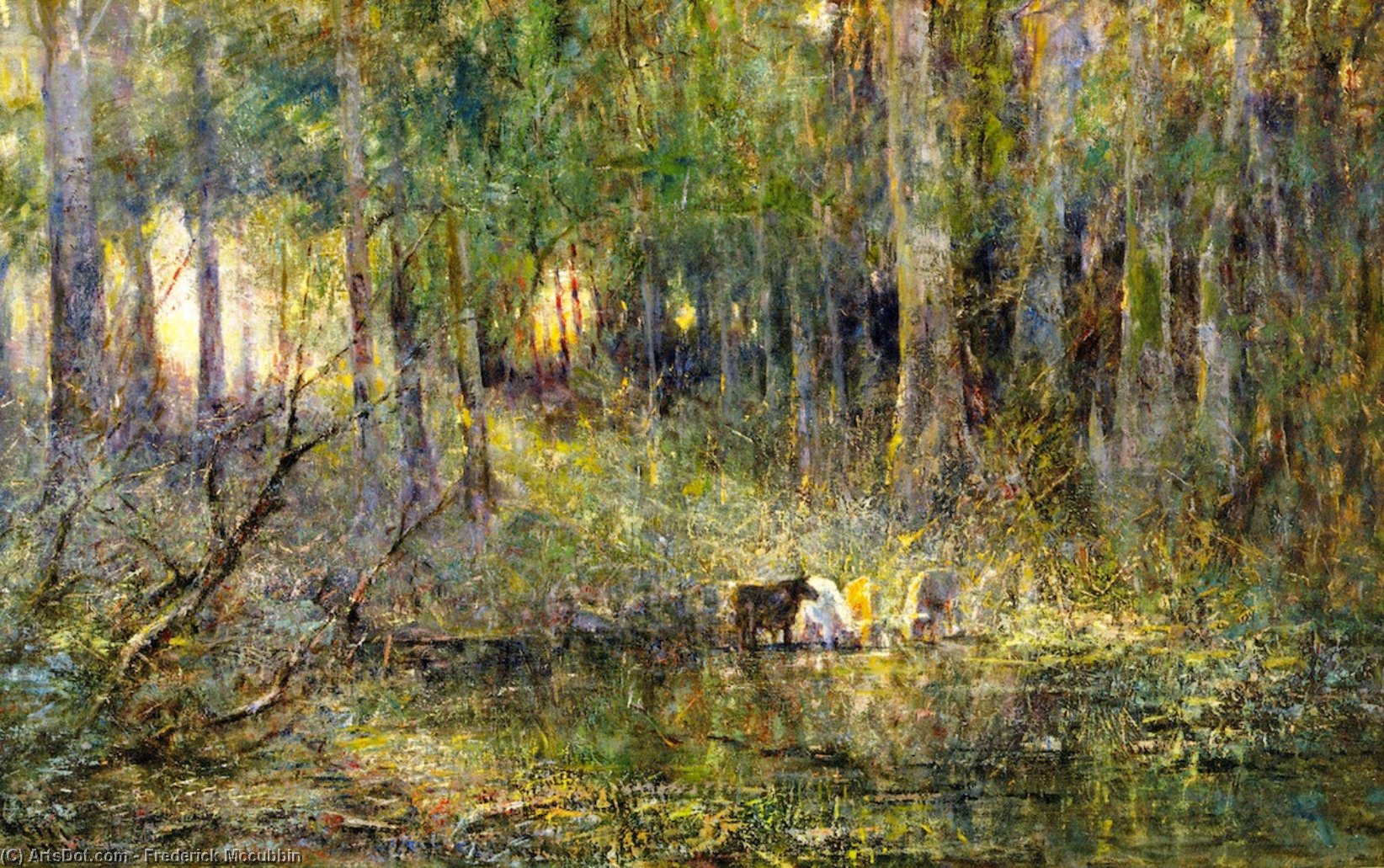
The painting measures 72 x 130 cm and features a serene forest setting. Two individuals are seated on the ground in front of trees, possibly enjoying each other's company or taking a break from their activities. Three dogs are also present in the image, one near the left side and two others closer to the right side of the painting. The overall atmosphere is peaceful, with humans and animals coexisting harmoniously within the natural environment.Color Palette and Technique
The colors used in Violet and Gold are rich and vibrant, adding depth and life to the scene. McCubbin's skillful use of oil on canvas creates a sense of texture and dimensionality, drawing the viewer into the tranquil world he has depicted.Artist's Background
Frederick McCubbin was an Australian artist known for his landscapes and portraits. His work often explored themes of nature and human interaction with the environment. Violet and Gold is a prime example of his ability to capture the beauty and serenity of the natural world.Other Notable Works by McCubbin
Some of McCubbin's other notable works include:Conclusion
Violet and Gold by Frederick McCubbin is a beautiful representation of nature, showcasing the artist's skill in capturing serene and peaceful scenes. The painting is a testament to McCubbin's contribution to Australian art and his ability to evoke emotions through his work. For those interested in exploring more about the National Gallery of Australia and its collections, visit The National Gallery of Australia, a Cultural Treasure.Frågor och svar
I vilken rörelse och i vilken epok kan "Violet and Gold" av Frederick McCubbin placeras?
"Violet and Gold" tillhör den Australian Impressionism rörelsen, och dess skapare verkade under talet-eran.
Hur förhåller sig motivet i "Violet and Gold" till Frederick McCubbins vanliga teman?
Frederick McCubbins återkommande teman inkluderar australian landscape art, rural life depiction", mccubbin's regional focus, nature and humanity, "simple, peaceful scenes", domestic tranquility, regional identity; "Violet and Gold" fokuserar på australian landscape, rural life painting, forest scene art, dogs in artwork, mccubbin’s style”, “violet and gold hues”, peaceful countryside”.
Är "Violet and Gold" av Frederick McCubbin ett ljust eller ett mörkt konstverk?
Den upplevda ljusstyrkan i "Violet and Gold" av Frederick McCubbin är balanced. Den kan anpassas efter ljuset i det avsedda rummet.
Om konstnären
A Life Rooted in the Australian Landscape
Frederick McCubbin, born in Melbourne on February 25th, 1855, stands as a cornerstone of Australian art, inextricably linked to the nation’s evolving identity and its unique visual language. His journey from humble beginnings – the son of bakers who instilled in him a strong work ethic – to becoming a pivotal figure in the Heidelberg School is a testament to his dedication and artistic vision. McCubbin's early life was marked by diverse experiences, working as a solicitor’s clerk and assisting in the family bakery before fully embracing his calling as a painter. These formative years, though seemingly disparate, imbued him with a deep understanding of everyday Australian life, a theme that would resonate profoundly throughout his oeuvre. He received foundational training at the National Gallery of Victoria's School of Design, studying under esteemed artists like Eugene von Guerard and George Folingsby, honing his skills in landscape painting while absorbing the prevailing artistic currents of the time. A crucial turning point arrived with his enduring friendship with Tom Roberts, a bond that would shape the course of Australian art history.Early Years and Artistic Foundations
McCubbin’s upbringing in Melbourne profoundly influenced his artistic sensibilities. Growing up amidst the bustling city and the quiet countryside instilled in him an appreciation for both urban dynamism and rural tranquility – themes that would permeate his paintings throughout his career. He began sketching at a young age, capturing scenes of Melbourne's streets and buildings with meticulous detail, demonstrating an early talent for observation and representation. His formal education included studies at William Willmett’s West Melbourne Common School and St Paul’s School, Swanston Street, where he developed a disciplined approach to artistic training. Crucially, his enrollment in the National Gallery of Victoria Art School under Eugene von Guerard and George Folingsby provided him with invaluable instruction in traditional landscape painting techniques—a foundation that would serve as inspiration for decades to come. The influence of Folingsby’s academic style is particularly evident in McCubbin's early works, characterized by careful composition and precise rendering.The Heidelberg School: Defining a National Aesthetic
A pivotal moment arrived with his collaboration with Tom Roberts, initiating a lifelong artistic partnership that would redefine Australian art. Together they established the Box Hill Artists’ Camp in 1885—a bold experiment in *plein air* painting—drawing inspiration from Impressionist masters like Jules Bastien-Lepage and Millet. This collective – soon joined by Arthur Streeton and Charles Conder – sought to capture the essence of Australian life and landscapes with unprecedented immediacy and authenticity, rejecting the rigid conventions of European academic art. They ventured into the bushland surrounding Melbourne, embracing the raw beauty and harsh realities of the Australian environment—a deliberate rejection of idealized representations favored in Europe at the time. McCubbin’s contributions during this period were instrumental in establishing a distinctly Australian aesthetic. Paintings like *Down on His Luck* (1889) and *On the Wallaby Track* (1896) exemplify this approach, depicting scenes of rural life with remarkable detail and capturing the subtle nuances of light and color—a stylistic hallmark of the Heidelberg School movement. The group’s aim was to portray Australia as it truly was: a land of both grandeur and hardship, inhabited by ordinary people grappling with daily challenges.Major Achievements and Artistic Legacy
McCubbin's artistic output spanned several decades, culminating in monumental history paintings that cemented his reputation as one of Australia’s most significant artists. *The Pioneer* (1904), depicting a lone shepherd tending to his flock amidst the vast Australian bush—a subject deeply rooted in folklore and national mythology—became an iconic image of Australian identity. Inspired by Turner's atmospheric landscapes, McCubbin embraced a looser brushstroke technique and explored tonal variations to convey mood and emotion—a stylistic shift that foreshadowed developments in European art at the time. His final paintings, produced in the years leading up to Federation, demonstrated a remarkable artistic maturity and continued engagement with themes of Australian life and landscape. Critics recognized his ability to capture the spirit of the bushland, portraying it not merely as scenery but as a reflection of human experience—a testament to McCubbin’s profound understanding of both art and culture. Frederick McCubbin's legacy continues to inspire artists today, ensuring that his vision of Australia—as a land of beauty, resilience, and enduring tradition—remains vividly present in the Australian artistic canon.
Frederick McCubbin
1855 - 1917 , Australien
Snabbfakta
- Artistic Movement Or Style: Heidelberg School
- Artists Who Influenced This Artist:
- Eugene von Guerard
- George Folingsby
- Date Of Birth: Feb 25, 1855
- Date Of Death: Dec 20, 1917
- Full Name: Frederick McCubbin
- Nationality: Australian
- Notable Artworks:
- On the Wallaby Track
- Down on His Luck
- The Pioneer
- Place Of Birth: Melbourne, Australia
Relaterade artiklar

Evocations of Place: A Historical Journey Through Landscape Art
Explore the rich history of landscape art with OriginalUniqueArt. Discover renowned artists, movements like Impressionism & Romanticism, and expert guidance for collecting timeless pieces. Find your perfect serene escape today!

Evoking Nature's Sublime: A Comprehensive Exploration of 19th-Century Landscape Painting
Explore the captivating world of 19th-century landscape painting! Discover renowned artists like Friedrich & Monet, key movements, and find the perfect artwork to bring nature's serenity into your home. Expert insights at OriginalUniqueArt.

John Constables 25 Mästerverk: En Konstnärlig Resa i Det Engelska Landskapet | OriginalUniqueArt
Utforska John Constables 25 mest ikoniska målningar – romantikens mästare av det engelska landskapet. Upptäck historien, tekniken & skönheten i verk som 'Hay Wain'. Köp exklusiva konsttryck på OriginalUniqueArt.com.

Romantiska landskap: Topp 10 mästerverk som definierade en epok – OriginalUniqueArt.se
Utforska de 10 mest ikoniska mästerverken inom romantisk landskapsmålning! Lär känna Caspar David Friedrich, Turner & andra. Hitta inspiration och köp museumkvalitativa konsttryck på OriginalUniqueArt.com.

Evocations of Place: A Historical Journey Through Landscape Art
Explore the rich history of landscape art with OriginalUniqueArt. Discover renowned artists, movements like Impressionism & tonalism, and expert guidance for collecting timeless pieces. Find your perfect serene escape today!
