Byt till tryck
 Visa mer







































 För konstverk eller reproduktioner som är större än 105 cm (cirka 41 tum) på någon sida, levereras ramen som ett isärplockat kit. Denna metod säkerställer en trygg leverans och förhindrar skador under transport.


A Symphony of Form and Fragmented Identity
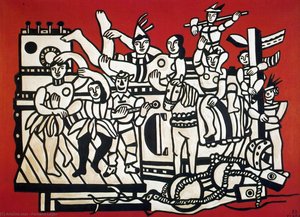
In the heart of 1942, amidst the profound shadows cast by the Second World War, Fernand Léger unveiled Plungers II, a work that serves as much more than a mere visual arrangement. It is an audacious declaration of artistic intent, a bold confrontation with the anxieties and aspirations of a world in flux. The composition centers around a group of individuals whose very essence seems to be undergoing a metamorphosis. Rather than traditional, soft anatomical renderings, Léger presents bodies fragmented into angular, geometric shapes, mirroring the relentless march of the machine age. There is a striking tension here; while the figures are composed of disjointed, mechanical-looking parts, they retain recognizable limbs—arms and legs that suggest a lingering human presence amidst the abstraction. This stylistic choice creates a captivating rhythm, where the boundaries between the organic human form and the industrial landscape begin to blur into a singular, pulsating energy.The Tactile Energy of the Machine Age
Léger, a sculptor by training, brought a unique, three-dimensional sensibility to his canvas, treating paint not just as color but as a physical substance. In Plungers II, this is achieved through a masterful use of thick impasto strokes that lend the surface a rugged, textural richness. The technique breathes life into the composition, providing a sense of movement and dynamism that reflects the industrial era's vitality. His palette is unapologetically bold, dominated by vibrant yellows, deep reds, and striking blues. These primary colors are applied with such vigor that they seem to vibrate against one another, creating a visual symphony that is both energetic and structured. The way these colors interact with the simplified, heavy contours of the figures creates a sense of weight and permanence, as if the subjects were forged in a foundry rather than painted on canvas. For the collector or interior designer, this interplay of color and texture offers a powerful focal point, capable of injecting a sense of modern strength and rhythmic vitality into any sophisticated space.An Enduring Legacy for the Modern Interior
To understand the emotional impact of Plungers II, one must look to its historical context. Created during a period of global upheaval, the painting captures the duality of the era: the fear of dehumanization through technology and the simultaneous awe of human progress. Léger eschewed the analytical coldness of early Cubism, opting instead for a lyrical approach that celebrates the beauty found within the mechanical. This makes the piece incredibly relevant for contemporary settings, where the intersection of humanity and digital or industrial advancement remains a central theme.For those seeking to curate an environment of intellectual depth and visual excitement, this reproduction offers:
- A profound connection to the avant-garde history of the twentieth century.
- A bold color palette that serves as a transformative element in modern decor.
- A sculptural texture that provides tactile interest and visual depth.
Frågor och svar
Vem är upphovspersonen till "Plungers II" och vilket år skapades verket?
"Plungers II" är skapad av Fernand Léger och daterad till 1942.
Hur gammal var Fernand Léger när hen skapade "Plungers II"?
Fernand Léger var 61 år gammal när hen skapade "Plungers II" år 1942. Åldern är beräknad utifrån konstnärens födelseår, 1881.
Vilken fas av Fernand Légers konstnärliga utveckling representerar "Plungers II"?
Inom Fernand Légers karriär tillhör "Plungers II" perioden Machine Age. Denna fas underlättar jämförelser med konstnärens övriga verk.
 Förhandsvisa
 Skicka
 Dela
Dela
 Visa detaljer
 Guide
Guide

 Ladda ner
 Liknande objekt
 Röntgen
 Bildspel
 Q&A
Q&A Statistik