Cubist Style
Mechanical Elements (Fernand Léger)
Fernand Léger (1881–1955) skapade Mechanical Elements. Det tillhör Cubist Style-rörelsen. Den är utförd i Oil On Canvas. Verket finns bevarat på Metropolitan Museum of Art i New York, USA.
- Oil On Canvas
- Metropolitan Museum of Art, New York

 Förhandsvisa

 Handmålad oljemålning
 Skicka
 Dela
 Faktablad


 Ladda ner
 Liknande objekt
 Röntgen
 Bildspel
 Frågor och svar

 Statistik
Mechanical Elements i korthet
- Titel
- Mechanical Elements
- Konstnär
- Fernand Léger (1881–1955)
- Konstnär född i
- Argentan, Frankrike
- Material
- Oil On Canvas
- Utställningsplats
- Metropolitan Museum of Art, New York, USA
- Rörelse
- Cubist Style
- Tidsperiod
- Modern
- Motiv
- mechanical elements, cubism, geometry, industrial design, abstraction, assemblage
Vad föreställer Mechanical Elements?
A Vision of Industrial Harmony
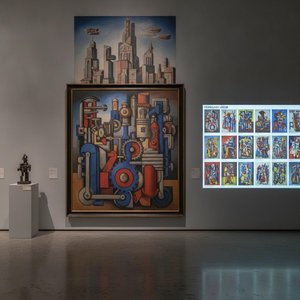
Fernand Léger’s “Mechanical Elements,” painted in 1924, stands as a striking testament to the burgeoning fascination with technology during the interwar period. More than just a depiction of gears and pipes—though undeniably prominent—the artwork embodies Léger's ambitious goal: to synthesize Cubist fragmentation with the dynamism of the machine age, creating an aesthetic that simultaneously challenged artistic conventions and reflected the transformative realities of modern life.
Born Joseph Fernand Henri Léger in Argentan, Normandy, 1881, Léger embarked on a journey from rural landscapes to the epicenter of Parisian avant-garde. Initially drawn to architecture, his artistic path swiftly pivoted toward painting after arriving in Paris around 1900, fueled by an unwavering conviction that art could engage with the complexities of its time.
Cubism Revisited: Geometric Precision
Léger’s stylistic evolution is inextricably linked to Cubism. Influenced profoundly by Picasso and Braque, he adopted the fractured perspective and simultaneous viewpoints characteristic of this revolutionary movement—a deliberate rejection of traditional representation in favor of exploring spatial relationships through geometric forms. However, Léger didn't simply replicate Cubist principles; he pushed them further, distilling them into a simplified vocabulary of circles, squares, and lines.
“Mechanical Elements” exemplifies this approach brilliantly. The canvas is dominated by interlocking geometric shapes—primarily circles and squares—arranged in a rhythmic pattern that evokes the precision and repetition found in industrial machinery. These forms aren’t merely decorative; they actively contribute to conveying a sense of movement and energy, mirroring the ceaseless pace of urban life.
Symbolism Beyond Mechanism
While the artwork's visual language speaks directly to the influence of technology, Léger imbued “Mechanical Elements” with deeper symbolic resonance. The repetition of geometric shapes isn’t merely a stylistic device; it represents an attempt to capture the impersonal logic and order inherent in industrial processes—a deliberate contrast to the organic forms favored by Impressionism and Post-Impressionism.
Furthermore, Léger's use of color – predominantly shades of gray punctuated by vibrant accents – underscores this thematic preoccupation. Gray symbolizes the materiality of metal and concrete, while bursts of color represent human vitality and creativity—a harmonious blend reflecting Léger’s belief that art could coexist with technological advancement without sacrificing beauty or emotional depth.
A Legacy of Innovation
"Mechanical Elements" cemented Léger's position as a pioneer of Tubism – a variant of Cubism developed by Léger himself—characterized by the use of tubular forms to represent objects and figures. This innovative technique anticipated developments in Pop Art decades later, demonstrating Léger’s enduring influence on subsequent generations of artists.
Today, reproductions of “Mechanical Elements” continue to captivate audiences with their bold aesthetic and intellectual ambition. They serve as a powerful reminder that art can not only reflect the spirit of its time but also actively shape our understanding of it—a timeless masterpiece celebrating both geometric precision and human resilience.
Vilket museum har Mechanical Elements?
Metropolitan Museum of Art
New York, USA
Ursprung och historia för Metropolitan Museum of Art Metropolitan Museum of Art föddes ur en vision som delades av en grupp affärsmän, finansmän samt ledande konstnärer och tänkare. Efter att institutionen bildades år 1870 sökte den efter ett permanent hem för att kunna hysa sina ständigt växande förvärv. Innan museet fann sin nuvarande plats hade det under en kort period vistats på Douglas Mansion-fastigheten på West 14th Street.


Högupplösta bilder av Mechanical Elements

Allmän egendom: konstnären avled 1955.
Andra storlekar, beskärningar och citering →Fernand Léger, Mechanical Elements, Metropolitan Museum of Art. Allmän egendom
Färgerna är matchade mot originalet av en digital expert och filen är noggrant retuscherad för att vara trogen konstnärens penseldrag.
Köp högupplöst filFrågor om Mechanical Elements besvarade
Vilket museum har originalet till "Mechanical Elements"?
Originalet av "Mechanical Elements" av Fernand Léger finns på Metropolitan Museum of Art, New York, USA. En reproduktion gör det möjligt att visa verket i hemmet.
Vilket medium är "Mechanical Elements" av Fernand Léger utförd i?
"Mechanical Elements" av Fernand Léger är utförd i Oil On Canvas. Reproduktionerna strävar efter att återge teknikens särpräglade utseende.
Vad föreställer "Mechanical Elements" av Fernand Léger?
"Mechanical Elements" av Fernand Léger föreställer: mechanical elements, cubism, geometry, industrial design, abstraction, assemblage, modern art.
Är bilden av "Mechanical Elements" av Fernand Léger fri att återge?
Upphovsrättslig status för "Mechanical Elements" av Fernand Léger: verket är allmän egendom – upphovsrätten har löpt ut. Detta avgör om reproduktioner av bilden får framställas fritt.
Vem är konstnären bakom "Mechanical Elements"?
"Mechanical Elements" skapades av Fernand Léger. Informationen på denna sida beskriver Fernand Légers originalverk.
Vilken konstnärlig inriktning tillhör "Mechanical Elements" av Fernand Léger?
"Mechanical Elements" av Fernand Léger tillhör Cubist Style-rörelsen. Denna rörelse ger det stilistiska sammanhanget för verket.
Vilken fas av Fernand Légers konstnärliga utveckling representerar "Mechanical Elements"?
"Mechanical Elements" representerar Fernand Légers Mechanical Period.
Vad förklarar upphovsrättssituationen för "Mechanical Elements" av Fernand Léger?
Upphovsrättsläget för "Mechanical Elements" - allmän egendom – upphovsrätten har löpt ut - baseras på konstnärens dödsår 1955.
Förvaras "Mechanical Elements" i sin konstnärs hemland?
Nej – konstverket förvaras utomlands. Fernand Léger föddes i Frankrike, och originalet av "Mechanical Elements" finns på ett museum i USA.
Om konstnären, Fernand Léger

1881–1955, Frankrike
Fernand Léger
Fernand Légers liv Berättelsen om Fernand Léger tar sin början i den lilla byn Argentan, belägen i Orne-regionen i Nedre Normandie. Han föddes den 4 februari 1881 som enda son. Hans tidiga år formades av den franska landsbygdens stillhet och närvaron av hans mor, Marie-Adèle Daunou. Hans far, en man som försörjde sig som boskapshandlare, gick bort när Fernand fortfarande var en liten pojke, vilket lämnade barnet att fostras av sin mor i ett hem präglat av hennes fromhet och en viss ödmjuk natur.
Andra verk av Fernand Léger
 Staden1919
 Arbetaren1920
 Tre kvinnor1921
 Nattbilder i skogen1910

Essäer om Mechanical Elements
 Cubism Unveiled: How Picasso and Braque Redefined Modern Art through Geometric RevolutionExplore the revolutionary world of Cubism. Discover how Pablo Picasso and Georges Braque dismantled perspective to redefine modern art thro…
 Mastering the Machine Age: The 25 Best Artworks by Fernand LégerImmerse yourself in the vibrant world of Fernand Léger. Explore 25 iconic masterpieces of Cubism and Tubism, from bold geometric forms to m…
 Industriell Estetik i Konsten: Topp 10 Verk för Hemmet & InspirationUtforska 10 ikoniska konstverk som fångar industriell estetik – från Munchs dramatik till Turners stormar. Lär känna historien bakom mäster…