

 Visa i rummet
 Skicka
 Dela
Dela
 Detaljer
 Studentguide för konstverk

 Ladda ner
 Liknande objekt
 Röntgen
 Bildspel
 Besökstatistik
Still Life


 Läs mer
Handgjord oljereproduktion
Handmålad olja på duk i din valda storlek och ram, tillverkad efter beställning av våra konstnärer. ( Byt till tryckta exemplar Byt till digital bildförsäljning)




P118B Skr10

P118H Skr10

P118W Skr10

P438Z Skr10

P508JH Skr12

P508YH Skr12

P805H Skr10

P805Z Skr10

P919BZ Skr10

P919G Skr10

P919XJ Skr10

P959ZH Skr10

P968JZ Skr12

W106C Skr8

W218G Skr10

W218JH Skr8

W218Y Skr10

W307PJ Skr10

W316G Skr10

W316PJ Skr8

W316Y Skr10

W398PJ Skr8

W4111J Skr10

W500HY Skr15

W500JH Skr15

W692G Skr12

W849H Skr8

W940BG Skr15

W953PJ Skr8




Välj bland våra förinställda storlekar som motsvarar konstverkets ursprungliga proportioner.

Ange den bredd och höjd du behöver för att passa din ram eller din vägg. Eftersom detta är handmålat kan konstnären vid en annan form måla lite mer runt bilden eller beskära den något – du väljer själv. Vi skickar en digital mockup för godkännande innan målningen påbörjas. Bilden som visas på denna sida representerar inte det slutgiltiga resultatet — det är endast mockuppen som visar det.
Efter beställning kommer OriginalUniqueArt.com team att mejla kunden för instruktioner och tillhandahålla en skissförhandsvisning
Leverans över hela världen () på 3–4 veckor istället för standard 5 veckor. (22 oktober). Inga kompromisser med kvaliteten.

Fri expressfrakt över hela världen

Högkvalitativ linnecanvas

Fullständig fraktförsäkring

Garantier för återbetalning av tullavgifter

Garantier för exakt färgåtergivning

100 dagars returrätt vid fabrikationsfel

100% pengarna tillbaka-garanti

Mängdrabatt erbjuds
 Glasalternativet är endast tillgängligt i storlekar under 110 cm.

Still Life
Tryckteknik
Reproduktionsstorlek
-


Totalpris
Skr 2972
A Moment Frozen in Time: Ferdinand Guillaimin’s “Still Life”
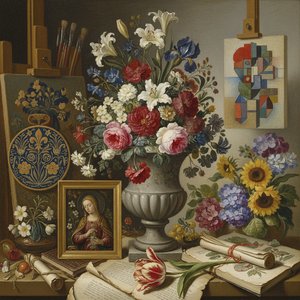
Ferdinand Guillaimin's "Still Life," painted in 1872, isn’t merely a depiction of objects arranged on a table; it’s a carefully constructed tableau brimming with quiet observation and subtle symbolism. This work, rendered in the heart of the Impressionist movement, captures a fleeting moment of domestic tranquility – a scene both familiar and imbued with an understated elegance. The painting immediately draws the eye to the central arrangement: a vase overflowing with vibrant red and yellow flowers, their petals seemingly caught mid-bloom, radiating warmth against the cooler tones that dominate the rest of the composition. Beside them rests a worn book, its pages hinting at untold stories and intellectual pursuits, while a simple bowl holds what appears to be fruit – perhaps apples or pears – adding another layer of earthly abundance.
Guillaimin’s technique is distinctly Impressionistic, prioritizing capturing the *impression* of light and color rather than precise detail. Loose brushstrokes dance across the canvas, creating an atmospheric haze that softens the edges of each object. He masterfully employs broken color – applying small dabs of paint side-by-side to build up hues and create a shimmering effect, particularly noticeable in the reflections on the table’s surface. The dark background serves not as mere backdrop but as a crucial element, intensifying the luminosity of the floral arrangement and lending the scene a sense of intimacy and depth. The artist's focus is less on photographic realism and more on conveying the *feeling* of being present within this quiet space.
The Context of Parisian Impressionism
To fully appreciate “Still Life,” it’s essential to understand the artistic climate in which Guillaimin was working. The 1870s were a period of profound change and experimentation for French art, marked by the rise of Impressionism. Artists like Monet, Renoir, and Pissarro sought to break free from the rigid conventions of academic painting, embracing plein air (outdoor) painting and capturing the ephemeral qualities of light and atmosphere. Guillaimin’s work reflects this spirit of innovation, moving away from traditional subject matter and exploring new ways of representing the world around him.
Guillaimin's connection to Pissarro is particularly noteworthy. The artist spent a significant period painting alongside Pissarro in Pontoise, a suburb of Paris, where he found inspiration in the everyday life of the region. This proximity fostered a collaborative environment, allowing Guillaimin to refine his style and develop his unique approach to capturing light and color. The Impressionists were not simply interested in depicting what they *saw*; they were driven by a desire to express their subjective experience of the world.
Symbolism and the Language of Objects
Beyond its aesthetic qualities, “Still Life” is rich with symbolic meaning. The flowers themselves represent beauty, fragility, and the fleeting nature of life – themes frequently explored in Impressionist art. The book suggests knowledge, contemplation, and a connection to the past. The bowl of fruit symbolizes abundance, nourishment, and the pleasures of earthly existence. Even the dark background can be interpreted as representing mortality or the unknown.
Guillaimin’s use of these objects is deliberate and carefully considered, inviting the viewer to engage in a process of interpretation. He doesn't offer explicit explanations; instead, he presents a series of interconnected symbols that resonate with universal themes of beauty, life, and death. The arrangement feels deliberately balanced, creating a harmonious composition that evokes a sense of peace and serenity.
A Legacy of Delicate Beauty
Ferdinand Guillaimin’s “Still Life” stands as a testament to the power of observation and the enduring appeal of simple subjects rendered with exquisite sensitivity. It's a painting that rewards close attention, revealing layers of meaning and emotional depth with each viewing. Reproductions capture much of the original atmosphere, but nothing quite replicates the subtle nuances of light and color that define Guillaimin’s masterful technique.
Today, this work is celebrated for its evocative beauty and its contribution to the development of Impressionism. It remains a poignant reminder of the quiet moments of everyday life – a timeless meditation on beauty, mortality, and the enduring power of art.
Frågor och svar
Vilken typ av färger används i "Still Life"?
"Still Life" av Ferdinand Guillaumin använder en Earthy färgpalett. Paletten sammanfattar verkets övergripande färgkaraktär.
Finns det verk som liknar "Still Life"?
Sidan Liknande verk för "Still Life" av Ferdinand Guillaumin presenterar relaterade konstverk.
Vem skapade "Still Life" och när?
Upphovsmannen till "Still Life" är Ferdinand Guillaumin, och verket är daterat 1872.
Om konstnären
early life and career
Ferdinand Guillaumin föddes i Paris år 1841 och började sin konstnärliga resa mitt i det vikande 1800-talet, då impressionismen tog sitt grepp om Frankrike. Hans ungdom var präglad av en tid då nya estetiska idéer utmanade den akademiska konsten och öppnade upp för spontana och subjektiva perspektiv på världen.
Han studerade vid École Supérieure des Beaux-Arts i Paris där han utvecklade sina färdigheter inom målning och grafik. Guillaumin fascinerades av landskapskonstens möjligheter att fånga ljusets flyktiga skönhet och atmosfär, vilket skulle komma att vara en återkommande tema i hans verk.
contribution to impressionism
Guillaumin blev medlem av Impressionistgruppen och arbetade aktivt för att främja denna nya konstnärliga rörelse. Han deltog i flera viktiga utställningar där han presenterade sina unika bilder och bidrog till att etablera impressionismen som en betydande kraft inom den europeiska konsten.
Hans målningar kännetecknas av användningen av ljusa färger och lösa penseldrag, vilket är typiskt för impressionistisk teknik. Han försökte skapa illusioner av naturligt ljus och atmosfär genom att använda olika tekniker och perspektiv.
notable works and associations
Guillaumin samarbetade nära med andra prominenta impressionister som Claude Monet och Camille Pissarro, vilket gav honom möjlighet att utveckla sin stil och påverka sina kollegor. Hans verk inkluderar landskap från Frankrike och Belgien samt några porträtt av familjemedlemmar och vänner.
Han är särskilt känd för sitt mästerverk "Garden in Janville in June", där han fångar ljuset och färgen på ett blomstrande trädgård i juni med en imponerande detaljrikedom. Detta målning anses vara ett av de bästa exemplen på impressionistisk landskapsmåleri.
legacy and remembrance
Ferdinand Guillaumin är en viktig figur inom den franska impressionismen och hans verk fortsätter att inspirera konstnärer och entusiaster än idag. Hans konst anses vara ett viktigt bidrag till utvecklingen av modern konst och hans stil har haft ett bestående inflytande på senare konstnärliga rörelser.
Hans målningar finns i flera museer över hela världen, inklusive Musée d’Orsay i Paris där de visas för offentligheten och uppmärksammas av konsthistoriker och besökare. Hans konst anses vara ett viktigt exempel på den romantiska estetiken och hans verk är värda att studeras och bevaras för kommande generationer.

Ferdinand Guillaumin
1841 - 1927 , Frankrike
Snabbfakta
- Artistic Movement Or Style: Impressionism
- Artists Who Influenced This Artist:
- Vincent van Gogh
- Claude Monet
- Paul Cézanne
- Date Of Birth: Februari 16, 1841
- Date Of Death: Juni 26, 1927
- Full Name: Jean Baptiste Armand Guillaumin
- Nationality: Fransk
- Notable Artworks:
- Trädgården i Janville i juni
- Landskapsbild
- Vy över Puy de Dôme
- Place Of Birth: Paris, Frankrike
Relaterade artiklar

Blossoms of Time: A Historical Journey Through Flower Painting
Explore the captivating history of flower painting! Discover Dutch masters, symbolic meanings, & botanical art. Expert insights & high-quality reproductions at OriginalUniqueArt.
Blossoming Symbolism: A Historical Journey Through Flowers in Western Painting
Explore the rich history of flower symbolism in Western painting! Discover how artists from the Renaissance to Modernism used blossoms to convey meaning, emotion & beauty. Learn about iconic artworks and movements.

Impressionismens Mästverk: Topp 10 Verk som Fångar Ögonblicket | OriginalUniqueArt
Upptäck impressionismens magi! Utforska 10 ikoniska verk av Monet, Renoir & Degas. Lär känna historien bakom mästerverken och hitta inspiration till din inredning med konsttryck från OriginalUniqueArt.com.

Silent Narratives: Exploring the Enduring Appeal of Still Life Painting Across Centuries
Explore the rich history of still life painting with OriginalUniqueArt. Discover Dutch Masters, decode vanitas symbolism & learn about collecting timeless art. Expert insights and museum-quality reproductions.

Paul Cézannes 25 Mästerverk: En Konsthistorisk Resa för Hemmet
Utforska Paul Cézannes 25 mest ikoniska målningar! Fördjupa dig i impressionismens värld, från Mont Sainte-Victoire till stillsben. Hitta inspiration & museumkvalitativa konsttryck på OriginalUniqueArt.com.