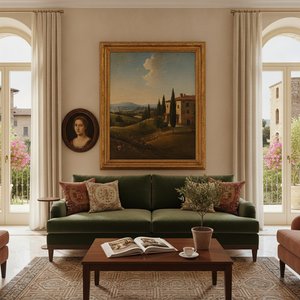
Meny
Text size

() ·

A painting made for you, by hand

Installation View

Handgjord oljereproduktion

Handmålad olja på duk i din valda storlek och ram, tillverkad efter beställning av våra konstnärer. ( Byt till tryck Byt till digital bild)

Beskrivning av samlarobjekt

Explore Fabio Mauri's 'Installation View,' a powerful assemblage of framed artworks reflecting on history, ideology, and loss through his signature screen-based installations. A poignant meditation on memory & the human condition.

Konstnärens biografi

Fabio Mauri (1926-2009) was a leading Italian avant-garde artist known for his pioneering 'Schermi' (Screens), performances exploring ideology, cinema & history. Represented by Hauser & Wirth.

from ·

Chapter 1

How large should it be?

Slide to change the size; the picture on the left shows the frame at its real width. The proportions of the original are kept.

Standardstorlek
skräddarsydd
CM
INCH

Välj bland våra förinställda storlekar som motsvarar konstverkets ursprungliga proportioner.

bredd
höjd

Ange den bredd och höjd du behöver för att passa din ram eller din vägg. Eftersom detta är handmålat kan konstnären, vid ett annat format, måla lite mer runt bilden eller beskära den något – det är du som väljer. Vi skickar en digital mockup för godkännande innan målningen påbörjas. Bilden som visas på denna sida representerar inte det slutgiltiga resultatet — det är endast mockuppen som visar det.

Chapter 2

How should it arrive?

Choose the edges of the stretched canvas

Choose your frame

Corner sample of the WhiteWrap canvas edge finish, stretched on massivt trä bars
White Skr1
Corner sample of the BlurSideWrap canvas edge finish, stretched on massivt trä bars
Blurside Skr1
Corner sample of the ExtendedWrap canvas edge finish, stretched on massivt trä bars
Extended Skr1
Corner sample of the P118B picture frame: formgjuten polystyren, 5 cm wide and 3 cm thick
P118B Skr10
Corner sample of the P118H picture frame: formgjuten polystyren, 5 cm wide and 3 cm thick
P118H Skr10
Corner sample of the P118W picture frame: formgjuten polystyren, 5 cm wide and 3 cm thick
P118W Skr10
Corner sample of the P438Z picture frame: formgjuten polystyren, 5.5 cm wide and 3.5 cm thick
P438Z Skr10
Corner sample of the P508JH picture frame: formgjuten polystyren, 7 cm wide and 3.5 cm thick
P508JH Skr12
Corner sample of the P508YH picture frame: formgjuten polystyren, 7 cm wide and 3.5 cm thick
P508YH Skr12
Corner sample of the P805H picture frame: formgjuten polystyren, 5 cm wide and 3.5 cm thick
P805H Skr10
Corner sample of the P805Z picture frame: formgjuten polystyren, 5 cm wide and 3.5 cm thick
P805Z Skr10
Corner sample of the P919BZ picture frame: formgjuten polystyren, 7 cm wide and 3.5 cm thick
P919BZ Skr10
Corner sample of the P919G picture frame: formgjuten polystyren, 7 cm wide and 3.5 cm thick
P919G Skr10
Corner sample of the P919XJ picture frame: formgjuten polystyren, 7 cm wide and 3.5 cm thick
P919XJ Skr10
Corner sample of the P959ZH picture frame: formgjuten polystyren, 5 cm wide and 3 cm thick
P959ZH Skr10
Corner sample of the P968JZ picture frame: formgjuten polystyren, 6 cm wide and 4 cm thick
P968JZ Skr12
Corner sample of the W106C picture frame: massivt trä, 5 cm wide and 3 cm thick
W106C Skr8
Corner sample of the W218G picture frame: massivt trä, 5 cm wide and 3 cm thick
W218G Skr10
Corner sample of the W218JH picture frame: massivt trä, 5 cm wide and 3 cm thick
W218JH Skr8
Corner sample of the W218Y picture frame: massivt trä, 5 cm wide and 3 cm thick
W218Y Skr10
Corner sample of the W307PJ picture frame: massivt trä, 6 cm wide and 3 cm thick
W307PJ Skr10
Corner sample of the W316G picture frame: massivt trä, 6 cm wide and 3 cm thick
W316G Skr10
Corner sample of the W316PJ picture frame: massivt trä, 6 cm wide and 3 cm thick
W316PJ Skr8
Corner sample of the W316Y picture frame: massivt trä, 6 cm wide and 3 cm thick
W316Y Skr10
Corner sample of the W398PJ picture frame: massivt trä, 5 cm wide and 3 cm thick
W398PJ Skr8
Corner sample of the W4111J picture frame: massivt trä, 6.5 cm wide and 3.5 cm thick
W4111J Skr10
Corner sample of the W500HY picture frame: massivt trä, 7 cm wide and 5 cm thick
W500HY Skr15
Corner sample of the W500JH picture frame: massivt trä, 7 cm wide and 5 cm thick
W500JH Skr15
Corner sample of the W692G picture frame: massivt trä, 8 cm wide and 4 cm thick
W692G Skr12
Corner sample of the W849H picture frame: massivt trä, 5 cm wide and 3 cm thick
W849H Skr8
Corner sample of the W940BG picture frame: massivt trä, 7.5 cm wide and 4.5 cm thick
W940BG Skr15
Corner sample of the W953PJ picture frame: massivt trä, 6 cm wide and 3.5 cm thick
W953PJ Skr8
Corner sample of the H24-GOLD picture frame: snidad trä med gesso, 10 cm wide and 6 cm thick
H24-GOLD Skr30
Corner sample of the H24-SILVER picture frame: snidad trä med gesso, 10 cm wide and 6 cm thick
H24-SILVER Skr30
Corner sample of the H36-GOLD picture frame: snidad trä med gesso, 15 cm wide and 6.5 cm thick
H36-GOLD Skr45
Corner sample of the H36-SILVER picture frame: snidad trä med gesso, 15 cm wide and 6.5 cm thick
H36-SILVER Skr45
Förhandsvisning av ram
Inramad

Moulding: . Overall size with the frame: .

Chapter 3

Who paints it, and should anything change?

Examples of what can be changed: Replace face with customer photo; Add pet (e.g., replace cat with dog); Include hidden message in background; Change background landscape or elements.

After order, OriginalUniqueArt.com team will email client for instructions and provide a mockup preview

Leverans över hela världen () på 3–4 veckor istället för standard 5 veckor. (31 oktober). Inga kompromisser med kvaliteten.

Chapter 4

The finishing touches

A nameplate, as in a museum?

Detaljer för graverad bronsplatta

This elegant plaque features the artist's name and the title of the artwork, finely engraved for a timeless presentation.

It is made from bronze with a refined, elegant finish. The text is precisely laser-engraved for a sharp and permanent result. Measuring 9x2 cm, the plaque is compact yet easy to read. It's built to be durable and scratch-resistant, offering a professional, museum-quality look. Mounting is simple thanks to the included adhesive backing.

Detaljer för transparent akrylplatta

The plaque includes essential engraved details such as the artist's name, the title of the artwork, the date it was created, the type of media used-like oil on canvas or watercolor-a brief description of the piece, and a QR code that links to the complete artwork information.

It is crafted from clear acrylic, offering a sleek, modern appearance. The text is UV-engraved in black to ensure strong visual contrast. With a size of 10x15 cm, it ensures optimal readability. It comes equipped with two metal hooks for secure wall mounting. The plaque is designed to be weather-resistant, making it suitable for various environments, and it includes interactive features that work seamlessly with smartphone scanning.

Detaljer för svart akrylplatta

This elegant plaque includes engraved information such as the artist's name, the title of the artwork, the date it was created, the type of media used (like oil on canvas or watercolor), a short description of the artwork, and a QR code for quick access to more information.

The plaque itself is made from refined black acrylic with a premium finish. The text is laser-engraved in white for high contrast and readability. Its size is 10x15 cm, designed to be easy to read. It comes with two metal hooks for professional mounting. The design is sleek and fits any interior style. It is also weather-resistant and durable, with built-in digital integration for mobile compatibility.

A protective varnish?

When do you need it?

Chapter 5

Your painting, as you ordered it

Installation View

Reproduktionsmetod

Storlek på reproduktion

-

Elitkonstnär av högsta klass

Mer detaljrikedom, finess och extra produktionstid

-

Inramning av reproduktion

-

-

För konstverk eller reproduktioner som är större än 105 cm (cirka 41 tum) på någon sida, levereras ramen som ett isärplockat kit. Denna metod säkerställer en trygg leverans och förhindrar skador under transport.

Professionell montering krävs – detta är inte en produkt för självmontering.
Kitet måste monteras och duken spännas av en erfaren professionell inramare med hjälp av trälim (ingår ej), en spänntång för duk och klämmor för att hålla sargen rak medan limmet torkar. Felaktig montering eller ojämn spänning av duken kan orsaka permanenta skador på konstverket och täcks inte av vår garanti.

  • Alla massiva träribbor ingår, exakt tillkapade efter mått.

  • Monteras med de medföljande skruvarna, samt trälim för hörnfogarna, vilket inte ingår och måste anskaffas av din ramverkare.

  • Professionella verktyg krävs och ingår ej: en dukspännare och klämmor för att hålla listerna raka medan limmet torkar.

Viktigt:
Hörnjunctionerna kräver trälim, listerna måste hållas på plats med tvingar tills limmet har torkat helt, och för att spänna duken på den monterade ramen krävs en spänntång för duk. Inget av detta ingår i kitet. Vänligen kontakta en erfaren professionell rammakare innan du beställer denna storlek.

Namnskylt

-

-

Skyddande fernissa

Glansig fernissa (förstärker färgerna, skyddar mot ljus och fukt)

-

Anpassa mitt konstverk

Exempel på vad som kan ändras: Byt ut ansiktet mot ett foto från kunden; Lägg till ett husdjur (t.ex. byt ut en katt mot en hund); Inkludera ett dolt meddelande i bakgrunden; Ändra bakgrundens landskap eller detaljer.

-

Expressleverans

Leverans över hela världen () inom 3–4 veckor istället för standardiserade 5 veckor. (31 oktober). Inga kompromisser med kvaliteten.

-

Expressleverans

Leverans över hela världen () inom 5 veckor. (7 november).

Ingår

Slutgiltigt pris

Skr 3014

Totalt pris Skr 3014

Glasalternativet är endast tillgängligt i storlekar under 110 cm.

Included with every order

  • Fri expressfrakt över hela världen
  • Högkvalitativ linnecanvas
  • Fullständig fraktförsäkring
  • Garantier för återbetalning av tullavgifter
  • Garantier för exakt färgåtergivning
  • 100 dagars returrätt (endast vid fel)
  • 100% pengarna tillbaka-garanti
  • Mängdrabatt erbjuds

The Weight of Absence: Unpacking Fabio Mauri's "Installation View"

Fabio Mauri, a profoundly enigmatic figure in post-war Italian art, didn’t simply create images; he constructed experiences. His work, often grappling with the lingering trauma of war and the insidious creep of ideology, demands not passive observation but active engagement. “Installation View,” a series of framed drawings – ‘Disegno’ – presented within an architectural setting, embodies this core principle. It's less a collection of artworks and more a carefully orchestrated meditation on memory, loss, and the difficulty of confronting history’s darkest corners. The piece isn’t about depicting events; it’s about evoking their emotional residue, creating a space where the viewer is invited to confront the uncomfortable truths Mauri so relentlessly pursued.

The arrangement itself speaks volumes. A stark white wall serves as the backdrop, immediately establishing a sense of clinical neutrality – a deliberate choice that contrasts sharply with the intensely personal narratives embedded within the drawings. To the left, an ornate architectural element—a doorway leading to another space—introduces a subtle tension, suggesting a journey beyond the immediate scene and hinting at the broader historical context Mauri explores. The placement of the framed works is meticulously considered, creating a horizontal rhythm that draws the eye across the composition while simultaneously emphasizing the individual weight of each piece. The lighting, focused and directional, accentuates the textures of the frames and casts dramatic shadows, further amplifying the sense of depth and layering.

Echoes of Trauma: The Drawings as Vessels

Each “Disegno” – ‘Drawing’ – within the installation is a deceptively simple work. The drawings themselves are primarily black and white, executed with varying degrees of urgency and directness. Some appear to be hastily scratched onto paper, while others possess a more deliberate, almost obsessive quality. The repeated phrase "The End" – “Fine” in Italian – is not merely decorative; it’s a haunting refrain, a constant reminder of finality, loss, and the impossibility of truly escaping the past. Mauri's early encounter with photographs of German concentration camps profoundly shaped his artistic vision, fueling an ongoing inquiry into the treacherous logic of art, ideology, and totalitarianism. These drawings aren’t simply representations of these events; they are attempts to grapple with their incommunicable horror, to translate a traumatic experience into a visual language that transcends words.

The inclusion of “The End” – repeated across multiple pieces – is particularly poignant. It's not just an ending point but also a perpetual state of suspension, suggesting that the horrors of war and fascism never truly disappear; they linger in the collective memory, demanding to be confronted. The use of simple materials—paper, canvas—further underscores the fragility of human existence and the precariousness of historical narratives. The drawings themselves feel vulnerable, as if bearing witness to something profoundly unsettling.

A Legacy of Remembrance: Context and Symbolism

Fabio Mauri’s work is deeply rooted in the Arte Povera movement, yet he resisted easy categorization. His installations, performances, and writings consistently explored history through the lens of individual experience, challenging conventional notions of art and its relationship to the world. The “Installation View” reflects this broader approach, inviting viewers to consider not just the artworks themselves but also the space in which they are presented – a gallery or museum setting that becomes an integral part of the artwork’s meaning. The repeated motif of "The End" is echoed throughout Mauri's oeuvre, serving as a constant reminder of loss and impermanence, while simultaneously suggesting a refusal to accept easy closure.

Beyond its immediate visual impact, “Installation View” speaks to the broader themes that preoccupied Mauri – the manipulation of mass media, the dangers of ideology, and the difficulty of confronting history’s darkest moments. It's a powerful testament to the enduring legacy of trauma and the ongoing need for remembrance. The work invites us to contemplate not just what happened but also how we can bear witness to it, ensuring that such horrors are never forgotten.

Frågor och svar

Har "Installation View" starka ljus-mörkerkontraster?

"Installation View" av Fabio Mauri uppvisar en Statement kontrast mellan sina ljusa och mörka partier.

Vilken period av Fabio Mauris karriär tillhör "Installation View"?

"Installation View" representerar Fabio Mauris Late Period.

Vilken användning och vilken yta rekommenderas för "Installation View" av Fabio Mauri?

"Installation View" rekommenderas för Reflective och passar utmärkt i ett Living Room.

More about this painting

Byt till tryck Byt till digital bild Skicka
Visa detaljer Guide Lägg till i favoriter Ladda ner Liknande objekt Bildspel Q&A Statistik

In numbers

  • 1994the year it was painted
  • 29frames to choose from
  • standard sizes, in its own proportions
  • 5weeks to paint and deliver it

About the original

Fabio Mauri

Fabio Mauri

1926 - 2009, Italy

Quick facts about Fabio Mauri

  • Full Name: Fabio Mauri
  • Nationality: Italian
  • Date Of Birth: 1926
  • Date Of Death: 2009
  • Place Of Birth: Rome, Italy
  • Notable Artworks:
    • Schermi
    • Il Muro Occidentale
    • Linguaggio è guerra
    • Che cosa è il fascismo
  • Artistic Movement Or Style: Post-war avant-garde
  • Artists Who Influenced This Artist:
    • Pier Paolo Pasolini
    • Luigi Pirandello
  • Artists Or Movements Influenced By This Artist:
    • Gruppo 63
    • Pop Art

Konstnärsbiografi

Fabio Mauri: Architect of the Screen, Chronicler of Ideology

Fabio Mauri (1926-2009) remains a profoundly enigmatic and influential figure in post-war Italian art. Born into a family steeped in theatre and publishing—his uncle Valentino Bompiani’s house was a hub for literary innovation—Mauri’s artistic journey was inextricably linked to the tumultuous events of his youth, particularly the trauma of World War II and its lingering ideological scars. His work isn't easily categorized; it resists simple labels, oscillating between performance, installation, drawing, and theoretical reflection, always probing the complex relationship between individual consciousness and the pervasive forces of mass media and propaganda.

Early years in Bologna laid the groundwork for his artistic sensibility. He began publishing drawings in 1942 alongside Pier Paolo Pasolini, a collaboration that would profoundly shape both their intellectual trajectories. The experience of war, however, left an indelible mark, triggering episodes of severe mental distress and hospitalization. This personal crisis, far from being a creative dead end, became the catalyst for a radical shift in his artistic approach—a deliberate confrontation with the psychological impact of violence and ideology. His early struggles with psychosis fueled a lifelong investigation into the nature of trauma, memory, and the ways in which history is constructed and perpetuated through images.

The ‘Schermi’ – A New Language of Perception

Mauri's artistic breakthrough arrived in 1957 with the creation of his “Schermi” (Screens). These deceptively simple works—black frames surrounding white sheets of paper—represented a fundamental departure from traditional painting. He described them as seeking a ‘zero degree’ – a space beyond representation, a blank canvas for projection and contemplation. The Schermi weren't merely paintings; they were invitations to engage with the potential of the image itself, acting as conduits for unseen narratives and future possibilities. This concept evolved over time, incorporating elements like stretched cloth or wooden frames reminiscent of television screens, further emphasizing the role of media and technology in shaping our perception.

The Schermi weren’t static objects; they were designed to be activated—projected upon, layered with text, or used as a backdrop for performance. Mauri's meticulous attention to detail – the precise framing, the stark contrast between black and white – created a powerful visual language that challenged viewers to question their assumptions about representation and reality. The Schermi became a central element in his exploration of ideology, serving as a platform for confronting uncomfortable truths about power, violence, and manipulation.

Performance, Ideology, and the ‘Crack’ Group

Beyond the Schermi, Mauri's artistic practice expanded dramatically throughout the 1960s. He became deeply involved in theatre, co-founding the “Quindici” magazine with poets like Pier Paolo Pasolini and Edoardo Sanguineti, and staging politically charged performances such as *L’Isola* (1964), a pop-art theatrical piece that combined literature, comic books, and visual imagery. He also formed the ‘Crack’ group in 1960 with artists like Pietro Cascella, Gino Marotta, and Achille Perilli—a collective dedicated to exploring the intersection of art, politics, and social critique.

Crucially, Mauri distanced himself from the burgeoning Pop Art movement in 1964, recognizing its superficial embrace of consumer culture. He shifted his focus towards a more rigorous investigation of ideology, producing works like *Che cosa è il fascismo* (What is Fascism) and *Ebrea*, which confronted the horrors of Nazi-fascist ideology with unflinching honesty. These performances weren’t merely aesthetic events; they were acts of remembrance, attempts to bear witness to historical trauma and expose its lingering effects on contemporary society.

Legacy and Enduring Relevance

Fabio Mauri's work continues to resonate powerfully in the 21st century. His exploration of mass media, propaganda, and the manipulation of images remains profoundly relevant in an age dominated by social media and digital technologies. His insistence on confronting uncomfortable truths—particularly those related to violence, trauma, and ideology—demands a critical engagement with history and its ongoing influence on our present. Mauri’s legacy lies not only in his innovative artistic practices but also in his unwavering commitment to using art as a tool for social critique and personal reflection. He left behind a body of work that challenges us to question the very nature of representation, perception, and the power dynamics that shape our world.

Kortfakta

  • Title: Installation View
  • Movement: Arte Povera
  • Influences:
    • Artaud
    • Jesuit Theater
  • Notable elements or techniques: Schermi, historical reflection
  • Medium: Drawing/Canvas, Oil, Paper