Expressionism
Evening (Emil Nolde)
Emil Nolde (1867–1956) skapade Evening. Det tillhör Expressionism-rörelsen.

 Förhandsvisa

 Handmålad oljemålning
 Skicka
 Dela
 Faktablad


 Ladda ner
 Liknande objekt
 Röntgen
 Bildspel
 Frågor och svar

 Statistik
Evening i korthet
- Titel
- Evening
- Konstnär
- Emil Nolde (1867–1956)
- Konstnär född i
- Nolde, Danmark
- Rörelse
- Expressionism
- Motiv
- landscape painting, cloudscape artwork, water reflection, dreamlike scene, abstract nature, evening glow”
Vad föreställer Evening?
A Symphony of Color: Experiencing Emil Nolde’s “Evening”
Emil Nolde's "Evening" is a captivating exploration of light and atmosphere, characteristic of his expressive landscape work. This piece doesn’t depict a literal evening scene, but rather an *emotional* response to one – a distillation of the feeling of twilight rendered in bold color and simplified forms. A dominant, luminous yellow cloud commands attention in the upper left quadrant, acting as a focal point that draws the eye down into the composition. Below, a gradient of blues transitions from deep indigo to lighter turquoise and verdant greens along the horizon line, suggesting water reflecting the celestial drama above.
Expressionism & The Power of Color
- Stylistic Roots: Nolde was a key figure in early 20th-century Expressionism, a movement that prioritized subjective experience and emotional impact over realistic representation. “Evening” exemplifies this approach through its non-naturalistic color palette and abstracted forms.
- Technique & Materials: The artwork appears to be executed in watercolor or gouache, evidenced by the fluidity of the washes and blending of colors. Nolde masterfully employs these techniques to create a sense of atmospheric depth despite the flattened perspective. Visible brushstrokes add texture and energy.
- Influences: While forging his own path, Nolde was influenced by artists like Vincent van Gogh and Paul Gauguin, particularly their use of intense color to convey emotion. He also drew inspiration from traditional folk art and primitive masks, evident in the bold outlines and simplified shapes.
Symbolism & Emotional Resonance
The symbolism within “Evening” is subtle yet potent. The large yellow cloud can be interpreted as a source of radiant energy or enlightenment – a beacon amidst the darkening sky. The winding body of water, reflecting the colors above, suggests a connection between the earthly and celestial realms. More broadly, Nolde’s landscapes often represent an attempt to connect with nature on a spiritual level.
The overall emotional impact is one of tranquility mixed with a hint of mystery. The stylized representation invites contemplation and allows viewers to project their own feelings onto the scene. Nolde's work frequently evokes a sense of longing or melancholy, reflecting his own complex relationship with the world around him.
Nolde’s Life & Legacy
Born in 1867 in Nordel, Germany, Emil Nolde dedicated himself to art after years working as a wood carver. Despite facing opposition from his family and later persecution under the Nazi regime (his work was deemed “degenerate”), he remained committed to his artistic vision. Nolde’s landscapes, seascapes, and portraits are celebrated for their raw emotional power and innovative use of color. His ability to capture the essence of a place or feeling – rather than simply its appearance – continues to resonate with audiences today.
Högupplösta bilder av Evening
Allmän egendom: konstnären avled 1956.
Emil Nolde, Evening. Allmän egendom
Frågor om Evening besvarade
Vad föreställer "Evening"?
Motiven i "Evening" är landscape painting, cloudscape artwork, water reflection, dreamlike scene, abstract nature, evening glow”, “stylized landscape”.
Är "Evening" fri från upphovsrätt?
När det gäller upphovsrätt är "Evening" allmän egendom – upphovsrätten har löpt ut.
Vem är konstnären bakom "Evening"?
Konstnären bakom "Evening" är Emil Nolde. Verket är katalogiserat under Emil Noldes namn.
Vilken konststil tillhör "Evening" av Emil Nolde?
"Evening" är ett verk inom Expressionism. Denna stilriktning anger den konstnärliga tradition som verket tillhör.
Var i Emil Noldes karriär placerar sig "Evening"?
"Evening" tillhör Emil Noldes Mature Period i konstnärskarriären. Denna klassificering relaterar verket till konstnärens utveckling.
Vad förklarar upphovsrättssituationen för "Evening" av Emil Nolde?
"Evening" av Emil Nolde är allmän egendom – upphovsrätten har löpt ut. Upphovsrätten löper från konstnärens dödsår, vilket var 1956.
Hur förhåller sig "Evening" till Emil Noldes samlade konstnärskap?
"Evening" delar med Emil Noldes övriga verk sin Expressionism-stil och de återkommande temana: german romanticism influence, nature's ethereal beauty", "symbolic, spiritual themes", expressionist color theory, reflects coastal landscapes, nolde's personal visions.
Är "Evening" typisk för vad Emil Nolde vanligtvis skapade?
Emil Noldes återkommande teman inkluderar german romanticism influence, nature's ethereal beauty", "symbolic, spiritual themes", expressionist color theory, reflects coastal landscapes, nolde's personal visions; "Evening" fokuserar på landscape painting, cloudscape artwork, water reflection, dreamlike scene, abstract nature, evening glow”, “stylized landscape”.
Om konstnären, Emil Nolde
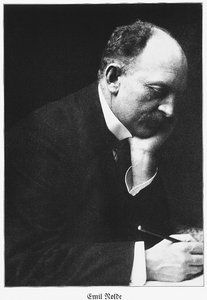
1867–1956, Danmark
Emil Nolde
Emil Noldes liv och identitet Född som Hans Emil Hansen den 7 augusti 1867, växte mannen som senare skulle bli känd som Emil Nolde upp nära byn Nolde i hertigdömet Schleswig. Hans tidiga år präglades av familjens lantliga och agrara livsstil. Han valde dock så småningom att lämna denna bana och arbetade istället som träsnidare och möbeldekorerare. Detta taktila och fysiska arbete föregick hans skifte mot måleri och grafik.
Andra verk av Emil Nolde
 Sunset
 Sea with Red Sky
 Couple on the beach1903
 Masks1911
Essäer om Evening
 Masterpieces of Emotion: The Top 25 Vincent van Gogh ArtworksImmerse yourself in the vibrant world of Vincent van Gogh. Explore 25 iconic Post-Impressionist masterpieces, from Starry Night to Sunflowe…
 Chasing Shadows: The Enchanting Beauty of Dim Light in Impressionist MasterpiecesDiscover the ethereal magic of Impressionist nightscapes. Explore how masters like Monet and Whistler captured the alchemy of moonlight, sh…
 Unveiling Inner Worlds: Exploring Psychological Depth in 20th & 21st Century ArtExplore the profound psychological themes within 20th & 21st-century art. Discover Expressionism, Surrealism & more – and learn how to coll…