- Hem

- Reproduktion av oljemålning
- Émile Bernard
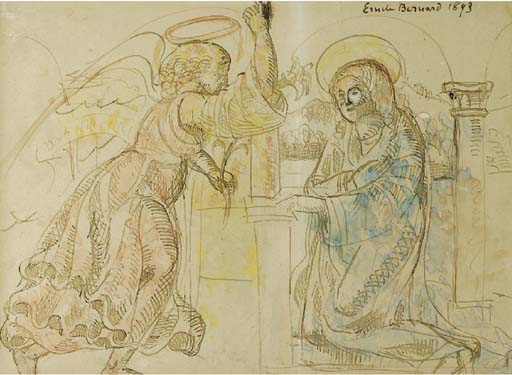
- Annunciation
 Köp tryck Köp högupplöst digital bild
 Skicka
 Dela
Dela
 Visa detaljer
 Lägg till i favoriter

 Ladda ner
 Liknande objekt
 Röntgen
 Bildspel
Annunciation

 Visa mer
Handgjord oljereproduktion
Handmålad olja på duk i din valda storlek och ram, tillverkad efter beställning av våra konstnärer.




































Välj bland våra förinställda storlekar som motsvarar konstverkets ursprungliga proportioner.

Du kan ange egna mått för att passa en specifik ram eller yta. Om den valda storleken inte matchar originalbildens proportioner kommer vi antingen att beskära konstverket eller utöka målningen med ytterligare handmålade element. En digital skiss skickas till dig för godkännande innan produktionen påbörjas.
Observera att förhandsvisningen på skärmen inte återspeglar den faktiska beskärningen eller utökningen. Endast skissen visar den slutgiltiga kompositionen korrekt.
Även om anpassade storlekar är möjliga, rekommenderar vi att du väljer en dimension från den fördefinierade listan för att bevara originalproportionerna.
Efter beställning kommer OriginalUniqueArt.com team att mejla kunden för instruktioner och tillhandahålla en skissförhandsvisning
Leverans över hela världen () på 3–4 veckor istället för standard 5 veckor. (18 juli). Inga kompromisser med kvaliteten.

Fri expressfrakt över hela världen

Högkvalitativ linnecanvas

Fullständig fraktförsäkring

Garantier för återbetalning av tullavgifter

Garantier för exakt färgåtergivning

60 dagars returrätt (endast vid fabrikationsfel)

100% pengarna tillbaka-garanti

Mängdrabatt erbjuds
 Glasalternativet är endast tillgängligt i storlekar under 110 cm.

Annunciation
Teknik för reproduktion
Storlek på reproduktion
-


Slutgiltigt pris
-
Konstnärsbiografi
Émile Bernard: A Post-Impressionist Pioneer
Émile Henri Bernard (1868–1941) was a French painter and writer, who had artistic friendships with Vincent van Gogh, Paul Gauguin and Eugène Boch, 1 and at a later time, Paul Cézanne. Most of his notable work was accomplished at a young age, in the years 1886 through 1897. He is also associated with Cloisonnism and Synthetism, two late 19th-century art movements. Less known is Bernard's literary work, comprising plays, poetry, and art criticism as well as art historical statements that contain first-hand information on the crucial period of modern art to which Bernard had contributed. ### Early Life and Education Émile Henri Bernard was born in Lille, France, in 1868. As in his younger years his sister was sick, Émile was unable to receive much attention from his parents; he therefore stayed with his grandmother, who owned a laundry in Lille, employing more than twenty people. She was one of the greatest supporters of his art. The family moved to Paris in 1878, where Bernard attended the Collège Sainte-Barbe. He began formal art studies at the École des Arts Décoratifs and later joined the Atelier Cormon in 1884. Here, he experimented with Impressionism and Pointillism. His expressive tendencies led to a suspension from the École des Beaux-Arts, prompting a formative journey through Brittany on foot. ### Artistic Development and Influences Bernard’s artistic development was significantly influenced by his travels in Brittany, where he encountered local traditions and landscapes that deeply resonated with him. A pivotal moment came in August 1886 when he met Paul Gauguin in Pont-Aven. This encounter sparked a close artistic friendship and profoundly impacted both artists’ styles. Bernard's style played a crucial role in shaping Gauguin’s mature work, particularly his exploration of symbolism and flattened forms. He also associated with Vincent van Gogh, forming part of the “School of Petit-Boulevard” alongside Anquetin and Toulouse-Lautrec. ### Key Artistic Movements Bernard is considered a pioneer of Cloisonnism, a style characterized by bold, flat shapes separated by dark contours – reminiscent of stained glass. He also played a key role in the development of Synthetism, which emphasized the creation of art based on subjective experience and symbolic meaning rather than direct observation of nature. These movements represented a departure from Impressionism, focusing instead on structure, symbolism, and emotional expression. ### Notable Works Bernard’s most iconic piece is “La Grandmère” (1887), a poignant portrait of his grandmother, showcasing the artist’s early mastery of expressive form and color. Numerous Breton landscapes capture the essence of rural life in Brittany. Religious works such as “The Adoration of the Shepherds” demonstrate his exploration of symbolic themes. ### Literary Contributions and Historical Significance Beyond painting, Bernard was a prolific writer, producing plays, poetry, and art criticism. His writings provide valuable first-hand insights into the development of modern art during his time. He died in 1941, leaving behind a body of work that continues to be celebrated for its originality and artistic innovation. His legacy extends beyond individual paintings; he fundamentally reshaped the visual language of his era, paving the way for Fauvism and Expressionism and inspiring generations of artists to prioritize emotional resonance over photographic realism.
Émile Bernard
1868 - 1941 , Frankrike
Kortfattad information
- Artistic Movement Or Style: Post-Impressionism
- Artists Or Movements Influenced By This Artist: ['Vincent van Gogh']
- Artists Who Influenced This Artist: ['Paul Gauguin']
- Date Of Birth: April 28, 1868
- Date Of Death: 1941
- Full Name: Émile Henri Bernard
- Nationality: French
- Notable Artworks: ['La Grandmère']
- Place Of Birth: Lille, France
Relaterade artiklar
Högrenässansens 10 mästerverk – Konsthistoriens ikoner för ditt hem
Upptäck högrenässansens 10 mest ikoniska mästerverk – från Leonardo da Vincis Mona Lisa till Michelangelos skapelser. Lär känna konsthistorien och hitta inspiration för din heminredning med OriginalUniqueArt.com. Utforska samlingen online!
The Eloquent Line: Exploring the Artistic Significance of Sketches Across Movements and Media
Explore the profound artistic significance of sketches throughout history. From Renaissance masters to modern innovators like Van Gogh & Guston, discover how these foundational works reveal technique, emotion, and vision. Learn more at OriginalUniqueArt.
Émile Bernard: Pioneering Synthetism & the Post-Impressionist Quest for Essence
Explore the life & work of Émile Bernard, a pivotal Post-Impressionist pioneer of Synthetism. Discover his influence on Van Gogh & Gauguin and learn about collecting his art with OriginalUniqueArt.
The Eloquent Body: Anatomy's Enduring Legacy in Art from Renaissance Dissection to Modern Representation
Explore the fascinating history of anatomy in art! From Renaissance dissections to modern masterpieces, discover how artists & scientists collaborated to depict the human form with unprecedented realism. Learn more at OriginalUniqueArt.
The Nuances of Graphite: Exploring Emotional Depth & Technical Mastery in Pencil Drawing
Explore the captivating world of graphite drawing! Discover its rich history, master essential techniques like chiaroscuro, and learn how artists evoke emotion through this timeless medium. Expert insights for art enthusiasts.



