Byt till tryck
 Visa mer







































 För konstverk eller reproduktioner som är större än 105 cm (cirka 41 tum) på någon sida, levereras ramen som ett isärplockat kit. Denna metod säkerställer en trygg leverans och förhindrar skador under transport.


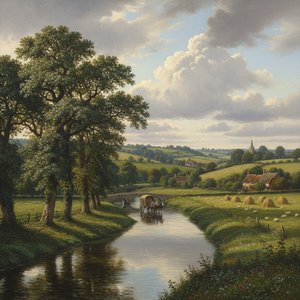
Elioth Gruner was born in New Zealand and arrived in Australia. He studied with Julian Ashton at the Art Society of New South Wales where he met the flamboyant George Lambert, an artist whose work would inspire Gruner. He died in Sydney in 1939, alone and destitute, a few weeks after the declaration of war between Great Britain and the Commonwealth and Germany.Gruner was one of the most popular landscape artists working in Australia in the period from c.1910 to 1939. He was awarded the Wynne Prize for landscape at the Art Gallery of New South Wales no fewer than 7 times from 1916 to 1937.Landscape is one of a number of works painted when Gruner discovered the Murrumbidgee River whilst staying at a property near Yass in 1929. He returned to this area a number of times over the next ten years and produced some of his major late works. The clarity of light in the region particularly impressed him and this is beautifully expressed in this picture.Gruner
Frågor och svar
Vad är luminansen i "Landscape" av Elioth Gruner?
Färgerna i "Landscape" har en Gentle Luminance luminans.
Förvaras "Landscape" i sin konstnärs hemland?
Nej – konstverket förvaras utomlands. Elioth Gruner föddes i Nya Zeeland, och originalet av "Landscape" finns på ett museum i Australien.
Hur förhåller sig motivet i "Landscape" till Elioth Gruners vanliga teman?
"Landscape" skildrar landscape, rural australia, murrumbidgee river, tranquility, light study, impressionism, australian art, serene valley, medan Elioth Gruners dokumenterade teman är late works, light studies, wynne prize winner", heidelberg school, plein air, julian ashton, rural life, australian landscape. En jämförelse mellan dessa visar hur verket förhåller sig till konstnärens vanliga motiv.
 Förhandsvisa

 Skicka
 Dela
 Visa detaljer
 Guide


 Ladda ner
 Liknande objekt
 Röntgen
 Bildspel
 Frågor och svar
 Statistik