1879
At Elmore, Gloucester (Edward Smith, 1879)
Edward Smith skapade At Elmore, Gloucester. Den är från 1879. Verket finns bevarat på Museum of Gloucester i Gloucester, Storbritannien. Måtten är 31 × 46 cm.
- 1879
- 31 × 46 cm
- Museum of Gloucester

 Förhandsvisa

 Handmålad oljemålning
 Skicka
 Dela
 Faktablad


 Ladda ner
 Liknande objekt
 Röntgen
 Bildspel
 Frågor och svar

 Statistik
At Elmore, Gloucester i korthet
- Titel
- At Elmore, Gloucester
- Konstnär
- Edward Smith
- Konstnär född i
- Kingdom of Great Britain
- Datum
- 1879
- Mått
- 31 × 46 cm
- Utställningsplats
- Museum of Gloucester, Gloucester, Storbritannien
Vad föreställer At Elmore, Gloucester?
A Glimpse into Rural Life
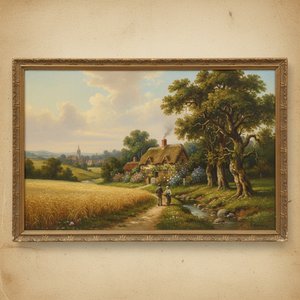
The scene depicted in "At Elmore, Gloucester" is one of serenity and tranquility. A couple, with a woman holding a baby, is seen walking towards a house or farm building, surrounded by animals such as dogs, horses, and cows. The presence of birds flying overhead adds to the sense of peace and harmony that pervades the atmosphere. This painting is a testament to Edward Smith's skill in capturing the beauty of everyday life.Other Notable Works by Edward Smith
Some of Edward Smith's other notable works include River Scene with Anglers, the Leadon, Gloucestershire, Southgate Street, Gloucester, and The Quay and Docks, Gloucester, 1878. These paintings can be found on OriginalUniqueArt.com, where art enthusiasts can discover and purchase handmade oil painting reproductions of these masterpieces.- Handmade oil painting reproductions of "At Elmore, Gloucester" and other works by Edward Smith are available on OriginalUniqueArt.com.
- The Museum of Gloucester is home to an impressive collection of artworks, including those by Edward Smith.
- For more information on Edward Smith and his works, visit OriginalUniqueArt.com's artist page.
The captivating scene depicted in "At Elmore, Gloucester" is a testament to Edward Smith's skill as an artist and his ability to capture the essence of rural life in the late 19th century.
Vilket museum har At Elmore, Gloucester?
Museum of Gloucester
Gloucester, Storbritannien
En viktoriansk fristad för historia och konst: Avtäckandet av Gloucesters skatter Inbäddat i en magnifik viktoriansk byggnad med Grade II-listning – ursprungligen Price Memorial Hall tillhörande Gloucester Science and Art Society – erbjuder Museum of Gloucester en extraordinär resa genom tiden, ett vittnesbörd om kulturarvets och det konstnärliga uttryckets bestående kraft. Denna struktur, färdigställd 1893 av F.S. Waller i tidig renässansstil, är i sig själv ett fängslande konstverk; dess stenar viskar berättelser om intellektuell nyfikenhet och medborgerlig stolthet, och ekar av rösterna från svunna generationer.


Högupplösta bilder av At Elmore, Gloucester

Upphovsrättsskyddat: dessa filer är för personligt bruk och utgör inte en licens för återpublicering.
Edward Smith, At Elmore, Gloucester (1879), Museum of Gloucester.
Frågor om At Elmore, Gloucester besvarade
Var kan man se "At Elmore, Gloucester" av Edward Smith utställd idag?
Originalet av "At Elmore, Gloucester" av Edward Smith finns på Museum of Gloucester, Gloucester, Storbritannien. En reproduktion gör det möjligt att visa verket i hemmet.
Vilket år skapades "At Elmore, Gloucester" av Edward Smith?
"At Elmore, Gloucester" av Edward Smith skapades år 1879.
Vilka är måtten på originalet av "At Elmore, Gloucester"?
De registrerade måtten för "At Elmore, Gloucester" av Edward Smith är 31 x 46 cm. Reproduktioner kan beställas i andra storlekar med bibehållna proportioner.
Är "At Elmore, Gloucester" av Edward Smith fri från upphovsrätt?
När det gäller upphovsrätt är "At Elmore, Gloucester" fortfarande skyddat av upphovsrätt.
Vem har skapat "At Elmore, Gloucester"?
"At Elmore, Gloucester" skapades av Edward Smith. Informationen på denna sida beskriver Edward Smiths originalverk.
Förvaras "At Elmore, Gloucester" i skaparens hemland?
Nej – konstverket förvaras utomlands. Edward Smith föddes i Kingdom of Great Britain, och museet som förvarar originalet av "At Elmore, Gloucester" ligger i Storbritannien.
Om konstnären, Edward Smith

Kingdom of Great Britain
Edward Smith
The Visionary Landscapes of Edward Smith Edward Smith (1850 – 1912) stands as a singular figure in Victorian British art, recognized primarily for his monumental canvases depicting mythological scenes—particularly the biblical Flood—and expansive landscapes imbued with an almost unsettling grandeur. While overshadowed by contemporaries like Turner and Constable during his lifetime, Smith’s distinctive style has garnered renewed appreciation in recent decades, cementing his place as a pivotal artist of the era and influencing subsequent generations of painters. His work transcends mere representation; it strives to convey profound emotional resonance and philosophical contemplation, reflecting the anxieties and aspirations of a society grappling with scientific advancements alongside spiritual yearning. Born in Hanley, Staffordshire, Smith’s upbringing amidst a family of potters instilled an appreciation for craftsmanship and detail—traits that would become hallmarks of his artistic practice.
Andra verk av Edward Smith
 Market House, Dursley, Gloucestershire1879
 An Angling Party (The Willyams Family at Carnanton )1773
 Edward Rushton (1795–1851)1840
 Spa Grounds, Gloucester1875
Essäer om At Elmore, Gloucester
 Alfred I. Glendening: Capturing Rural England's Poetic EssenceExplore the captivating rural landscapes of Alfred I. Glendening, a master of British sporting paintings. Discover his life, artistic style…
 Masterpieces of the Countryside: Top 25 Sir Alfred James Munnings ArtworksImmerse yourself in the vibrant world of Sir Alfred James Munnings. Explore 25 iconic equestrian paintings and English landscapes that defi…
 25 Must-See Masterpieces at the Smithsonian American Art MuseumExplore 25 iconic works from the Smithsonian American Art Museum. From Hopper to O'Keeffe, find museum-quality art on OriginalUniqueArt.com.