
 Förhandsvisa
 Skicka
 Dela
Dela
 Visa detaljer
 Guide
Guide

 Ladda ner
 Liknande objekt
 Röntgen
 Bildspel
 Q&A
Q&A Statistik
Putto Picking Grapes

- 49.0 x 64.0 cm


 Visa mer
Giclée / Konsttryck
Giclée- eller canvasprint av museumskvalitet med snabb produktion och flexibla ytbehandlingsalternativ. ( Beställ handmålad reproduktion Byt till digital bild)




P118B Skr10

P118H Skr10

P118W Skr10

P438Z Skr10

P508JH Skr12

P508YH Skr12

P805H Skr10

P805Z Skr10

P919BZ Skr10

P919G Skr10

P919XJ Skr10

P959ZH Skr10

P968JZ Skr12

W106C Skr8

W218G Skr10

W218JH Skr8

W218Y Skr10

W307PJ Skr10

W316G Skr10

W316PJ Skr8

W316Y Skr10

W398PJ Skr8

W4111J Skr10

W500HY Skr15

W500JH Skr15

W692G Skr12

W849H Skr8

W940BG Skr15

W953PJ Skr8




Välj bland våra förinställda storlekar som motsvarar konstverkets ursprungliga proportioner.

Ange den bredd och höjd du behöver för att passa din ram eller vägg. Ett tryck kan endast beskäras, aldrig göras större än originalbilden, vilket innebär att ett format med en annan proportion leder till att en del av bilden går förlorad. Vi skickar en digital mockup för godkännande innan vi påbörjar tryckningen. Bilden som visas på denna sida visar inte den faktiska beskärningen — det är endast mockuppen som gör det.
Leverans över hela världen () på 2 veckor istället för standard 4/5 veckor. (2 november)

Fri expressfrakt över hela världen

Högkvalitativ linnecanvas

Fullständig fraktförsäkring

Garantier för återbetalning av tullavgifter

Garantier för exakt färgåtergivning

100 dagars returrätt (endast vid fel)

100% pengarna tillbaka-garanti

Mängdrabatt erbjuds
 Glasalternativet är endast tillgängligt i storlekar under 110 cm.

Putto Picking Grapes
Giclée / Konsttryck
Storlek på reproduktion
-


Slutgiltigt pris
Skr 803
Bernardino Luini’s “Putto Picking Grapes”: A Symphony of Grace and Renaissance Reverie
Bernardino Luini's "Putto Picking Grapes," painted around 1523, isn’t merely a depiction of a young boy gathering fruit; it’s a profound meditation on childhood innocence, the bounty of nature, and the enduring legacy of Leonardo da Vinci. This exquisite panel painting, now housed within the Pinacoteca di Brera in Milan, offers a glimpse into the heart of the High Renaissance, revealing Luini's unique artistic vision and his deep connection to the master who profoundly shaped his style.
Luini’s distinctive “Luinesque” aesthetic—characterized by elongated figures, gentle expressions, and an almost dreamlike quality—is immediately apparent. The central figure, a young boy with a serene countenance, is bathed in soft light that seems to emanate from within the painting itself. His posture is relaxed yet attentive, his gaze fixed on the grapes he delicately gathers from a vine. The artist masterfully employs sfumato – Leonardo’s signature technique of blurring lines and softening edges – creating an atmosphere of hazy beauty and imbuing the scene with a sense of ethereal tranquility. Notice how the details are rendered with remarkable precision, yet never feel overly realistic; Luini prioritizes capturing the *essence* of the moment over photographic accuracy.
A Dialogue with Leonardo: Influences and Techniques
Luini’s artistic journey is inextricably linked to that of Leonardo da Vinci. While the precise nature of their collaboration remains debated, it's widely accepted that Luini spent several formative years working directly under the master in Milan. This apprenticeship instilled within him a deep appreciation for Leonardo’s innovative techniques and his profound understanding of human anatomy and perspective. “Putto Picking Grapes” is a testament to this influence; observe how Luini subtly echoes Leonardo’s use of light and shadow, creating a sense of depth and volume that draws the viewer into the scene. The composition itself—a carefully balanced arrangement of figures and elements—demonstrates a clear debt to Leonardo's meticulous approach to design.
Furthermore, Luini’s work reflects the broader artistic trends of the era. The painting embodies the Renaissance ideal of *natura mortua* – the beauty of decay and the cyclical nature of life. The grapes themselves represent abundance, fertility, and the passage of time. The setting, a rustic vineyard bathed in golden light, evokes a sense of pastoral harmony—a refuge from the complexities and anxieties of urban life.
Symbolism and Emotional Resonance
Beyond its technical brilliance, “Putto Picking Grapes” is rich in symbolic meaning. The young boy embodies innocence, purity, and the promise of future growth. His simple act of gathering grapes becomes a metaphor for the acquisition of knowledge and wisdom—a fundamental theme of Renaissance humanism. The vine itself symbolizes life, connection, and the interconnectedness of all things. The overall mood is one of quiet contemplation and gentle joy, inviting the viewer to pause and appreciate the beauty of the natural world.
Interestingly, Luini’s work often features a subtle undercurrent of melancholy—a recognition that even in moments of idyllic beauty, time inevitably marches on. This poignant awareness adds another layer of depth to the painting's emotional resonance. It’s not simply a celebration of youth and abundance; it’s also a meditation on mortality and the fleeting nature of earthly pleasures.
A Timeless Masterpiece: Reproduction and Display
Reproductions of “Putto Picking Grapes” capture only a fraction of the painting's original allure. The delicate sfumato, the subtle nuances of color, and the profound sense of atmosphere are difficult to replicate fully. However, high-quality reproductions offer an accessible way to experience Luini’s genius and bring this timeless masterpiece into your home or office.
When selecting a reproduction, consider the materials used—a fine art print on archival paper will ensure that the colors remain vibrant for generations to come. Furthermore, think about the framing – a simple, elegant frame will allow the painting’s beauty to shine through without distracting from its inherent charm. “Putto Picking Grapes” is more than just a decorative image; it's a window into the soul of the Renaissance—a testament to the enduring power of art to inspire and uplift.
Frågor och svar
Är färgerna i "Putto Picking Grapes" av Bernardino Luini klara eller dämpade?
"Putto Picking Grapes" av Bernardino Luini återges med en Clear Color Presence mättnad och en Vivid intensitet.
Under vilket år och inom vilken stil skapades "Putto Picking Grapes"?
"Putto Picking Grapes" skapades år 1523 inom Northern Renaissance-rörelsen.
Kan jag använda augmented reality för att se "Putto Picking Grapes" av Bernardino Luini i mitt rum?
"Putto Picking Grapes" av Bernardino Luini kan förhandsvisas på din egen vägg via konstverkets Förhandsvisning i AR-sida med hjälp av förstärkt verklighet (AR) på en kompatibel enhet.
Konstnärsbiografi
A Lombard Luminary: The Life and Art of Bernardino Luini
Bernardino Luini, a name that echoes softly within the halls of Italian Renaissance painting, emerged from the tranquil beauty of Lake Maggiore’s surroundings around 1480. Born in Runo, a small village nestled near Dumenza in Lombardy, his early life remains shrouded in a gentle mist of mystery – details scarce and often debated by art historians. Yet, it is clear that fate guided him towards Milan, the vibrant heart of artistic innovation during this period, where he would spend most of his career absorbing the creative energy of the city. By 1500, he had settled there with his father, poised to immerse himself in the burgeoning artistic landscape and hone his skills under the tutelage of some of Italy’s greatest masters. While precise accounts of his initial training remain elusive – some attribute it to Giovan Stefano Scotto, others to Ambrogio Bergognone – a far more profound influence was undoubtedly on the horizon: Leonardo da Vinci. The exact nature of their relationship is a subject of ongoing scholarly debate, but it's widely accepted that Luini worked directly under the master’s guidance, an apprenticeship that profoundly shaped his artistic trajectory and instilled within him a deep appreciation for observation, innovative composition, and the elusive quality known as *sfumato* – a technique he would skillfully integrate into his own unique style.The Shadow of Leonardo: Influence and Artistic Development
Luini's artistic development wasn’t simply a matter of imitation; it was a remarkably sensitive assimilation of Leonardo’s techniques, filtered through the lens of his own distinctly Lombard sensibility. He didn’t strive to replicate Da Vinci’s intellectual rigor or anatomical precision with the same meticulous detail – rather, he embraced the softer, more lyrical aspects of Leonardo's style, prioritizing atmosphere and emotional resonance over rigid realism. This is particularly evident in his depictions of women – figures rendered with an ethereal grace, often described by Vladimir Nabokov as “Luinesque.” These captivating gazes possess a subtle melancholy, an inwardness that invites contemplation and draws the viewer into a world of quiet beauty. Early works, such as the *Adoration of the Magi* (c. 1505) in San Pietro, Luino, already hint at this emerging style, showcasing a delicate handling of light and shadow, a masterful use of perspective, and a growing mastery of composition. The frescoes he created for the presbytery of Monza Cathedral further solidified his distinctive approach, demonstrating an ability to balance technical skill with a profound understanding of human emotion. It’s important to note that Luini's artistic journey wasn’t a straightforward progression; he absorbed influences from various sources – including Bernardino Zenale – and developed a style that was uniquely his own, blending elements of the High Renaissance with the more intimate and expressive tendencies of Mannerism.Frescoes for Churches and Palaces: A Flourishing Career
The period between 1509 and 1514 witnessed a remarkable surge in Luini’s artistic activity. He wasn't confined to religious subjects; his talents were sought after for secular commissions as well, reflecting the breadth of his skill and the esteem in which he was held by patrons throughout Milanese society. The frescoes he created for Villa Pelucca in Sesto San Giovanni stand as a particularly compelling testament to his versatility, depicting mythological scenes with an elegance that graced the walls of this aristocratic residence – these works are now housed in Milan’s Pinacoteca di Brera. He continued to receive prestigious commissions, adorning churches and palaces throughout Lombardy with his distinctive style, demonstrating an ability to adapt his approach to suit the specific needs and tastes of each patron. His work during this period is characterized by a remarkable sense of serenity and harmony, reflecting the prevailing mood of the era. The influence of Bernardino Zenale’s *Cantù Polyptych* is also visible in works like *St. Anthony of Padua* (1510s), showcasing Luini's ability to synthesize diverse influences into a cohesive artistic vision.The “Luinesque” Style: A Legacy of Graceful Figures
Perhaps the most enduring aspect of Luini’s artistic legacy is his distinctive style, often referred to as "Luinesque." This style is immediately recognizable by its elongated figures, particularly in depictions of women – their eyes are large and expressive, their gazes imbued with a subtle melancholy. These figures possess an ethereal quality, seeming to float within the confines of the painted space. The use of *sfumato*, Leonardo’s technique of blurring outlines and softening edges, is also central to the “Luinesque” style, creating a sense of atmospheric depth and contributing to the overall feeling of intimacy and emotional resonance. Works such as *Salome with the Head of John the Baptist* exemplify this distinctive approach, capturing a moment of intense emotion with remarkable sensitivity and detail. The influence of this style extended beyond Luini’s own work, inspiring subsequent generations of artists in Lombardy and contributing to the broader development of Italian Renaissance painting.A Final Resting Place: Death and Historical Significance
Bernardino Luini passed away in Milan in June 1532, leaving behind a legacy that transcended his own lifetime. His son, Aurelio, continued the family’s artistic tradition, carrying on the Luini name and style. However, it is Bernardino who remains the more celebrated figure – remembered for his graceful figures, delicate *sfumato*, and the uniquely captivating quality of his “Luinesque” women. His paintings continue to enchant viewers with their beauty, grace, and enduring emotional power, offering a poignant glimpse into the artistic sensibilities of a bygone era. Today, Luini’s masterpieces can be found in museums and churches throughout Italy – the Pinacoteca di Brera being a particularly rich repository of his works. His ability to imbue even grand-scale frescoes with an air of intimacy and emotional resonance cemented his position as one of the most sought-after artists of his time, leaving behind a body of work that continues to inspire and move audiences centuries later.
Bernardino Luini
1480 - 1532 , Italien
Kortfakta
- Artistic Movement Or Style: Renaissance, Mannerism
- Artists Or Movements Influenced By This Artist: ['Luinesque stil']
- Artists Who Influenced This Artist: ['Leonardo da Vinci']
- Date Of Birth: c. 1480
- Date Of Death: 1532
- Full Name: Bernardino Luini
- Nationality: Italienare
- Notable Artworks:
- Adoration Magi
- St Anthony
- Villa Pelucca
- Place Of Birth: Reno, Italien
Relaterade artiklar

The Enduring Legacy of Fresco: Technique, History & Artistic Expression
Explore the rich history & enduring artistry of fresco painting. Discover techniques from Giotto to Michelangelo, conservation efforts, & modern applications. Learn how OriginalUniqueArt brings this timeless art form to your home.

The Enduring Legacy of Fresco: Technique, History & Artistic Expression Across Cultures
Explore the rich history & enduring legacy of fresco painting! Discover ancient techniques, Giotto's masterpieces, and modern applications. Expert insights for art lovers & professionals.

Leonardo da Vincis 25 Mästerverk: Konsthistoriens Största Genier – OriginalUniqueArt
Utforska Leonardo da Vincis 25 mest ikoniska verk – från Mona Lisa till Sista måltiden. Upptäck renässansens mästerverk, deras historia och teknik. Köp högkvalitativa konsttryck & reproduktioner på OriginalUniqueArt.com.

Frescens arv som familjetradition: Måla din historia på väggarna
Utforska väggmålningens historia och teknik! Lär dig skapa din egen familjetradition med konst på väggen. Expertguider, inspiration & tips.
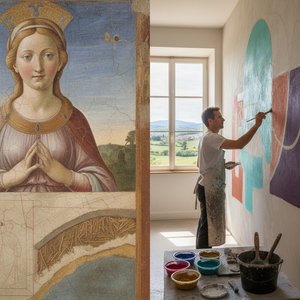
The Enduring Legacy of Fresco Painting: Techniques, History & Contemporary Relevance
Explore the rich history & enduring artistry of fresco painting – from Giotto to Michelangelo! Discover techniques, conservation efforts, & modern applications. Learn how OriginalUniqueArt brings this timeless art form to your home.

