Visa i rummet
 Skicka
 Dela
Dela
 Detaljer
 Studentguide för konstverk

 Ladda ner
 Liknande objekt
 Röntgen
 Bildspel
 Besökstatistik
Descent from the Cross
 Oil On Canvas
- WallArt
- Neoclassical Revival
 Early Modern
 366.0 x 183.0 cm
 St John’s College
 Läs mer
Giclée / Konsttryck
Giclée- eller canvasprint av museumskvalitet med snabb produktion och flexibla ytbehandlingsalternativ. ( Köp handmålat konstverk Byt till digital bildförsäljning)




P118B Skr10

P118H Skr10

P118W Skr10

P438Z Skr10

P508JH Skr12

P508YH Skr12

P805H Skr10

P805Z Skr10

P919BZ Skr10

P919G Skr10

P919XJ Skr10

P959ZH Skr10

P968JZ Skr12

W106C Skr8

W218G Skr10

W218JH Skr8

W218Y Skr10

W307PJ Skr10

W316G Skr10

W316PJ Skr8

W316Y Skr10

W398PJ Skr8

W4111J Skr10

W500HY Skr15

W500JH Skr15

W692G Skr12

W849H Skr8

W940BG Skr15

W953PJ Skr8




Välj bland våra förinställda storlekar som motsvarar konstverkets ursprungliga proportioner.

Du kan ange egna mått för att passa en specifik ram eller yta. Om det valda måttet inte överensstämmer med originalbildens proportioner kommer vi antingen att beskära konstverket eller utöka bilden med en speglad eller enfärgad kant. En digital mockup skickas för ditt godkännande innan produktionen påbörjas.
Vänligen notera att förhandsvisningen på skärmen inte återspeglar den faktiska beskärningen eller utökningen. Endast mockuppen visar den slutgiltiga kompositionen korrekt.
Även om anpassade storlekar är möjliga, rekommenderar vi att du väljer ett mått från den fördefinierade listan för att bevara de ursprungliga proportionerna.
Leverans över hela världen () på 2 veckor istället för standard 4/5 veckor. (13 oktober)

Fri expressfrakt över hela världen

Högkvalitativ linnecanvas

Fullständig fraktförsäkring

Garantier för återbetalning av tullavgifter

Garantier för exakt färgåtergivning

100 dagars returrätt vid fabrikationsfel

100% pengarna tillbaka-garanti

Mängdrabatt erbjuds
 Glasalternativet är endast tillgängligt i storlekar under 110 cm.

Descent from the Cross
Giclée / Konsttryck
Reproduktionsstorlek
-


Totalpris
Skr 781
A Monumental Vision of Faith
In the quiet, hallowed halls of St John's College, Cambridge, hangs a masterpiece that commands both silence and profound contemplation. Anton Raphael Mengs’s "Descent from the Cross" is not merely a depiction of a biblical event; it is a monumental vision of faith captured in oil on canvas. Executed around 1760, this expansive work—measuring an imposing 366 x 183 cm—serves as a bridge between the spiritual intensity of the past and the emerging intellectual clarity of the Enlightenment. The scene captures the heavy, somber moment when the body of Christ is lowered from the cross, surrounded by a group of mourners whose faces reflect a spectrum of human grief, reverence, and devotion.
The composition is masterfully orchestrated to draw the eye toward the central, cruciform arrangement of Christ’s limp form. As the light catches the pale, sculptural anatomy of the Savior, the viewer is struck by the physical weight of the moment. The figures surrounding him—some draped in religious vestments, others clutching sacred texts—create a rhythmic movement that guides the gaze through the crowded, emotional landscape. There is a palpable sense of stillness amidst the sorrow, an atmosphere where the divine meets the earthly in a singular, breathless instant of transition.
The Dawn of Neoclassical Elegance
To understand this work is to understand the pivotal shift in European aesthetics during the mid-18th century. Mengs, a titan of the Neoclassical movement, consciously sought to move away from the dizzying, ornate excesses of the Rococo style. Influenced by the rigorous theories of Johann Joachim Winckelmann, Mengs embraced a philosophy of restraint, clarity, and balanced proportions. In "Descent from the Cross," this is evident in the way he avoids unnecessary flourish, opting instead for a structured composition that mirrors the stability and moral fortitude prized during the Enlightenment.
His technique is nothing short of extraordinary. Utilizing meticulous oil glazing, Mengs achieved a luminous quality that breathes life into the skin tones and fabric of his subjects. Every brushstroke is disciplined, contributing to a sense of hyper-realistic precision that elevates the figures from mere characters to idealized icons of virtue. This technical mastery allows for subtle tonal variations that create depth and volume, making the monumental canvas feel as though it possesses its own internal light, casting a soft, spiritual glow over the entire assembly.
A Timeless Legacy for the Discerning Collector
For the art lover or the interior designer, a reproduction of this magnitude offers more than just decoration; it offers a focal point of historical and emotional gravity. The painting’s symbolism—the intersection of human suffering and divine sacrifice—resonates across centuries, making it an ideal centerpiece for spaces designed for reflection, study, or grand architectural statements. Whether placed in a private library, a formal gallery, or a sophisticated living space, the work brings with it the prestige of the Cambridge collection and the intellectual weight of the Neoclassical era.
Owning a high-quality hand-painted reproduction of Mengs’s masterpiece allows one to invite this profound sense of history into the modern home. It is an opportunity to surround oneself with the beauty of classical ideals—balance, harmony, and truth—and to celebrate a period of art history where the brush was used to capture the very essence of the human soul.
Frågor och svar
Vilket format har "Descent from the Cross" av Anton Raphael Mengs?
"Descent from the Cross" av Anton Raphael Mengs har ett Portrait-format. Formatet beskriver kompositionens proportioner.
Var rekommenderas det att visa Portrait-formatet av "Descent from the Cross"?
Med sin Portrait-form rekommenderas en reproduktion av "Descent from the Cross" för ett Living Room.
Vilken fas av Anton Raphael Mengss utveckling representerar "Descent from the Cross"?
"Descent from the Cross" tillhör Anton Raphael Mengss Mature Period i konstnärskarriären. Denna klassificering relaterar verket till konstnärens utveckling.
Vilken är den färgmässiga identiteten hos "Descent from the Cross" av Anton Raphael Mengs?
"Descent from the Cross" definieras av en Earthy-palett med Espresso (#322a27) som dominerande färg.
Vilken storlek och orientering rekommenderas för ett tryck av "Descent from the Cross" av Anton Raphael Mengs?
Storlek Large, Portrait-orientering: detta är den rekommenderade tryckinställningen för "Descent from the Cross" av Anton Raphael Mengs.
Vilken reproduktionsstorlek rekommenderas för "Descent from the Cross" av Anton Raphael Mengs?
Rekommenderad tryckstorlek för "Descent from the Cross" är Large. Andra storlekar finns tillgängliga med samma proportioner.
Kan "Descent from the Cross" av Anton Raphael Mengs, som finns i samlingen på St John’s College, reproduceras lagligt?
"Descent from the Cross" av Anton Raphael Mengs, som finns på St John’s College, är allmän egendom – upphovsrätten har löpt ut. Denna status avgör om reproduktioner av bilden får framställas.
Vilken underliggande nyans genomsyrar "Descent from the Cross" av Anton Raphael Mengs?
En Golden Yellow Range nyans går igenom "Descent from the Cross" av Anton Raphael Mengs.
Om konstnären
En bro mellan världar: Anton Raphael Mengs liv och konst
Anton Raphael Mengs framträdde under en fascinerande period i den europeiska konsten, en tid då rokokons utsmyckade detaljer började ge vika för en förnyad uppskattning av klassiska ideal. Han föddes 1728 i Ústí nad Labem, Böhmen – en region som idag är en del av Tjeckien – och hans konstnärliga resa formades djupt av både hans härkomst och upplysningens intellektuella strömningar. Hans far, Ismael Mengs, en dansk målare som fann beskydd vid hovet i Dresden, kände tidigt igen den unge Antons exceptionella talang. Denna insikt ledde till en avgörande vändpunkt 1741: en flytt till Rom, där den spirande konstnären sänktes ner i studierna av antika mästerverk och verken från renässansens stora mästare som Rafael. Det var denna exponering som för alltid skulle prägla hans estetiska sinne och ingjuta en djup vördnad för klassisk form, klarhet och komposition – egenskaper som skulle bli kännetecken för hans mogna stil. De tidiga åren ägnades åt noggrann kopiering, inte bara som en teknisk övning utan som en djup konstnärlig pilgrimsfärd för att absorbera essensen av Rafaels geni.Från Dresden till Madrid: En karriär genom europeiska hov
Mengs karriär utspelade sig vid flera framstående europeiska hov, där varje plats satte sitt unika avtryck på hans konstnärliga utveckling. År 1749 säkrade han en prestigefylld position som hovmålare åt Fredrik August, kurfurste av Sachsen, en roll som gav både ekonomisk stabilitet och friheten att behålla sin bas i Rom – epicentrum för hans konstnärliga inspiration. Det var dock hans fresker som verkligen etablerade hans rykte. Parnassus i Villa Albani i Rom, färdigställd omkring ng 1761, blev en omedelbar sensation och hyllades för sin harmoniska komposition, sina eleganta figurer och sin subtila men kraftfulla frammaning av klassisk mytologi. Detta verk var inte bara en dekorativ utsmyckning; det var ett manifest – ett medvetet försök att förena barockens storslagenhet med de framväxande neoklassiska principerna. Fler uppdrag följde, inklusive den fantastiska fresken i kupolen på kyrkan Sant'Eusebio i Rom, som visade hans mästerskap inom monumental dekoration och rumsillusioner. Kanske var hans mest ambitiösa projekt en inbjudan från det spanska hovet 1761. Han reste till Madrid, där han fick i uppdrag att dekorera flera kungliga palats, vilket kulminerade i det magnifika taket i festsalen i det kungliga palatset – ett verk som anses vara bland hans främsta prestationer och som demonstrerar en anmärkningsvärd förmåga att sammanväva italiensk elegans med spanska sinnesstämningar.Kopplingen till Winckelmann: Formandet av neoklassiskt tänkande
Mengs konstnärliga evolution drevs inte enbart av visuella studier; den var djupt sammanflätad med det intellektuella samtalet. En avgörande vändpunkt kom genom hans nära vänskap och samarbete med Johann Joachim Winckelmann, den banbrytande konsthistorikern vars skrifter skulle bli grundläggande för den neoklassiska rörelsen. Winckelmann förespråkade en återgång till den uppfattade renheten och enkelheten i den antika grekiska konsten, och förespråkade en estetik baserad på förnuft, ordning och idealiserade former. Mengs illustrerade inte bara Winckelmanns teorier; han var aktivt involverad i att forma dem genom att översätta abstrakta koncept till påtagliga konstnärliga uttryck. Tillsammans trodde de att sann skönhet inte låg i ytlig ornamentik utan i de underliggande principerna om harmoni och proportion som återfinns i antiken. Detta partnerskap sträckte sig bortom teoretiska diskussioner; det manifesterades i själva Mengs målningar, som alltmer speglade Winckelmanns betoning på ädel enkelhet och återhållsam emotion. Inflytandet var ömsesidigt: Winckelmanns skrifter gav en filosofisk ram för Mengs konstnärliga strävanden, medan Mengs konst fungerade som ett visuellt bevis på de neoklassiska idealens livskraft och skönhet.Arv och inflytande: En pionjär i sin tid
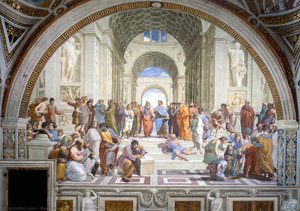
Anton Raphael Mengs dog i Rom 1779 och lämnade efter sig ett arv som sträckte sig långt bortom hans imponerande produktion. Han var mer än bara en målare; han var en nyckelfigur i övergången från en konstnärlig era till en annan. Trots att han var rotad i barocktraditionen – vilket märks i hans dramatiska användning av ljus och skugga samt hans mästerliga teknik med illusioner – omfamnade Mengs modigt de framväxande neoklassiska principerna och banade väg för konstnärer som Jacques-Louis David och Antonio Canova. Hans betoning på klassiska ideal, kombinerat med hans tekniska virtuositet, etablerade honom som en ledande kraft i formandet av 1700-talets konst. Skolan i Aten, målad för hertigen av Northumberland, står som ett bevis på hans förmåga att förena historiska förebilder med samtida konstnärliga sinnen. Utöver sina målningar och fresker sträckte sig Mengs inflytande även till utbildningsväsendet; han tjänstgjorde som direktör för Vatikanens målarskola, där han odlade en ny generation konstnärer djupt rotade i klassiska principer. Han var en komplex gestalt – en hängiven katolik som även engagerade sig i upplysningens tankevärld, en konstnär som balanserade tradition med innovation. Hans liv och verk representerar en fascinerande skärningspunkt mellan konstnärlig skicklighet, intellektuell nyfikenhet och historiska omständigheter, vilket befäster hans plats som en sann pionjär inom den neoklassiska konsten. Hans inflytande ekar än idag och påminner oss om de klassiska idealens bestående kraft att inspirera och transformera det konstnärliga uttrycket.
Anton Raphael Mengs
1728 - 1779 , Tyskland
Snabbfakta
- Artistic Movement Or Style: Neoclassicism
- Artists Or Movements Influenced By This Artist:
- David
- Canova
- Artists Who Influenced This Artist:
- Raphael
- Winckelmann
- Date Of Birth: 12 mars 1728
- Full Name: Anton Raphael Mengs
- Nationality: Tysk
- Notable Artworks:
- Parnassus
- The Dream of Joseph
- Place Of Birth: Ústí nad Labem, Böhmen
Relaterade artiklar
The Timeless Elegance of Academic Classicism: A Journey Through Order, Precision, and the Pursuit of Perfection
Explore the profound beauty of Academic Classicism. Discover how masters used order, precision, and classical ideals to achieve timeless perfection in art history, from Neoclassical portraits to the pursuit of ideal beauty.

The Enduring Legacy of Oil on Canvas: Technique, History & Aesthetic Impact
Explore the rich history & techniques of oil painting – from Renaissance masters to Impressionism. Discover pigments, layering methods, and why this timeless medium endures. Expert insights for artists & art enthusiasts.

Neoclassical Art: The Timeless Elegance of Order, Virtue, and Classical Grace
Explore the profound elegance of Neoclassical art. Discover the principles of order, symmetry, and virtue through the works of masters like David and Mengs. Immerse yourself in a journey of classical grace and timeless aesthetic perfection.
Timeless Elegance: The Ultimate Buyer's Guide to Choosing Classical Portraits for Sophisticated Interiors
Discover how to select the perfect classical portrait for your home. Our expert guide explores matching art styles to interiors, choosing between hand-painted oils and Giclée prints, and transforming personal photos into timeless masterpieces with professional artistry.

Olja på duk: En tidlös teknik – Historik, process och konstnärliga möjligheter
Utforska oljemålningskonsten! Lär dig om flamländsk teknik, materialval och historisk utveckling. Expertguider för både nybörjare och erfarna konstnärer – bevara dina målningar med bästa praxis.