Meny
Text size

() ·

A painting made for you, by hand

Hercules at the Crossroads

Handgjord oljereproduktion

Handmålad olja på duk i din valda storlek och ram, tillverkad efter beställning av våra konstnärer. ( Byt till tryck Byt till digital bild)

Beskrivning av samlarobjekt

Annibale Carracci's 'Hercules at the Crossroads' (1596) depicts a pivotal moment, showcasing virtue vs. pleasure. Explore this Baroque masterpiece’s rich symbolism and historical context.

Konstnärens biografi

Annibale Carracci: En banbrytande konstnär från Bologna som förnyade den klassiska skolan och ledde vägen mot barockens dynamik med sin färgrika och dramatiska stil.

from ·

Chapter 1

How large should it be?

Slide to change the size; the picture on the left shows the frame at its real width. The proportions of the original are kept.

Standardstorlek
skräddarsydd
CM
INCH

Välj bland våra förinställda storlekar som motsvarar konstverkets ursprungliga proportioner.

bredd
höjd

Ange den bredd och höjd du behöver för att passa din ram eller din vägg. Eftersom detta är handmålat kan konstnären, vid ett annat format, måla lite mer runt bilden eller beskära den något – det är du som väljer. Vi skickar en digital mockup för godkännande innan målningen påbörjas. Bilden som visas på denna sida representerar inte det slutgiltiga resultatet — det är endast mockuppen som visar det.

Chapter 2

How should it arrive?

Choose the edges of the stretched canvas

Choose your frame

Corner sample of the WhiteWrap canvas edge finish, stretched on massivt trä bars
White Skr1
Corner sample of the BlurSideWrap canvas edge finish, stretched on massivt trä bars
Blurside Skr1
Corner sample of the ExtendedWrap canvas edge finish, stretched on massivt trä bars
Extended Skr1
Corner sample of the P118B picture frame: formgjuten polystyren, 5 cm wide and 3 cm thick
P118B Skr10
Corner sample of the P118H picture frame: formgjuten polystyren, 5 cm wide and 3 cm thick
P118H Skr10
Corner sample of the P118W picture frame: formgjuten polystyren, 5 cm wide and 3 cm thick
P118W Skr10
Corner sample of the P438Z picture frame: formgjuten polystyren, 5.5 cm wide and 3.5 cm thick
P438Z Skr10
Corner sample of the P508JH picture frame: formgjuten polystyren, 7 cm wide and 3.5 cm thick
P508JH Skr12
Corner sample of the P508YH picture frame: formgjuten polystyren, 7 cm wide and 3.5 cm thick
P508YH Skr12
Corner sample of the P805H picture frame: formgjuten polystyren, 5 cm wide and 3.5 cm thick
P805H Skr10
Corner sample of the P805Z picture frame: formgjuten polystyren, 5 cm wide and 3.5 cm thick
P805Z Skr10
Corner sample of the P919BZ picture frame: formgjuten polystyren, 7 cm wide and 3.5 cm thick
P919BZ Skr10
Corner sample of the P919G picture frame: formgjuten polystyren, 7 cm wide and 3.5 cm thick
P919G Skr10
Corner sample of the P919XJ picture frame: formgjuten polystyren, 7 cm wide and 3.5 cm thick
P919XJ Skr10
Corner sample of the P959ZH picture frame: formgjuten polystyren, 5 cm wide and 3 cm thick
P959ZH Skr10
Corner sample of the P968JZ picture frame: formgjuten polystyren, 6 cm wide and 4 cm thick
P968JZ Skr12
Corner sample of the W106C picture frame: massivt trä, 5 cm wide and 3 cm thick
W106C Skr8
Corner sample of the W218G picture frame: massivt trä, 5 cm wide and 3 cm thick
W218G Skr10
Corner sample of the W218JH picture frame: massivt trä, 5 cm wide and 3 cm thick
W218JH Skr8
Corner sample of the W218Y picture frame: massivt trä, 5 cm wide and 3 cm thick
W218Y Skr10
Corner sample of the W307PJ picture frame: massivt trä, 6 cm wide and 3 cm thick
W307PJ Skr10
Corner sample of the W316G picture frame: massivt trä, 6 cm wide and 3 cm thick
W316G Skr10
Corner sample of the W316PJ picture frame: massivt trä, 6 cm wide and 3 cm thick
W316PJ Skr8
Corner sample of the W316Y picture frame: massivt trä, 6 cm wide and 3 cm thick
W316Y Skr10
Corner sample of the W398PJ picture frame: massivt trä, 5 cm wide and 3 cm thick
W398PJ Skr8
Corner sample of the W4111J picture frame: massivt trä, 6.5 cm wide and 3.5 cm thick
W4111J Skr10
Corner sample of the W500HY picture frame: massivt trä, 7 cm wide and 5 cm thick
W500HY Skr15
Corner sample of the W500JH picture frame: massivt trä, 7 cm wide and 5 cm thick
W500JH Skr15
Corner sample of the W692G picture frame: massivt trä, 8 cm wide and 4 cm thick
W692G Skr12
Corner sample of the W849H picture frame: massivt trä, 5 cm wide and 3 cm thick
W849H Skr8
Corner sample of the W940BG picture frame: massivt trä, 7.5 cm wide and 4.5 cm thick
W940BG Skr15
Corner sample of the W953PJ picture frame: massivt trä, 6 cm wide and 3.5 cm thick
W953PJ Skr8
Corner sample of the H24-GOLD picture frame: snidad trä med gesso, 10 cm wide and 6 cm thick
H24-GOLD Skr30
Corner sample of the H24-SILVER picture frame: snidad trä med gesso, 10 cm wide and 6 cm thick
H24-SILVER Skr30
Corner sample of the H36-GOLD picture frame: snidad trä med gesso, 15 cm wide and 6.5 cm thick
H36-GOLD Skr45
Corner sample of the H36-SILVER picture frame: snidad trä med gesso, 15 cm wide and 6.5 cm thick
H36-SILVER Skr45
Förhandsvisning av ram
Inramad

Moulding: . Overall size with the frame: .

Chapter 3

Who paints it, and should anything change?

Examples of what can be changed: Replace face with customer photo; Add pet (e.g., replace cat with dog); Include hidden message in background; Change background landscape or elements.

After order, OriginalUniqueArt.com team will email client for instructions and provide a mockup preview

Leverans över hela världen () på 3–4 veckor istället för standard 5 veckor. (29 oktober). Inga kompromisser med kvaliteten.

Chapter 4

The finishing touches

A nameplate, as in a museum?

Detaljer för graverad bronsplatta

This elegant plaque features the artist's name and the title of the artwork, finely engraved for a timeless presentation.

It is made from bronze with a refined, elegant finish. The text is precisely laser-engraved for a sharp and permanent result. Measuring 9x2 cm, the plaque is compact yet easy to read. It's built to be durable and scratch-resistant, offering a professional, museum-quality look. Mounting is simple thanks to the included adhesive backing.

Detaljer för transparent akrylplatta

The plaque includes essential engraved details such as the artist's name, the title of the artwork, the date it was created, the type of media used-like oil on canvas or watercolor-a brief description of the piece, and a QR code that links to the complete artwork information.

It is crafted from clear acrylic, offering a sleek, modern appearance. The text is UV-engraved in black to ensure strong visual contrast. With a size of 10x15 cm, it ensures optimal readability. It comes equipped with two metal hooks for secure wall mounting. The plaque is designed to be weather-resistant, making it suitable for various environments, and it includes interactive features that work seamlessly with smartphone scanning.

Detaljer för svart akrylplatta

This elegant plaque includes engraved information such as the artist's name, the title of the artwork, the date it was created, the type of media used (like oil on canvas or watercolor), a short description of the artwork, and a QR code for quick access to more information.

The plaque itself is made from refined black acrylic with a premium finish. The text is laser-engraved in white for high contrast and readability. Its size is 10x15 cm, designed to be easy to read. It comes with two metal hooks for professional mounting. The design is sleek and fits any interior style. It is also weather-resistant and durable, with built-in digital integration for mobile compatibility.

A protective varnish?

When do you need it?

Chapter 5

Your painting, as you ordered it

Hercules at the Crossroads

Reproduktionsmetod

Storlek på reproduktion

-

Elitkonstnär av högsta klass

Mer detaljrikedom, finess och extra produktionstid

-

Inramning av reproduktion

-

-

För konstverk eller reproduktioner som är större än 105 cm (cirka 41 tum) på någon sida, levereras ramen som ett isärplockat kit. Denna metod säkerställer en trygg leverans och förhindrar skador under transport.

Professionell montering krävs – detta är inte en produkt för självmontering.
Kitet måste monteras och duken spännas av en erfaren professionell inramare med hjälp av trälim (ingår ej), en spänntång för duk och klämmor för att hålla sargen rak medan limmet torkar. Felaktig montering eller ojämn spänning av duken kan orsaka permanenta skador på konstverket och täcks inte av vår garanti.

  • Alla massiva träribbor ingår, exakt tillkapade efter mått.

  • Monteras med de medföljande skruvarna, samt trälim för hörnfogarna, vilket inte ingår och måste anskaffas av din ramverkare.

  • Professionella verktyg krävs och ingår ej: en dukspännare och klämmor för att hålla listerna raka medan limmet torkar.

Viktigt:
Hörnjunctionerna kräver trälim, listerna måste hållas på plats med tvingar tills limmet har torkat helt, och för att spänna duken på den monterade ramen krävs en spänntång för duk. Inget av detta ingår i kitet. Vänligen kontakta en erfaren professionell rammakare innan du beställer denna storlek.

Namnskylt

-

-

Skyddande fernissa

Glansig fernissa (förstärker färgerna, skyddar mot ljus och fukt)

-

Anpassa mitt konstverk

Exempel på vad som kan ändras: Byt ut ansiktet mot ett foto från kunden; Lägg till ett husdjur (t.ex. byt ut en katt mot en hund); Inkludera ett dolt meddelande i bakgrunden; Ändra bakgrundens landskap eller detaljer.

-

Expressleverans

Leverans över hela världen () inom 3–4 veckor istället för standardiserade 5 veckor. (29 oktober). Inga kompromisser med kvaliteten.

-

Expressleverans

Leverans över hela världen () inom 5 veckor. (5 november).

Ingår

Slutgiltigt pris

Skr 3001

Totalt pris Skr 3001

Glasalternativet är endast tillgängligt i storlekar under 110 cm.

Included with every order

  • Fri expressfrakt över hela världen
  • Högkvalitativ linnecanvas
  • Fullständig fraktförsäkring
  • Garantier för återbetalning av tullavgifter
  • Garantier för exakt färgåtergivning
  • 100 dagars returrätt (endast vid fel)
  • 100% pengarna tillbaka-garanti
  • Mängdrabatt erbjuds

A Crossroads of Virtue and Vice: Annibale Carracci’s “Hercules at the Crossroads”

Annibale Carracci's "Hercules at the Crossroads," painted between 1596 and 1597 for the opulent Camerino room within the Farnese Palace in Rome, is more than just a depiction of a legendary hero; it’s a meticulously crafted allegory of human choice, a vibrant testament to Renaissance ideals, and a remarkably prescient foreshadowing of Baroque dynamism. This monumental oil on canvas, now housed in the Capodimonte Museum in Naples, immediately commands attention with its dramatic composition and rich palette, drawing the viewer into a pivotal moment in Hercules’s life – a moment of profound deliberation between the allure of pleasure and the demanding path of virtue.

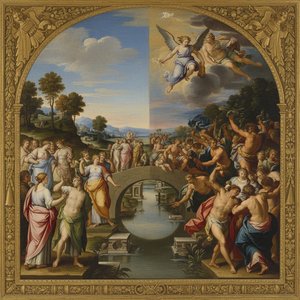
The scene unfolds within a verdant, almost Edenic landscape, sharply divided to mirror the two opposing forces confronting the hero. To his left, a seductive vision of Pleasure beckons, an explosion of vibrant color and theatricality. Playing cards spill from hands, musical instruments overflow, and masked figures dance in a whirlwind of indulgence – a direct reference to the hedonistic pursuits that Hercules could easily abandon for immediate gratification. The terrain here is lush and inviting, a rolling meadow promising ease and fleeting joy. Conversely, on the right, Virtue stands firm and resolute, bathed in cooler tones of blue and red. She points towards a rugged, winding road leading upwards – a steep ascent toward a winged Pegasus, symbolizing divine favor and ultimate glory. This landscape is starker, drier, and more challenging, reflecting the arduous journey demanded by moral righteousness.

The Mythic Foundation and Farnese Ideology

Carracci’s painting isn't simply illustrating a Greek myth; it’s deeply rooted in the philosophical currents of his time. The story originates from Prodicus, a Sophist who presented Hercules with two paths: one leading to immediate pleasure through worldly pursuits, the other demanding hardship and dedication to virtue. Cardinal Odoardo Farnese, the palace's librarian and a key patron of the arts, recognized the potent symbolism within this parable – a visual representation of the virtues he wished to instill in his court. Fulvio Orsini, another influential figure at the Farnese Palace, further shaped the painting’s iconography, drawing inspiration from ancient Greek tales recounted by Cicero, ensuring the narrative resonated with humanist ideals.

The choice of Hercules himself is significant. He represents not just strength and heroism but also a crucial test – a demonstration that even a demigod could be tempted by earthly desires. The painting’s placement within the Camerino room, a space designed to embody moral principles, underscores its didactic purpose. It wasn't intended as mere decoration; it was a carefully orchestrated visual sermon, guiding visitors toward a life of virtue and civic responsibility – a core tenet of Renaissance humanism.

A Synthesis of Styles: High Renaissance and Baroque Foreshadowing

Carracci’s genius lies in his masterful synthesis of artistic styles. While deeply influenced by the classical ideals of the High Renaissance, particularly Michelangelo's frescoes in the Sistine Chapel, he skillfully incorporates elements that prefigure the dramatic intensity and emotional depth characteristic of the emerging Baroque style. The figures are rendered with a remarkable sense of volume and plasticity, echoing Michelangelo’s monumental forms but imbued with a greater dynamism and expressiveness. Notice how Hercules himself is not depicted as a static hero but as a figure caught in a moment of intense contemplation – his posture conveying both strength and vulnerability.

The use of color is equally striking. The vibrant hues of Pleasure contrast sharply with the cooler tones of Virtue, creating a visual tension that mirrors the internal conflict at the heart of the myth. Carracci’s brushwork is loose and expressive, abandoning the meticulous detail favored by earlier Renaissance painters in favor of a more fluid and gestural approach – a hallmark of Baroque painting. This deliberate shift signals a move towards greater emotional impact and a heightened sense of realism.

Symbolism and Emotional Resonance

Beyond its narrative content, “Hercules at the Crossroads” is rich in symbolic detail. The poet crowned with laurels at the bottom left serves as a moral guide, assuring Hercules that virtue will ultimately lead to renown. The presence of Pegasus, representing divine favor, underscores the rewards awaiting those who choose the path of righteousness. Even the landscape itself contributes to the painting’s meaning – the lush meadow symbolizing fleeting pleasure, the rugged road signifying the arduous journey toward true fulfillment.

Ultimately, “Hercules at the Crossroads” is a profoundly moving work that speaks to the universal human struggle between desire and duty. It invites viewers to contemplate their own choices, to consider the consequences of their actions, and to embrace the virtues that will lead them towards a life of purpose and meaning. Its enduring power lies not only in its masterful execution but also in its timeless message – a reminder that true glory is found not in fleeting pleasures but in unwavering commitment to moral principles.

Frågor och svar

Förvaras "Hercules at the Crossroads" av Annibale Carracci i konstnärens hemland?

Ja – konstverket förvaras i konstnärens hemland. Annibale Carracci föddes i Italien, och museet som förvarar originalet av "Hercules at the Crossroads" ligger i Italien.

Under vilka andra namn är Annibale Carracci känd?

Annibale Carracci är även känd som Ludovico Carracci, Agostino Carracci.

Vilket rum rekommenderas för "Hercules at the Crossroads" av Annibale Carracci?

En reproduktion av "Hercules at the Crossroads" passar bra i ett Living Room.

More about this painting

Förhandsvisa Förhandsgranska i AR Byt till tryck Byt till digital bild Skicka
Visa detaljer Guide Lägg till i favoriter Ladda ner Liknande objekt Röntgen Bildspel Q&A Statistik

In numbers

  • 1596the year it was painted
  • 29frames to choose from
  • standard sizes, in its own proportions
  • 5weeks to paint and deliver it
Annibale Carracci

Annibale Carracci

1560 - 1609, Italien

Quick facts about Annibale Carracci

  • Artistic Movement Or Style: Barock
  • Artists Or Movements Influenced By This Artist: ['Bologneskolan']
  • Artists Who Influenced This Artist:
    • Raffael
    • Andrea del Sarto
  • Date Of Birth: 3 nov 1560
  • Date Of Death: 15 juli 1609
  • Full Name: Annibale Carracci
  • Nationality: Italiensk
  • Notable Artworks:
    • Triumf av Bacchus
    • Gudarnas kärlek
  • Place Of Birth: Bologna, Italien

Konstnärsbiografi

Early Life and the Bolognese Roots

Annibale Carracci, född den 3 november 1560 i Bologna, var en italiensk målare och grafiker vars liv och verk är djupt sammanflätade med den konstnärliga utvecklingen i hans hemstad. Hans barndom och tidiga utbildning präglades av en stark familjär tradition inom konsten – hans far var skomakare, men familjen sysslade även med målning, vilket gav Annibale en unik möjlighet att växa upp i ett miljö där konst var en integrerad del av vardagen. Det är troligt att han fick sin första träning inom familjens verkstad, där han lärde sig grunderna i tekniken och utvecklade sina färdigheter under den tidiga åldern. Bologna på 1500-talet var en dynamisk stad, ett centrum för intellektuell och konstnärlig aktivitet som samtidigt kändes något avlägsen från de dominerande strömningarna i Rom och Venedig. Denna känsla av provinsialism bidrog till att driva fram en ambition bland en grupp unga konstnärer – Annibale, hans bror Agostino och kusinen Ludovico – att skapa sin egen väg, en som skulle revitalisera italiensk konst genom att återvända till de klassiska idealen samtidigt som de omfamnade en mer naturalistisk approach.

År 1582 materialiserades denna ambition i grundandet av *Accademia degli Incamminati*, initialt känd som *Academia dei Desiderosi*. Detta var inte bara ett arbetsrum; det var en katalysator för konstnärliga innovationer, en plats dedikerad till rigorös livsteckning, passionerade debatter och en gemensam strävan efter konstnärlig excellens. Akademin själv, vars namn – ”De Strävande” – antydde dess syfte: att gå bortom de stilistiska kompliceringarna i Mannerismen och kartlägga en ny kurs mot ett mer jordbundet och känslomässigt resonansfullt uttryck. *Incamminati* blev en föregångare för konstakademier över hela Europa, med betoning på observation från livet som grundstenen i konstnärlig utbildning.

A Synthesis of Styles and Influences

Carraccis konstnärliga vision var inte skapad i vakuum; den formades noggrant genom en djupgående engagemang med de arvtagare av tidigare mästares verk. Han besatt en exceptionell förmåga att syntetisera olika influenser, vilket resulterade i en stil som kändes både djupt rotad i tradition och ändå distinkt originell. Han beundrade klarheten i linjerna och den kompositionella balansen hos Raphael och Andrea del Sarto, strävandes att efterlikna deras graciöshet och harmoni. Samtidigt erkände han dock kraften i färg och atmosfäriska effekter som främjats av venetianska målare som Titian, vilket lade till en livfull ljusstyrka och känslomässig djup i sin egen konst.

Correggios inflytande var särskilt betydelsefullt, vilket framgår i Carraccis dynamiska kompositioner och illusionistiska tekniker – särskilt som visat sig i hans fresker i Palazzo Farnese. Han kopierade inte bara dessa mästare; han absorberade deras styrkor och förvandlade dem till något nytt. Denna eklektiska blandning blev kännetecknande för den Bolognese Skolan, en betydande gren av barockkonsten som betonade både klassiska ideal och naturalistisk observation. Carraccis geni låg i hans förmåga att förena synes motsägelsefulla element, vilket skapade ett harmoniskt helhet som resonerade med både intellektuell rigor och känslomässig kraft.

The Roman Triumph: Palazzo Farnese and Beyond

Inbjudan till att dekorera Palazzo Farnese i Rom markerade en avgörande punkt i Annibale Carraccis karriär. Denna monumentala beställning – en omfattande fresksvit som skildrade scener från mytologin – gav honom en oöverträffad möjlighet att visa upp sin konstnärliga skicklighet och etablera sitt rykte på en stor skala. *Triumph of Bacchus and Ariadne*, sannolikt hans mästerverk, är en betäckande demonstration av illusionistisk teknik, dynamisk komposition och livfull färg. Freskerna verkar sudda ut gränserna mellan målning och verklighet, och drar betraktaren in i en värld av mytologisk prakt.

Tillsammans med *Triumph* genomförde Carracci också *The Loves of the Gods* i Palazzo Farnese, vilket ytterligare utforskade teman om mytologi och kärlek med en blandning av klassisk idealism och skarp observation. Dessa verk var inte bara dekorativa; de var uttömmande uttalanden om konstens kraft att höja den mänskliga ande och fira naturens skönhet. Hans framgång i Rom fastställde hans position som en av de ledande konstnärerna på sin tid, vilket lockade en ström av beställningar och inspirerade generationer av målare.

Legacy and Historical Significance

Annibale Carraccis inverkan på konsthistorien är obestridlig. Han spelade en nyckelroll i att brygga klyftan mellan den höga renässansen och barockperioden, och flyttade bortom de stilistiska kompliceringarna i Mannerismen mot ett mer dynamiskt och känslomässigt laddat estetiskt uttryck. Hans betoning på naturalism – på att skildra figurer med anatomisk noggrannhet och psykologisk djup – banade väg för konstnärer som Caravaggio, som ytterligare revolutionerade italiensk målning med sina dramatiska användningar av ljus och skugga.

Accademia degli Incamminati, grundad av Carracci och hans kollegor, fungerade som en föregångare för konstakademier över hela Europa, främjade konstnärlig utbildning baserad på observation och klassiska principer. Hans fresker i Palazzo Farnese är fortfarande ikoniska exempel på barockillusionism och konstnärlig prakt, och fortsätter att inspirera beundran och uppskattning århundraden efter deras skapande. Den kollektiva arvtagarinnan av Carracci-familjen – Annibale, Agostino och Ludovico – är en djupgående innovation och bestående inflytande, etablerade Bologna som ett viktigt centrum för konstnärlig kreativitet.

Kortfakta

  • Subject or theme: Mythological allegory
  • Location: Capodimonte Museum
  • Influences: Michelangelo
  • Artist: Annibale Carracci
  • Year: 1596