

 Visa i rummet
 Skicka
 Dela
Dela
 Detaljer

 Ladda ner
 Liknande objekt
 Röntgen
 Bildspel
 Besökstatistik
Untitled
 Oil On Canvas
- WallArt
- Cubism
 1913
1913- Modern
 28.0 x 34.0 cm
 Centro de Arte Moderna Gulbenkian
 Läs mer
Giclée / Konsttryck
Giclée- eller canvasprint av museumskvalitet med snabb produktion och flexibla ytbehandlingsalternativ. ( Köp handmålat konstverk Byt till digital bildförsäljning)




P118B $10

P118H $10

P118W $10

P438Z $10

P508JH $12

P508YH $12

P805H $10

P805Z $10

P919BZ $10

P919G $10

P919XJ $10

P959ZH $10

P968JZ $12

W106C $8

W218G $10

W218JH $8

W218Y $10

W307PJ $10

W316G $10

W316PJ $8

W316Y $10

W398PJ $8

W4111J $10

W500HY $15

W500JH $15

W692G $12

W849H $8

W940BG $15

W953PJ $8




Välj bland våra förinställda storlekar som motsvarar konstverkets ursprungliga proportioner.

Du kan ange egna mått för att passa en specifik ram eller yta. Om det valda måttet inte överensstämmer med originalbildens proportioner kommer vi antingen att beskära konstverket eller utöka bilden med en speglad eller enfärgad kant. En digital mockup skickas för ditt godkännande innan produktionen påbörjas.
Vänligen notera att förhandsvisningen på skärmen inte återspeglar den faktiska beskärningen eller utökningen. Endast mockuppen visar den slutgiltiga kompositionen korrekt.
Även om anpassade storlekar är möjliga, rekommenderar vi att du väljer ett mått från den fördefinierade listan för att bevara de ursprungliga proportionerna.
Leverans över hela världen () på 2 veckor istället för standard 4/5 veckor. (20 september)

Fri expressfrakt över hela världen

Högkvalitativ linnecanvas

Fullständig fraktförsäkring

Garantier för återbetalning av tullavgifter

Garantier för exakt färgåtergivning

100 dagars returrätt vid fabrikationsfel

100% pengarna tillbaka-garanti

Mängdrabatt erbjuds
 Glasalternativet är endast tillgängligt i storlekar under 110 cm.

Untitled
Giclée / Konsttryck
Reproduktionsstorlek
-


Totalpris
$ 80
A Symphony of Geometry: The Radiant Vision of Amadeo de Souza-Cardoso
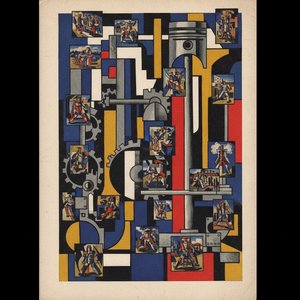
In the early tremors of the twentieth century, as the old world began to fracture under the weight of modernity, a new visual language was being whispered in the studios of Paris and the quiet corners of Portugal. At the heart of this revolution stood Amadeo de Souza-Cardoso, a luminary of Portuguese Modernism whose brief but incandescent career acted as a bridge between tradition and the avant-garde. His 1913 masterpiece, “Untitled,” serves as a breathtaking testament to this era of transition. It is not merely an arrangement of shapes, but a rhythmic dance of form and color that captures the very pulse of a world in motion. To gaze upon this work is to witness the moment where Cubist structure meets Expressionist soul, creating a composition that feels both mathematically precise and emotionally boundless.
The painting’s architecture is built upon a captivating geometric choreography. A dominant central circle acts as the piece's gravitational anchor, embodying a sense of wholeness and spiritual unity. This primary orb is surrounded by a constellation of smaller circles, meticulously placed to generate an intricate, pulsating pattern that draws the eye into a continuous loop of discovery. To disrupt this circular harmony, Souza-Cardoso introduced sharp, angular triangles on the periphery—one anchoring the left and another balancing the right. These triangular interventions create a sophisticated visual tension, a dialogue between the soft, infinite nature of the circle and the aggressive, directional energy of the triangle. For the discerning collector or interior designer, this balance offers a unique versatility; it possesses enough structural rigor to ground a modern space, yet enough fluid movement to breathe life into a minimalist setting.
Technique and the Palette of Emotion
Beyond its formal arrangement, “Untitled” is a masterclass in the expressive potential of oil on canvas. Souza-Cardoso utilized a technique of layering and subtle blending that allows light to seem as though it is emanating from within the pigment itself. The color palette is a bold, evocative choice: deep, nocturnal blues are set against vibrant, fiery reds. These are not merely decorative hues; they represent the duality of the human experience—the calm of contemplation versus the heat of passion. The way these colors interact at the edges of the geometric forms creates a luminous depth, defying the inherent flatness of abstract shapes. This interplay of light and saturated color ensures that the artwork remains visually arresting from every angle, making it an ideal centerpiece for those seeking to evoke a sense of sophisticated drama.
Historically, this work sits at the crossroads of the most influential movements of the 1910s. Having been deeply moved by the radical shifts occurring in Paris, Souza-Cardoso integrated the fragmented perspectives of Cubism with the raw, emotive power of Expressionism. In “Untitled,” we see the artist rejecting the literal representation of the world in favor of a more profound truth: that energy, shape, and color can communicate what words cannot. For anyone looking to curate a collection of high-quality reproductions, this piece offers more than just aesthetic beauty; it offers a connection to the very dawn of modern thought, providing an enduring sense of intellectual and emotional inspiration for any curated environment.
Om konstnären
Amadeo de Souza-Cardoso, A Pioneer of Portuguese Modernism: The Life and Art of Amadeo de Souza-Cardoso
Amadeo de Souza-Cardoso, a name resonating with the vibrant energy of early 20th-century modernism, remains a somewhat enigmatic figure despite his pivotal role in bridging Portuguese art to the international avant-garde. Born on November 14, 1887, in Manhufe, Portugal, his brief but intensely creative life was marked by a restless spirit and an unwavering dedication to artistic innovation. From humble beginnings rooted in the rural landscapes of his homeland, Souza-Cardoso embarked on a journey that would lead him to the heart of Parisian modernism, where he forged connections with some of the most influential artists of his time – Modigliani, Brancusi, Delaunay, and Gris among them. His early education began with architectural studies in Lisbon, but it was the allure of painting, particularly the expressive power of caricature, that truly captured his imagination and set him on a path toward artistic exploration. This initial foray into art wasn’t merely technical training; it was an awakening to the potential of visual language as a means of commentary and self-expression.- Early Life: Amadeo was born in Manhufe, Portugal, the son of José Emygdio de Souza-Cardoso, rural landowner and Emília Cândida Ferreira Cardoso. His maternal uncle, Francisco José Ferreira Lopes Cardoso, affectionately nicknamed “Uncle Chico”, supports him on his artistic vocation since he was young.
- Parisian Encounters: In 1906, Souza-Cardoso relocated to Paris, immersing himself in the city’s thriving artistic milieu. Initially continuing his architectural pursuits, he soon gravitated towards painting, quickly absorbing the radical ideas that were reshaping the art world. The influence of Cubism and Futurism became increasingly apparent in his work around 1910, establishing him as one of Portugal's first true modern painters.
- Artistic Style: Souza-Cardoso didn’t simply mimic these movements; he synthesized them with his own unique sensibility, creating a style characterized by bold forms, vibrant colors, and dynamic compositions. His paintings weren’t merely representations of reality but rather explorations of perception, emotion, and the very essence of form itself.
- Cultural Synthesis: Souza Cardoso’s artistic journey wasn't a complete severance from his Portuguese roots. Despite embracing the avant-garde spirit of Paris, he maintained a strong connection to his homeland, frequently returning to Manhufe. This duality is reflected in his art, where themes and motifs drawn from Portuguese culture – religious processions, rural landscapes, folk traditions – are interwoven with modernist techniques.
Key Characteristics of Souza-Cardoso’s Work
- Innovative Style: A pioneering approach to modern Portuguese art, blending Cubism, Futurism, and his own unique sensibility.
- Vivid Color Palette: Characterized by aggressive and vibrant use of color, creating dynamic and emotionally resonant compositions.
- Dynamic Composition: Often employing fragmented perspectives and seemingly chaotic arrangements that are, in fact, carefully balanced and structured.
- Cultural Synthesis: A unique ability to reconcile Portuguese themes and motifs with modernist techniques, creating a dialogue between cultures.
- Early Abstraction: Exploration of abstraction, particularly in his later works, pushing the boundaries of representational art.
Legacy and Remembrance: A Lasting Impact
Tragically, Amadeo de Souza-Cardoso’s promising career was cut short by his untimely death on October 25, 1918, at the age of just thirty. He succumbed to pneumonia during the Spanish Flu pandemic, leaving behind a relatively small but remarkably impactful body of work. For many years, his contributions were overlooked, overshadowed by more prominent figures in the modernist movement. However, in recent decades, there has been a growing recognition of his significance as a pioneer of Portuguese modernism and an important voice within the broader European avant-garde. Two major retrospectives – one in 1958 and another at the Grand Palais in Paris in 2016 – have helped to reintroduce his work to a wider audience, solidifying his place in art history. Today, his paintings can be found in museums around the world, including the Plymouth City Museum and Art Gallery, alongside works by other notable artists. His legacy continues to inspire contemporary artists, serving as a reminder of the power of artistic innovation and the enduring importance of cultural exchange.Useful Links
- Wikipedia: This article includes a list of...
- Swedish Wikipedia: Amadeo de Souza-Cardoso, född 14 november 1887 in Amarante – död 25 oktober 1918 in Espinho, var en portugisisk målare, en pionjär inom modern konst.
Additional Information
- Souza Cardoso’s paintings can be found in museums around the world.

Amadeo de Souza-Cardoso
1887 - 1918 , Portugal
Snabbfakta
- Artistic Movement Or Style: Modernism; Cubism; Futurism
- Artists Or Movements Influenced By This Artist:
- Cubism
- Futurism
- Artists Who Influenced This Artist:
- Modigliani
- Brancusi
- Delaunay
- Gris
- Date Of Birth: 14 november 1887
- Date Of Death: 25 oktober 1918
- Full Name: Amadeo de Souza-Cardoso Ferreira
- Nationality: Portugisisk
- Notable Artworks:
- Saut du Lapin
- Cabeça
- Place Of Birth: Manhufe, Portugal
Relaterade artiklar
Fernand Léger: Topp 25 mästerverk – Modernismens färgstarka visionärer | OriginalUniqueArt
Utforska Fernand Légers 25 mest ikoniska målningar! Fördjupa dig i kubismens värld, maskinålderns färgstarka estetik och tidlösa konstverk. Köp reproduktioner av högsta kvalitet på OriginalUniqueArt.com – för din inredning.

Topp 10 mästerverk inom abstrakt expressionism – konst för ditt hem | OriginalUniqueArt.com
Utforska de 10 mest inflytelserika verken inom abstrakt expressionism – från Rothkos färgfält till Pollocks action painting. Lär känna konstnärerna och deras teknik. Hitta museumskvalitativa tryck på OriginalUniqueArt.com och förvandla ditt hem med tidlös konst!

Geometrisk Abstraktion: Topp 10 Mästverk som Formade Konsten | OriginalUniqueArt.com
Utforska de 10 mästerverk som definierade geometrisk abstraktion! Lär känna Mondrian, Kandinsky & Malevich. Hitta inspiration och museumskvalitativa konsttryck för ditt hem på OriginalUniqueArt.com. Upptäck hela samlingen online!

De 10 mest ikoniska målningarna i nyansen 'Skifferblått' – Konst & Inredning
Utforska de 10 mest ikoniska målningarna dominerade av nyansen 'skifferblått'. Lär känna Monet, Van Gogh & andra mästare. Hitta inspiration för din inredning och köp museumkvalitativa konsttryck på OriginalUniqueArt.com – din källa till tidlös skönhet.

Kandinskys 25 Mästerverk: En Färgstark Resa i Abstrakt Konst | OriginalUniqueArt
Utforska Wassily Kandinskys 25 mest ikoniska verk – från expressionism till abstrakt konst. Lär känna historien bakom mästerverken och hitta inspiration för din heminredning med OriginalUniqueArt.com. Upptäck hela samlingen online!


