

 Förhandsvisa
 Skicka
 Dela
Dela
 Visa detaljer

 Ladda ner
 Liknande objekt
 Röntgen
 Bildspel
 Statistik
Marseille
 Visa mer
Handgjord oljereproduktion
Handmålad olja på duk i din valda storlek och ram, tillverkad efter beställning av våra konstnärer. ( Byt till tryck Byt till digital bild)




































Välj bland våra förinställda storlekar som motsvarar konstverkets ursprungliga proportioner.

Du kan ange egna mått för att passa en specifik ram eller yta. Om den valda storleken inte matchar originalbildens proportioner kommer vi antingen att beskära konstverket eller utöka målningen med ytterligare handmålade element. En digital skiss skickas till dig för godkännande innan produktionen påbörjas.
Observera att förhandsvisningen på skärmen inte återspeglar den faktiska beskärningen eller utökningen. Endast skissen visar den slutgiltiga kompositionen korrekt.
Även om anpassade storlekar är möjliga, rekommenderar vi att du väljer en dimension från den fördefinierade listan för att bevara originalproportionerna.
Efter beställning kommer OriginalUniqueArt.com team att mejla kunden för instruktioner och tillhandahålla en skissförhandsvisning
Leverans över hela världen () på 3–4 veckor istället för standard 5 veckor. (16 september). Inga kompromisser med kvaliteten.

Fri expressfrakt över hela världen

Högkvalitativ linnecanvas

Fullständig fraktförsäkring

Garantier för återbetalning av tullavgifter

Garantier för exakt färgåtergivning

100 dagars returrätt (endast vid defekter)

100% pengarna tillbaka-garanti

Mängdrabatt erbjuds
 Glasalternativet är endast tillgängligt i storlekar under 110 cm.

Marseille
Reproduktionsmedium
Storlek på reproduktion
-


Slutgiltigt pris
$ 300
Konstnärsbiografi
The Lens of a Changing Era
Born in the sun-drenched landscape of Aix-en-Provence in 1820, Adolphe Terris emerged as a pivotal figure in the history of nineteenth-century photography. While many of his contemporaries focused on the static portraits of the elite, Terris turned his gaze toward the breathing, evolving pulse of the urban environment. His life and work became inextricably linked to the transformation of Marseille during the Belle Époque, a period marked by rapid industrialization and profound architectural shifts. Through his meticulous lens, he did not merely record the passage of time; he captured the very soul of a city in flux, documenting the transition from historic bastions to modern thoroughfares with an artist's eye for composition and atmosphere.
Terris’s approach to the photographic medium was deeply informed by his rigorous early education in mathematics and natural sciences. This scientific foundation provided him with the technical precision necessary to master the demanding wet collodion process, a method that required immense skill and immediate execution. However, it was his artistic training at the École Supérieure des Beaux-Arts in Paris that truly elevated his work from mere documentation to fine art. Under the influence of the Romantic and Impressionist movements, and notably mentored by the legendary Eugène Delacroix, Terris learned to perceive light, shadow, and tonal gradation as expressive tools. This unique synthesis of scientific accuracy and painterly sensibility allowed him to imbue his silver prints with a palpable sense of drama and movement.
A Monumental Documentation of Marseille
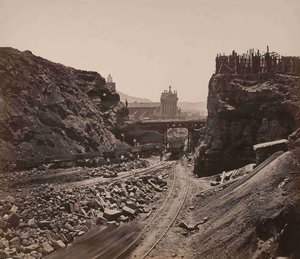
The true legacy of Adolphe Terris lies in his ambitious, large-scale project to survey the changing face of Marseille. Commissioned by municipal authorities and the prefectural administration, he undertook a systematic recording of the city's streets, public spaces, and monumental construction sites. This was a period of immense upheaval; the creation of new boulevards, such as the Boulevard de l'Empereur, necessitated the demolition of ancient neighborhoods and the displacement of thousands. Terris stood amidst the rubble and the rising ironwork, capturing the grit of construction alongside the grandeur of new engineering feats.
His work serves as a vital historical archive, preserving the memory of structures that no longer exist. Whether documenting the Percée du Fort St. Nicolas or the bustling activity of the Rue Impériale, his images offer a window into the industrial spirit of the age. His photographic style often mirrored the groundbreaking urban surveys being conducted by Charles Marville in Paris, positioning Terris as one of France’s most significant urban chroniclers. Through his work, we see the tension between the old world and the new—the heavy stone of historical forts juxtaposed against the sleek, modern lines of emerging industrial infrastructure.
Artistic Legacy and Historical Significance
The significance of Adolphe Terris extends far beyond the borders of Marseille. His ability to find beauty in the chaotic process of urban renewal has earned his work a permanent place in the world's most prestigious institutions, including The Metropolitan Museum of Art, MoMA, and the National Gallery of Art. These collections highlight not only his technical mastery of the albumen silver print but also his role in shaping the visual language of modern photography.
To study the work of Terris is to witness the birth of the modern city through a lens of profound respect for both progress and heritage. His photographs remain evocative and haunting, reminding us that every great architectural achievement is built upon layers of history and human endeavor. He remains a master of the atmospheric landscape, an artist who understood that to document a city is to capture its very heartbeat.
Kortfakta
- Artistic Movement Or Style: Photographic Impressionism
- Artists Or Movements Influenced By This Artist: ['Photographic Impressionism']
- Artists Who Influenced This Artist: ['Charles Marville']
- Date Of Death: 1900
- Full Name: Adolphe Terris
- Nationality: French
- Notable Artworks:
- Rue des Grands Carmes, Vue prise de la Rue Ste. Marthe, Marseille
- Grands Travaux de Marseille, vue des chantiers prise du milieu de la Rue de Monbrion
- Piercing of the Rue Impériale
- Place Of Birth: Aix-en-Provence, France