Portret Yun Shouping

Slike umetnika Yun Shouping: Najpoznatijih 25 kroz oči galerije

Ažurirano: новембар 2026 · rangirano prema našem koeficijentu popularnosti (pretrage, posete i porudžbine za svako delo) · 25 dela Yun Shouping u našem katalogu

Ukratko

Za ljubitelje galerije, najpoznatije delo umetnika Yun Shouping je Untitled (D2X9GB) (701), čiji se original nalazi u muzeju Metropoliten музеј у Њујорку, Њујорк. 清 惲壽平 倣宋元山水圖 冊 Landscapes in the Manner of Song and Yuan Masters (1667) i Bamboo and Trees in a Rockery (1680) čine triju koju svako oko prepoznaje. Od 25 dela umetnika Yun Shouping u našem katalogu, galerija u nastavku predstavlja 25 najpoznatijih dela, od kojih je svako originalno, sa navedenom godinom nastanka, muzejom i onim što ga čini jedinstvenim.

1633 – 1690, Wujin District Najviše dela: Harvard Art Museums

Top 10 slika umetnika Yun Shouping u galeriji

1
Untitled (D2X9GB) (701) čiji je Yun Shouping

Untitled (D2X9GB)

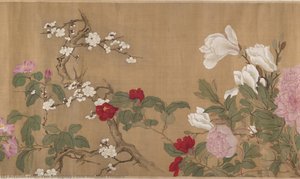
A single flowering branch extends across a muted brown field, its blossoms captured in a moment of quiet expansion. The composition relies on a delicate balance between the dark, fluid lines of the wood and the soft, luminous petals that emerge from it. Through a series of layered ink and watercolor washes, the artist achieves a sense of volume and depth, allowing the flowers to appear as if they possess…

Slike umetnika Yun Shouping, rangirane od 11 do 25

Motivi koji su privlačili pažnju Yun Shouping

Četiri teme koje se najčešće ponavljaju u ovim originalima, svaka sa svojim vrhunskim primerom.

Muzeji u kojima se čuvaju originalna dela umetnika Yun Shouping

5 muzeja u kojima se nalazi najviše slika sa ove stranice.

Muzej Grad Radovi umetnika Yun Shouping Slike iz ovog spiska
Harvard Art Museums, KembriđHarvard Art Museums Kembriđ 8 Landscape After Mi Fei (1051-1107), Landscape after Cao Zhibo (1272-1355), Landscape After Li Tang (ca. 1070-ca. 1150)
Metropoliten музеј у Њујорку, ЊујоркMetropoliten музеј у Њујорку Њујорк 7 Untitled (D2X9GB), 清 惲壽平 倣宋元山水圖 冊 Landscapes in the Manner of Song and Yuan Masters, 清 傳惲壽平 夏夜清荷圖 軸 Lotuses on a Summer Evening
Detroit Institute of Arts, DetroitDetroit Institute of Arts Detroit 1 Bamboo and Trees in a Rockery
Cleveland Museum of Art, KlivlendCleveland Museum of Art Klivlend 1 Herbaceous Peony
Nacionalni palata muzej, TaipeiNacionalni palata muzej Taipei 1 Peonies

Yun Shouping, najprepoznatljivija dela svake godine

19 godina umetnosti umetnika Yun Shouping, od 1667 do 1685: galerija ih prati godinu za godinom, kroz njihova najpoznatija originalna dela.

Slike umetnika Yun Shouping: odgovori galerije

Koja je najpoznatija slika umetnika Yun Shouping?Otkrij odgovor

Untitled (D2X9GB) (701), Metropoliten музеј у Њујорку, Њујорк. Slede 清 惲壽平 倣宋元山水圖 冊 Landscapes in the Manner of Song and Yuan Masters (1667) i Bamboo and Trees in a Rockery (1680).

Koja su najbolja 10 dela umetnika Yun Shouping?Otkrij odgovor

Untitled (D2X9GB), 清 惲壽平 倣宋元山水圖 冊 Landscapes in the Manner of Song and Yuan Masters, Bamboo and Trees in a Rockery, Herbaceous Peony, Landscape After Mi Fei (1051-1107), Landscape after Cao Zhibo (1272-1355), Landscape After Li Tang (ca. 1070-ca. 1150), Landscape After Oubo Laoren (Zhao Mengfu, 1254-1322), Landscape After Xu Ben (1335-1380) i Landscape After Wang Meng (ca. 1308-1385). Gornji rang pokazuje godinu i muzej za svako od njih.

Koliko je dela stvorio/la Yun Shouping?Otkrij odgovor

Naš katalog sadrži 25 dela umetnika Yun Shouping, datiranih od 1667 do 1685.

Gde se nalaze najpoznatiji originali umetnika Yun Shouping?Otkrij odgovor

Većinom u Harvard Art Museums (Kembriđ), Metropoliten музеј у Њујорку (Њујорк) i Detroit Institute of Arts (Detroit). Tabela muzeja iznad sadrži njih sve.

Kada je Yun Shouping stvorio svoje najpoznatije slike?Otkrij odgovor

U 1683: 8 od 25 dela na ovoj stranici nastalo je tada, od čega je Landscape After Mi Fei (1051-1107).

Koja su najranija i najkasnija poznata dela umetnika Yun Shouping?Otkrij odgovor

Na ovoj stranici, najstarije delo je iz 清 惲壽平 倣宋元山水圖 冊 Landscapes in the Manner of Song and Yuan Masters (1667), a najnovije iz Herbaceous Peony (1685).

Kojim se motivima Yun Shouping najčešće bavio?Otkrij odgovor

Flowers (3) i Chinese landscape (2), kroz svih 25 dela na ovoj stranici.

Koje originale umetnika Yun Shouping poseduje Harvard Art Museums?Otkrij odgovor

Landscape After Mi Fei (1051-1107), Landscape after Cao Zhibo (1272-1355) i Landscape After Li Tang (ca. 1070-ca. 1150): Harvard Art Museums, Kembriđ čuva 8 dela sa ove stranice.

Yun Shouping: umetnik

A Master of Blossoms and Breath

Born in the turbulent year of 1633 in Wujin, Jiangsu province, Yun Shouping—often revered by his sobriquet Nantian—emerged from a period of profound historical upheaval. As the Ming Dynasty crumbled and the Qing era took hold, Yun found himself navigating a world in transition. Though born into an impoverished family that could not afford the formal education required for the civil service examinations, he did not allow circumstance to stifle his spirit. Instead, he turned inward toward the natural world, devoting himself to the pursuit of the three perfections: painting, poetry, and calligraphy. From his earliest years, his soul was entwined with the delicate beauty of nature, a passion famously captured in his childhood compositions of poetry centered around lotus blossoms.

His artistic journey was one of remarkable evolution and profound transformation. While he initially trained in the rigorous traditions of landscape painting, a pivotal encounter with the works of the master Wang Hui altered the course of his career forever. Captivated by new possibilities, Yun transitioned from the grand vistas of mountains and rivers to the intimate, vibrant world of flora and fauna. This shift led to the founding of the Ch'ang-chou school, a movement that would redefine Chinese aesthetics for generations. He became a central figure among the celebrated Six Masters of the early Qing period, standing alongside luminaries such as Wu Li and the Four Wangs, creating a legacy that bridged the gap between classical tradition and a new, expressive vitality.

The Revolution of the Boneless Style

What truly set Yun Shouping apart from his contemporaries was his masterful command of the mogu, or "boneless" technique. Moving away from the rigid, ink-defined outlines that characterized much of traditional Chinese painting, Yun sought to capture the very essence and inner breath of his subjects through soft washes of color and delicate gradations. By imitating the 11th-century methods of Xu Xi, he achieved a sense of organic fluidity that made his flowers and birds appear to pulse with life. His palette was daring for its time; he embraced rich, saturated hues of reds and purples—colors that some traditionalists dismissed as gaudy—to convey the true splendor of a blooming peony or a sun-drenched petal.

This technique allowed him to achieve a breathtaking balance between structure and spontaneity. In his hands, a branch was not merely a line on paper, but a living limb, and a blossom was not just a shape, but a fleeting moment of seasonal beauty. His work often embodied the following characteristics:

  • Expressive Vitality: A profound ability to depict the "spirit resonance" or life force of plants and animals.
  • Coloristic Innovation: The use of vibrant, layered washes to create depth without the need for harsh borders.
  • Poetic Symbiosis: An inseparable connection between his visual imagery and the lyrical sentiment of his calligraphy and poetry.
  • Naturalism through Abstraction: A way of capturing the true likeness of nature through soft, impressionistic strokes rather than anatomical precision.

A Lasting Legacy in the Qing Dynasty

The historical significance of Yun Shouping cannot be overstated. He did not merely participate in the art of his era; he revitalized it. By breathing new life into the flower-and-bird genre, he provided a much-needed aesthetic refreshment to a landscape painting tradition that had become increasingly preoccupied with imitating ancient styles. His Ch'ang-chou school became a beacon of individual expression, emphasizing a deep, emotional connection to the natural world that resonated with the literati class. Even as his techniques were refined and passed down through generations—notably by his daughter, Bing—the core of his vision remained: a celebration of the ephemeral beauty found in the smallest corner of the earth.

Today, Yun Shouping is remembered not just as a painter of petals, but as a poet of the brush. His ability to find the infinite within the minute remains a cornerstone of Chinese art history. Through his "boneless" mastery, he taught the world that strength does not always require a hard edge, and that true beauty often resides in the softest, most delicate transitions of light and color.