


1


Ažurirano: октобар 2026 · rangirano prema našem koeficijentu popularnosti (pretrage, posete i porudžbine za svako delo) · 33 dela William Edward Stott u našem katalogu
Ukratko
Od svih originala koje je William Edward Stott ostavio, najpoznatiji je A Cottage Madonna (1907), koji se nalazi u kolekciji Harris Museum - Art Gallery, Preston. Odmah za njima slede There Was No Room in the Inn (1910) i Sunrise in Winter (1891). Naš katalog sadrži 33 dela umetnika William Edward Stott; galerija je čuvala 21 dela koja svet najviše admira, od kojih je svako prikazano sa svojim datumom, muzejom i pričom.

In the quiet, shadowed corners of William Edward Stott’s There Was No Room in the Inn, we find a moment frozen in time, where the weight of history meets the tenderness of a single breath. This evocative oil on canvas, dating from approximately 1910, invites the viewer into a rustic wooden stable that feels less like a mere setting and more like a sanctuary of profound humility. The composition is…


The Approaching Night painting by William Edward Stott is a beautiful representation of rural life, showcasing the artist's ability to capture the essence of nature. Created in 1917, this oil on canvas piece measures 28 x 41 cm and is currently housed at the Touchstones Rochdale museum in Rochdale, United Kingdom. Composition and Style The painting depicts a scene of a herd of cattle standing in front of a house…
 Ploughing, Early Spring1890 · Touchstones Rochdale
12
 Sheep in Snow
13
 The Turnip Field
14
 The Patriarch
15
 The Young Cowherd
16
 Self PortraitTouchstones Rochdale
17
 Study of a Girl's HeadBolton Museum And Art Gallery
18
 Lambing TimeTowner
19
 Saturday NightTowner
20
 The Watering PlaceNacionalni trust
21
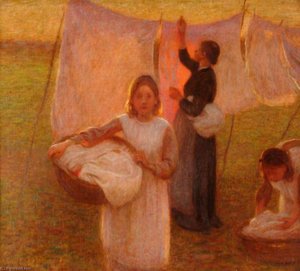 Washing DayWatts Gallery – Artists' Village
Četiri teme koje se najčešće ponavljaju u ovim originalima, svaka sa svojim vrhunskim primerom.
8 muzeja u kojima se nalazi najviše slika sa ove stranice.
| Muzej | Grad | Radovi umetnika William Edward Stott | Slike iz ovog spiska |
|---|---|---|---|
 Touchstones Rochdale |
Rochdale | 5 | There Was No Room in the Inn, Sunrise in Winter, Approaching Night |
 Nacionalni trust |
East Grinstead | 2 | Red Roses, The Watering Place |
 Towner |
Eastbourne | 2 | Lambing Time, Saturday Night |
 Harris Museum - Art Gallery |
Preston | 1 | A Cottage Madonna |
 Laing Art Gallery |
Njukl na Tajnu | 1 | The Widow's Acre |
 Ferens Art Gallery |
Hull | 1 | The Good Samaritan |
 Bolton Museum And Art Gallery |
Bolton | 1 | Study of a Girl's Head |
 Watts Gallery – Artists' Village |
Gildford | 1 | Washing Day |
A Cottage Madonna (1907), Harris Museum - Art Gallery, Preston. Slede There Was No Room in the Inn (1910) i Sunrise in Winter (1891).
A Cottage Madonna, There Was No Room in the Inn, Sunrise in Winter, Red Roses, Changing Pastures, The Widow's Acre, Noonday, The Watering Place, The Good Samaritan i Approaching Night. Gornji rang pokazuje godinu i muzej za svako od njih.
Naš katalog sadrži 33 dela umetnika William Edward Stott.
Većinom u Touchstones Rochdale (Rochdale), Nacionalni trust (East Grinstead) i Towner (Eastbourne). Tabela muzeja iznad sadrži njih sve.
Rural landscape (3), British countryside (3) i Rural life (2), kroz svih 21 dela na ovoj stranici.
Impressionism i Barbizon school, sudeći po originalima na ovoj stranici.
There Was No Room in the Inn, Sunrise in Winter i Approaching Night: Touchstones Rochdale, Rochdale čuva 5 dela sa ove stranice.
In the tapestry of late Victorian art, few threads possess the quiet, evocative strength of William Edward Stott. Born in 1855 amidst the industrial landscape of Wardleworth, near Rochdale, Stott emerged from a world defined by the rhythmic toil of Lancashire’s cotton mills. While his father, Samuel Stott, presided over a successful mill, the young artist’s gaze was frequently drawn away from the smoke of industry toward the enduring beauty of the natural world. This early exposure to the stark contrasts between industrial progress and rural tradition would become a cornerstone of his artistic identity, instating in him a profound empathy for the lives of those tethered to the land.
Stott’s journey was one of significant geographical and stylistic evolution. His formal training took him to the heart of the art world in Paris, where he studied under the esteemed academic painter Carolus Duran. While this period provided him with a rigorous foundation in meticulous technique and classical composition, it also placed him at the epicenter of a burgeoning revolution. The whispers of Impressionism and the soulful, earth-bound realism of the Barbizon School began to permeate his consciousness. He found himself deeply moved by the work of Jules Bastien-Lepage, whose ability to marry naturalistic detail with an atmospheric, almost poetic sense of light offered Stott a new vocabulary for his own explorations.
As his style matured, Stott transitioned from the rigid constraints of academicism toward a more fluid, emotive approach. His canvases became windows into a vanishing way of life, capturing the subtle shifts of light that define the English countryside. He did not merely paint landscapes; he painted atmospheres. Whether it was the soft, encroaching shadows in Approaching Night or the warm, sun-drenched serenity found in The Watering Place, Stott possessed a rare gift for rendering the ephemeral qualities of the air and the earth.
His subject matter often centered on the dignity of rural labor and the quiet rhythms of pastoral existence. In works such as Ploughing, Early Spring, one can sense the connection between the artist and his subjects—a shared understanding of the seasonal cycles and the physical reality of the landscape. His technique utilized a sophisticated palette to evoke mood, often employing:
Though Stott may not have attained the global celebrity of his contemporaries like Monet or Renoir, his contribution to the British aesthetic remains vital. He stood at a pivotal historical crossroads, navigating the transition from the structured traditions of the 19th century to the more experimental sensibilities of the early 20th century. His work serves as a poignant historical record, preserving the essence of an English landscape and a social order that were rapidly being transformed by the very industrial forces he witnessed in his youth.
Today, Stott’s paintings continue to resonate with a modern audience, offering a sense of tranquility and a nostalgic connection to the pastoral. His ability to imbue ordinary scenes with extraordinary emotional weight ensures his place in the canon of British Naturalism. To view a Stott painting is to experience a moment of stillness—a chance to witness the quiet dignity of the earth and the enduring, beautiful melancholy of the passing light.


