Portret Vilijam Mejson Braun

44 najpoznatijih slika umetnika Vilijam Mejson Braun, svaka potpuno jedinstvena

Ažurirano: новембар 2026 · rangirano prema našem koeficijentu popularnosti (pretrage, posete i porudžbine za svako delo) · 44 dela Vilijam Mejson Braun u našem katalogu

Ukratko

Summer Pastures (1856) je slika autora Vilijam Mejson Braun koja privlači najviše pogleda. Nakon toga, pogled se seli na Still Life (also known as Fruit and Art Objects) (1888) i Landscape with Two Indians (1855). Među 44 dela umetnika Vilijam Mejson Braun u našem katalogu, ovih 44 su najpoznatija, od kojih je svako jedinstveni original predstavljen sa godinom nastanka, muzejom i razlogom zbog kojeg je i danas neprocenjivo.

1823 – 1899, Njujork Hudson river school Najviše dela: Toledo Museum of Art

Top 10 slika umetnika Vilijam Mejson Braun, iz ugla galerije

1
Summer Pastures (1856) čiji je Vilijam Mejson Braun

Summer Pastures

1856 · Oil On Canvas

The scene unfolds within the quiet expanse of Summer Pastures, a work that captures a specific moment of pastoral peace. Painted in 1856, this piece brings the viewer into a lush, green world where the air feels heavy with the warmth of a midsummer afternoon. The artist, William Brown, also known by his full name William Mason Brown, directs our gaze across a landscape that feels both vast and intimately…

Čuvena dela umetnika Vilijam Mejson Braun, od 11 do 44

Čuvena dela Vilijam Mejson Braun po periodima

Motivi koji su privlačili pažnju Vilijam Mejson Braun

Četiri teme koje se najčešće ponavljaju u ovim originalima, svaka sa svojim vrhunskim primerom.

Muzeji u kojima se čuvaju originalna dela umetnika Vilijam Mejson Braun

7 muzeja u kojima se nalazi najviše slika sa ove stranice.

Muzej Grad Radovi umetnika Vilijam Mejson Braun Slike iz ovog spiska
Toledo Museum of Art, ToledoToledo Museum of Art Toledo 1 Landscape with Two Indians
Yale Center for British Art, New HavenYale Center for British Art New Haven 1 Tiptree Hall and Farm, Essex
Crystal Bridges Museum of American Art, BentonvilleCrystal Bridges Museum of American Art Bentonville 1 Raspberries in a Wooded Landscape
Cleveland Museum of Art, KlivlendCleveland Museum of Art Klivlend 1 Still Life with Cantaloupe
Birmingham Museum of Art, BirminghamBirmingham Museum of Art Birmingham 1 Still Life with Cantaloupe
National Gallery of Art, WashingtonNational Gallery of Art Washington 1 Mound of Cherries
Fries Museum, LievardenFries Museum Lievarden 1 Still Life with Melon, Peach, Fruit-Filled Compote and Glass of Wine on a Marble Table Top

Vilijam Mejson Braun kroz decenije: jedan jedinstveni original za svaku

Radovi po decenijama

Izaberite deceniju da biste videli original koji je definiše.

Slike umetnika Vilijam Mejson Braun: pitanja za galeriju

Koje je najpoznatije delo umetnika Vilijam Mejson Braun?Otkrij odgovor

Summer Pastures (1856). Slede Still Life (also known as Fruit and Art Objects) (1888) i Landscape with Two Indians (1855).

U kojoj je godini Vilijam Mejson Braun stvorio/la Summer Pastures?Otkrij odgovor

33 godina: Summer Pastures datira iz 1856, a Vilijam Mejson Braun je rođen/a 1823.

Koji je deset najpoznatijih slika autora Vilijam Mejson Braun?Otkrij odgovor

Summer Pastures, Still Life (also known as Fruit and Art Objects), Landscape with Two Indians, Tiptree Hall and Farm, Essex, Untitled (also known as Landscape with Indians), Three Men in a Landscape, Landscape with Two Indians, Raspberries in a Wooded Landscape, Still Life with Watermelon, Grapes, Peaches, Plums and Cantaloupe i Still Life with Melon, Grapes, Peaches, Pears and Black Raspberries. Gornji rang pokazuje godinu i muzej za svako od njih.

Koliko je poznatih dela umetnika Vilijam Mejson Braun?Otkrij odgovor

Naš katalog sadrži 44 dela umetnika Vilijam Mejson Braun, datiranih od 1850 do 1888.

Gde se mogu videti najpoznatiji originali umetnika Vilijam Mejson Braun?Otkrij odgovor

Većinom u Toledo Museum of Art (Toledo), Yale Center for British Art (New Haven) i Crystal Bridges Museum of American Art (Bentonville). Tabela muzeja iznad sadrži njih sve.

U kom periodu je Vilijam Mejson Braun stvorio/la svoje najpoznatije slike?Otkrij odgovor

U 1850s: 7 od 44 dela na ovoj stranici nastalo je tada, od čega je Summer Pastures.

Ko je najraniji, a koje je najkasnije čuveno delo umetnika Vilijam Mejson Braun?Otkrij odgovor

Na ovoj stranici, najstarije delo je iz Tiptree Hall and Farm, Essex (1850), a najnovije iz Still Life (also known as Fruit and Art Objects) (1888).

Koje su teme Vilijam Mejson Braun preferirao/la?Otkrij odgovor

Landscape (8), Life (8) i Fruits (6), kroz svih 44 dela na ovoj stranici.

Kojem umetničkom pravcu pripada delo umetnika Vilijam Mejson Braun?Otkrij odgovor

Hudson river school, sudeći po originalima na ovoj stranici.

Vilijam Mejson Braun: portret umetnika

The Meticulous Vision of William Mason Brown

Born in Troy, New York, William Mason Brown emerged as a distinctive voice within the American art landscape, carving out a legacy defined by an extraordinary devotion to detail. His artistic journey began under the tutelage of Abel Buell Moore, the preeminent portraitist of Troy, which laid the foundation for a career that would traverse several captivating genres. While his early training was rooted in the intimate realm of portraiture, Brown’s creative spirit eventually expanded into the sweeping vistas of the landscape and the hyper-realistic precision of still life painting.

As a prominent member of the second generation of the Hudson River School, Brown’s early work reflected the romantic traditions established by masters such as Thomas Cole. During his time in Newark, New Jersey, starting around 1850, he specialized in landscapes that captured the grandeur and serenity of the natural world. These works often featured a striking balance between vast, atmospheric backgrounds—such as distant mountains and flowing rivers—and an exacting, almost photographic precision in the foreground elements. This duality allowed him to evoke both the sublime scale of nature and a profound sense of tranquility.

A Transition to Hyper-Realistic Still Life

A pivotal shift occurred in 1858 when Brown moved to Brooklyn, New York, a transition that saw him move away from the expansive horizons of landscape painting toward the concentrated intensity of still life. This period marked his emergence as a master of trompe-l'œil, a technique designed to deceive the eye into perceiving three-dimensional reality on a flat canvas. Influenced by the Pre-Raphaelite movement and the teachings of John Ruskin, Brown developed a style characterized by an almost obsessive attention to texture and light.

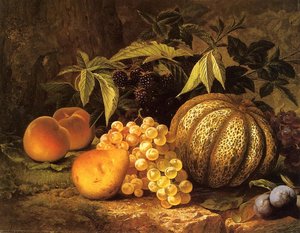
His still lifes became celebrated for their ability to replicate the tactile essence of the subjects they depicted. He possessed a rare talent for textural duplication, capturing the delicate fuzz on a peach or the intricate rind of a cantaloupe with such clarity that his work was often compared to the precision of French academician Jean-Léon Gérôme. In these compositions, Brown avoided visible brushwork, preferring a smooth, seamless finish that allowed the viewer to lose themselves in the luminous highlights and organic weights of fruit, berries, and flowers.

Legacy and Artistic Significance

Throughout his long career, Brown was a consistent and respected presence in the American art community, exhibiting annually at the National Academy of Design for over three decades. His ability to reach a wide audience through chromolithographic reproductions ensured that his meticulous renderings of nature were admired far beyond the gallery walls. His work remains preserved in prestigious institutions, including:

The historical significance of William Mason Brown lies in his unique ability to bridge the gap between the romanticism of the Hudson River School and the rigorous, scientific observation of the Pre-Raphaelite influence. By mastering both the sweeping emotion of the landscape and the quiet, intense reality of the still life, he left behind a body of work that celebrates the profound beauty found in both the vastness of the earth and the smallest details of its bounty.