Portret Vilhelm Hamershoi

100 najpoznatijih slika umetnika Vilhelm Hamershoi, svaka potpuno jedinstvena

Ažurirano: новембар 2026 · rangirano prema našem koeficijentu popularnosti (pretrage, posete i porudžbine za svako delo) · 224 dela Vilhelm Hamershoi u našem katalogu

Ukratko

Interior, Strandgade 30 (1909) je slika autora Vilhelm Hamershoi koja privlači najviše pogleda. Nakon toga, pogled se seli na Montague Street in London (1906) i Figura žene (1888). Među 224 dela umetnika Vilhelm Hamershoi u našem katalogu, ovih 100 su najpoznatija, od kojih je svako jedinstveni original predstavljen sa godinom nastanka, muzejom i razlogom zbog kojeg je i danas neprocenjivo.

1864 – 1916, Копенхаген Early twentieth century realism Najviše dela: Statens Museum For Kunst

Top 10 slika umetnika Vilhelm Hamershoi, iz ugla galerije

1
Interior, Strandgade 30 (1909) čiji je Vilhelm Hamershoi

Interior, Strandgade 30

1909 · Oil On Panel

A Masterpiece of Danish Art Vilhelm Hammershøi's 'Interior, Strandgade 30' is a captivating oil on panel painting that embodies the essence of Danish art from the early 20th century. Created in 1909, this masterpiece measures and is a testament to Hammershøi's unique ability to capture the quiet beauty of everyday life. The painting is a black and white depiction of a woman sitting in a chair next to a window,…

2
Montague Street in London (1906) čiji je Vilhelm Hamershoi

Montague Street in London

1906 · Oil On Panel · Ny Carlsberg Glyptotek, Kopenhagen

To encounter Vilhelm Hammershøi’s Montague Street in London is to step into a realm where time itself seems to have paused, caught in a delicate suspension between reality and a dream. Created in 1906, this exquisite oil on panel painting serves as a profound meditation on the beauty of stillness. The scene presents an empty London street, stripped of the frantic energy typically associated with urban life. Instead, we are…

3
Figura žene (1888) čiji je Vilhelm Hamershoi

Figura žene

1888 · Ulje na platnu · Statens Museum For Kunst, Kopenhagen

Figura Žene Vilhelma Hammershøija – Tišina Jedne Domovine Figura Žene Vilhelma Hammershøija predstavlja jedan od najpoznatijih i najdubljih umetničkih dela danske impresioniste Vilhelma Hammershøija, nastalih 1888. godine i sada izloženo u Državnom muzeju umetnosti Kopenhagenskog Univerziteta. Ova slika nije samo prikaz žene koja stoji pred stolom; ona je simbolička reprezentacija izolacije, unutarnje harmonije i delikatne lepote koju Hammershøi uspešno prenosi kroz svoj jedinstveni stil. ### Stil i Tehnička Veština Hammershøi…

4
Interior with the Artist's Easel (1910) čiji je Vilhelm Hamershoi

Interior with the Artist's Easel

1910 · Oil On Canvas · Statens Museum For Kunst, Kopenhagen

To gaze upon Vilhelm Hammershøi’s Interior with the Artist's Easel is not merely to observe a room; it is to slip into a state of profound, almost sacred stillness. This oil on canvas, dating from 1910, captures the essence of late nineteenth and early twentieth-century Danish domestic life, yet elevates it far beyond mere genre painting. Hammershøi possessed an unparalleled gift for rendering silence visible—a palpable quietude that seems to…

5
Интерijer из Стриндгаде са сунцем које пада на под (1901) čiji je Vilhelm Hamershoi

Интерijer из Стриндгаде са сунцем које пада на под

1901 · Ulje na panelu · Statens Museum For Kunst, Kopenhagen

Vilhelm Hammershøi i Svetlu Strade Interior from Strandgade with Sunlight on the Floor je jedan od najpoznatijih i najiščuđujućih pejzaža Vilhelma Hammershøija, danske umetnosti koji je ostavio nezaboravno mesto u istoriji umetnosti početka 20. veka. Kreiran godine 1901. godine, ovaj ulješan slikanje nalazi se u Državnom muzeju umetnosti Kopenhagena i predstavlja vrhunac njegovog stilskog razvoja i filozofije umetničkog dela. Kompozicija i Atmosfera: Jednostavnost kao Izraz Duše Hammershøi je poznat po…

6
St. Peter's Church, Copenhagen (1906) čiji je Vilhelm Hamershoi

St. Peter's Church, Copenhagen

1906 · Oil On Canvas · Statens Museum For Kunst, Kopenhagen

To gaze upon Vilhelm Hammershøi’s depiction of St. Peter's Church in Copenhagen is not merely to observe architecture; it is to enter a hushed, contemplative space suspended outside the rush of modern life. Painted in 1906, this oil on canvas captures the enduring spirit of Danish craftsmanship blended with an almost ethereal sense of stillness. The composition immediately draws the eye upward, following the vertical thrust of the steeple and…

7
Moonlight, Strandgade 30 (1900) čiji je Vilhelm Hamershoi

Moonlight, Strandgade 30

1900 · Oil On Canvas · Metropoliten музеј у Њујорку, Њујорк

Moonlight, Strandgade 30 emerges from the canvas as a quiet meditation on a private world. Painted by Vilhelm Hammershøi, this oil on canvas captures the unadorned interior of the artist's own apartment in Copenhagen. The scene looks out toward a windowed loggia, where the pale light of the moon begins to settle into the room. It is a space defined by its stillness and the soft, muted tones of a…

8
Ida Hammershøi (1907) čiji je Vilhelm Hamershoi

Ida Hammershøi

1907 · Oil On Panel

In this 1907 oil on panel painting, a woman named Ida Hammershøi sits at a table, her form positioned slightly off-center. She is captured in a moment of stillness, holding a cup and spoon as she gazes into the distance. A white cloth covers the table, providing a bright contrast to the muted tones of the surrounding space. The background remains largely undefined, composed of dark, receding shades that focus…

9
Sunbeams (also known as Sunshine. Dust Motes Dancing in the Sunbeams) (1900) čiji je Vilhelm Hamershoi

Sunbeams (also known as Sunshine. Dust Motes Dancing in the Sunbeams)

1900 · Oil On Canvas · Ordrupgaard, Gentofte

A stillness settles over the room, a silence so heavy it feels tangible. Through a large, multi-paned window, shafts of winter sunlight pierce the dimness, cutting diagonally across the space. In these beams, tiny particles of dust dance in a slow, rhythmic motion, visible only because the light catches them in their descent. The room itself feels suspended in time, an empty interior in a 17th-century apartment in the Christianshavn…

Čuvena dela umetnika Vilhelm Hamershoi, od 11 do 100

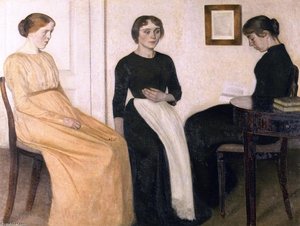
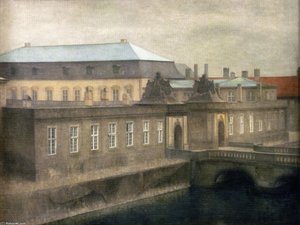
11Young Girl Sewing. Anna Hammershoi, the Artist's Sister (1887) čiji je Vilhelm HamershoiYoung Girl Sewing. Anna Hammershoi, the Artist's Sister1887 12From the British Museum, Winter (1906) čiji je Vilhelm HamershoiFrom the British Museum, Winter1906 13Four Rooms, Interior from the Artist's Home, Strandgade 25 (1914) čiji je Vilhelm HamershoiFour Rooms, Interior from the Artist's Home, Strandgade 251914 · Ordrupgaard 14Sunshine in the Drawing Room III (1903) čiji je Vilhelm HamershoiSunshine in the Drawing Room III1903 · Nationalmuseum 15A Greek Relief in the Louvre (1891) čiji je Vilhelm HamershoiA Greek Relief in the Louvre1891 · Ny Carlsberg Glyptotek 16Interior tate gallery (1899) čiji je Vilhelm HamershoiInterior tate gallery1899 · National Gallery 17Untitled (566) čiji je Vilhelm HamershoiUntitled (566) 18Nude Female Model (1884) čiji je Vilhelm HamershoiNude Female Model1884 · Statens Museum For Kunst 19Portrait of Young Woman, The Artist's Sister, Anna Hammershoi (1885) čiji je Vilhelm HamershoiPortrait of Young Woman, The Artist's Sister, Anna Hammershoi1885 · Hirschsprung Collection 20Frederikke Hammershøi, the artist's mother (1886) čiji je Vilhelm HamershoiFrederikke Hammershøi, the artist's mother1886 21Malerinden Elisabeth Wandel (1890) čiji je Vilhelm HamershoiMalerinden Elisabeth Wandel1890 · Statens Museum For Kunst 22Ida Ilsted, the Artist's Fiancée (1890) čiji je Vilhelm HamershoiIda Ilsted, the Artist's Fiancée1890 · Statens Museum For Kunst 23Evening in the Drawing Room. The Artist's Mother and Wife (1891) čiji je Vilhelm HamershoiEvening in the Drawing Room. The Artist's Mother and Wife1891 · Statens Museum For Kunst 24The art historian Karl Madsen, later Director of Statens Museum for Kunst (1890) čiji je Vilhelm HamershoiThe art historian Karl Madsen, later Director of Statens Museum for Kunst1890 · Statens Museum For Kunst 25The Painter Kristian Zahrtmann (1889) čiji je Vilhelm HamershoiThe Painter Kristian Zahrtmann1889 · Statens Museum For Kunst 26Ida Ilsted, the Artist's Wife (1890) čiji je Vilhelm HamershoiIda Ilsted, the Artist's Wife1890 · Nationalmuseum 27An Old Woman (1886) čiji je Vilhelm HamershoiAn Old Woman1886 · Hirschsprung Collection 28Frederikke Amalie Hammershøi, f. Rentzmann, kunstnerens moder (1894) čiji je Vilhelm HamershoiFrederikke Amalie Hammershøi, f. Rentzmann, kunstnerens moder1894 · Statens Museum For Kunst 29Portræt af fru Thora Bendix (Anne Victoria, f. Sundberg) (1896) čiji je Vilhelm HamershoiPortræt af fru Thora Bendix (Anne Victoria, f. Sundberg)1896 · Statens Museum For Kunst 30Komponisten Fini Henriques (1896) čiji je Vilhelm HamershoiKomponisten Fini Henriques1896 · Statens Museum For Kunst 31Maleren Svend Hammershøi, kunstnerens broder (1897) čiji je Vilhelm HamershoiMaleren Svend Hammershøi, kunstnerens broder1897 · Statens Museum For Kunst 32The Artist's Wife, Ida Hammershøi, née Ilsted (1894) čiji je Vilhelm HamershoiThe Artist's Wife, Ida Hammershøi, née Ilsted1894 · Statens Museum For Kunst 33Vilhelm Hammershøi (1895) čiji je Vilhelm HamershoiVilhelm Hammershøi1895 34Interior with a View of an Exterior Gallery (1903) čiji je Vilhelm HamershoiInterior with a View of an Exterior Gallery1903 35Ida in an Interior with Piano (1901) čiji je Vilhelm HamershoiIda in an Interior with Piano1901 36Portrait of Svend Hammershøi, the Artist´s Brother (1901) čiji je Vilhelm HamershoiPortrait of Svend Hammershøi, the Artist´s Brother1901 · Statens Museum For Kunst 37Henry Madsen (1904) čiji je Vilhelm HamershoiHenry Madsen1904 · Statens Museum For Kunst 38J.F. Willumsen (1901) čiji je Vilhelm HamershoiJ.F. Willumsen1901 · Statens Museum For Kunst 39Henry Madsen (1904) čiji je Vilhelm HamershoiHenry Madsen1904 · Statens Museum For Kunst 40The Architect Thorvald Bindesbøll (1904) čiji je Vilhelm HamershoiThe Architect Thorvald Bindesbøll1904 · Statens Museum For Kunst 41A Room in the Artist’s Home in Strandgade, Copenhagen, with the Artist’s Wife (1902) čiji je Vilhelm HamershoiA Room in the Artist’s Home in Strandgade, Copenhagen, with the Artist’s Wife1902 · Statens Museum For Kunst 42Aften i stuen (1904) čiji je Vilhelm HamershoiAften i stuen1904 · Statens Museum For Kunst 43Interior with a Reading Lady (1900) čiji je Vilhelm HamershoiInterior with a Reading Lady1900 · Nationalmuseum 44A room. The corner of a room with walls painted grey-lilac, divided into panels. (1903) čiji je Vilhelm HamershoiA room. The corner of a room with walls painted grey-lilac, divided into panels.1903 45The Coin Collector (study) (1904) čiji je Vilhelm HamershoiThe Coin Collector (study)1904 46Interior with Ida in a White Chair (1900) čiji je Vilhelm HamershoiInterior with Ida in a White Chair1900 47Interior with the Artist's Wife (1910) čiji je Vilhelm HamershoiInterior with the Artist's Wife1910 · National Museum of Art, Architecture and Design 48Ida Hammershøi, the Artist's Wife, with a Teacup (1907) čiji je Vilhelm HamershoiIda Hammershøi, the Artist's Wife, with a Teacup1907 · Statens Museum For Kunst 49Self-Portrait (1911) (1911) čiji je Vilhelm HamershoiSelf-Portrait (1911)1911 50Interior with Ida Playing the Piano (1910) čiji je Vilhelm HamershoiInterior with Ida Playing the Piano1910 · Национални музеј западне уметности 51Self-Portrait at Spurveskjul (1911) čiji je Vilhelm HamershoiSelf-Portrait at Spurveskjul1911 · Metropoliten музеј у Њујорку 52Open Doors (also known as White Doors) (1905) čiji je Vilhelm HamershoiOpen Doors (also known as White Doors)1905 53Interior, Strandgade 25 (1915) čiji je Vilhelm HamershoiInterior, Strandgade 251915 54Interior with the Artist's Mother and Sister (1889) čiji je Vilhelm HamershoiInterior with the Artist's Mother and Sister1889 · Nationalmuseum 55Interior, Bredgade (1911) čiji je Vilhelm HamershoiInterior, Bredgade1911 56Interior (1899) čiji je Vilhelm HamershoiInterior1899 · Tate Gallery 57Interior, Strandgade 30 - Vilhelm Hammershøi (2026) čiji je Vilhelm HamershoiInterior, Strandgade 30 - Vilhelm Hammershøi2026 58Self-Portrait (1890) čiji je Vilhelm HamershoiSelf-Portrait1890 · Statens Museum For Kunst 59Landscape in the Snow (1895) čiji je Vilhelm HamershoiLandscape in the Snow1895 · Hirschsprung Collection 60Sunshine in the Drawing Room (Solskin i dagligstuen) (1910) čiji je Vilhelm HamershoiSunshine in the Drawing Room (Solskin i dagligstuen)1910 · Nacionalna galerija Kanade 61Three Young Women (1895) čiji je Vilhelm HamershoiThree Young Women1895 62Portrait of Ida, the Artist (1898) čiji je Vilhelm HamershoiPortrait of Ida, the Artist1898 · Nacionalna galerija Danske 63Interior. Strandgade 30 (1906) čiji je Vilhelm HamershoiInterior. Strandgade 301906 · Tate Gallery 64View of Refsnæs (1900) čiji je Vilhelm HamershoiView of Refsnæs1900 65Interior with a Woman at a Sewing Table (1897) čiji je Vilhelm HamershoiInterior with a Woman at a Sewing Table1897 · Nasjonalgalleriet 66Young Girl Pouring Tea - the Artist's Sister. (1884) čiji je Vilhelm HamershoiYoung Girl Pouring Tea - the Artist's Sister.1884 67Study showing the back of a boy. (1884) čiji je Vilhelm HamershoiStudy showing the back of a boy.1884 68Study of Standing Woman, Seen from Behind (1884) čiji je Vilhelm HamershoiStudy of Standing Woman, Seen from Behind1884 69The Farm (1883) čiji je Vilhelm HamershoiThe Farm1883 70Landscape with Barn (1883) čiji je Vilhelm HamershoiLandscape with Barn1883 71Study drawing of plaster cast of ancient Greek Aphrodite, toss from c. 500 BC (1880) čiji je Vilhelm HamershoiStudy drawing of plaster cast of ancient Greek Aphrodite, toss from c. 500 BC1880 72Bedroom (Interior) (1890) čiji je Vilhelm HamershoiBedroom (Interior)1890 73View from Frederiksholms Kanal, Copenhagen. (1892) čiji je Vilhelm HamershoiView from Frederiksholms Kanal, Copenhagen.1892 74Landscape on the Island of Falster (1891) čiji je Vilhelm HamershoiLandscape on the Island of Falster1891 · Statens Museum For Kunst 75View of Jægersborg Allé. Gentofte, North of Copenhagen (1892) čiji je Vilhelm HamershoiView of Jægersborg Allé. Gentofte, North of Copenhagen1892 · Statens Museum For Kunst 76Dagligstuen på Frederiksberg Allé (1887) čiji je Vilhelm HamershoiDagligstuen på Frederiksberg Allé1887 · Statens Museum For Kunst 77Rainy summer landscape from Virum near Frederiksdal. (1888) čiji je Vilhelm HamershoiRainy summer landscape from Virum near Frederiksdal.1888 78View of Christiansborg Castle, Late Autumn (1890) čiji je Vilhelm HamershoiView of Christiansborg Castle, Late Autumn1890 · Statens Museum For Kunst 79Interior with Ida in a White Chair (1890) čiji je Vilhelm HamershoiInterior with Ida in a White Chair1890 · Ordrupgaard 80Portrait of Ida Ilsted, Later the Artist's Wife (1890) čiji je Vilhelm HamershoiPortrait of Ida Ilsted, Later the Artist's Wife1890 · Statens Museum For Kunst 81Self-Portrait (1891) čiji je Vilhelm HamershoiSelf-Portrait1891 82Interior in Louis Seize style. From the artist's home. Rahbeks Allé (1897) čiji je Vilhelm HamershoiInterior in Louis Seize style. From the artist's home. Rahbeks Allé1897 · Hirschsprung Collection 83Karen Bramsen (1898) čiji je Vilhelm HamershoiKaren Bramsen1898 84Interior (1893) čiji je Vilhelm HamershoiInterior1893 85Interior wit a Young Man Reading (1898) čiji je Vilhelm HamershoiInterior wit a Young Man Reading1898 · Hirschsprung Collection 86Interior (1898) čiji je Vilhelm HamershoiInterior1898 · Nationalmuseum 87Cello Player (1893) čiji je Vilhelm HamershoiCello Player1893 88Two Figures, The Artist and His Wife (1898) čiji je Vilhelm HamershoiTwo Figures, The Artist and His Wife1898 89Figures by the Window (1895) čiji je Vilhelm HamershoiFigures by the Window1895 90Artemis (1894) čiji je Vilhelm HamershoiArtemis1894 · Nacionalna galerija Danske 91White Doors, Strandgade 30 (1899) čiji je Vilhelm HamershoiWhite Doors, Strandgade 301899 · Ordrupgaard 92Sunny Parlor. (1901) čiji je Vilhelm HamershoiSunny Parlor.1901 · Alte Nationalgalerie 93The Coin Collector (1904) čiji je Vilhelm HamershoiThe Coin Collector1904 · National Museum of Art, Architecture and Design 94Forstudie til "Solregn. Gentofte Sø" (1903) čiji je Vilhelm HamershoiForstudie til "Solregn. Gentofte Sø"1903 · Statens Museum For Kunst 95Five Portraits. Study for painting in Thielska Galleriet, Stockholm (1901) čiji je Vilhelm HamershoiFive Portraits. Study for painting in Thielska Galleriet, Stockholm1901 · Statens Museum For Kunst 96Interior with the artist's wife seen from behind. (1901) čiji je Vilhelm HamershoiInterior with the artist's wife seen from behind.1901 97Interior with the artist's wife Ida in their home at Strandgade 30. (1905) čiji je Vilhelm HamershoiInterior with the artist's wife Ida in their home at Strandgade 30.1905 98Dunkebakke, Frederiksværk (1904) čiji je Vilhelm HamershoiDunkebakke, Frederiksværk1904 99Interior, Strandgade 30 (1899) čiji je Vilhelm HamershoiInterior, Strandgade 301899 100Interior with Punchbowl (1904) čiji je Vilhelm HamershoiInterior with Punchbowl1904

Čuvena dela Vilhelm Hamershoi po periodima

Motivi koji su privlačili pažnju Vilhelm Hamershoi

Četiri teme koje se najčešće ponavljaju u ovim originalima, svaka sa svojim vrhunskim primerom.

Muzeji u kojima se čuvaju originalna dela umetnika Vilhelm Hamershoi

8 muzeja u kojima se nalazi najviše slika sa ove stranice.

Muzej Grad Radovi umetnika Vilhelm Hamershoi Slike iz ovog spiska
Statens Museum For Kunst, KopenhagenStatens Museum For Kunst Kopenhagen 42 Figura žene, Interior with the Artist's Easel, Интерijer из Стриндгаде са сунцем које пада на под
Nationalmuseum, СтокхолмNationalmuseum Стокхолм 7 Sunshine in the Drawing Room III, Ida Ilsted, the Artist's Wife, Interior with a Reading Lady
Hirschsprung Collection, KopenhagenHirschsprung Collection Kopenhagen 5 Portrait of Young Woman, The Artist's Sister, Anna Hammershoi, An Old Woman, Landscape in the Snow
Ordrupgaard, GentofteOrdrupgaard Gentofte 5 Sunbeams (also known as Sunshine. Dust Motes Dancing in the Sunbeams), Four Rooms, Interior from the Artist's Home, Strandgade 25, Interior with Ida in a White Chair
National Museum of Art, Architecture and Design, OsloNational Museum of Art, Architecture and Design Oslo 3 Interior with the Artist's Wife, The Coin Collector
Nacionalna galerija Danske, KopenhagenNacionalna galerija Danske Kopenhagen 3 Portrait of Ida, the Artist, Artemis
Ny Carlsberg Glyptotek, KopenhagenNy Carlsberg Glyptotek Kopenhagen 2 Montague Street in London, A Greek Relief in the Louvre
Metropoliten музеј у Њујорку, ЊујоркMetropoliten музеј у Њујорку Њујорк 2 Moonlight, Strandgade 30, Self-Portrait at Spurveskjul

Vilhelm Hamershoi kroz decenije: jedan jedinstveni original za svaku

Radovi po decenijama

Izaberite deceniju da biste videli original koji je definiše.

Slike umetnika Vilhelm Hamershoi: pitanja za galeriju

Koje je najpoznatije delo umetnika Vilhelm Hamershoi?Otkrij odgovor

Interior, Strandgade 30 (1909). Slede Montague Street in London (1906) i Figura žene (1888).

U kojoj je godini Vilhelm Hamershoi stvorio/la Interior, Strandgade 30?Otkrij odgovor

45 godina: Interior, Strandgade 30 datira iz 1909, a Vilhelm Hamershoi je rođen/a 1864.

Koji je deset najpoznatijih slika autora Vilhelm Hamershoi?Otkrij odgovor

Interior, Strandgade 30, Montague Street in London, Figura žene, Interior with the Artist's Easel, Интерijer из Стриндгаде са сунцем које пада на под, St. Peter's Church, Copenhagen, Moonlight, Strandgade 30, Ida Hammershøi, Sunbeams (also known as Sunshine. Dust Motes Dancing in the Sunbeams) i Interior with Ida Playing the Piano - Vilhelm Hammershøi. Gornji rang pokazuje godinu i muzej za svako od njih.

Koliko je poznatih dela umetnika Vilhelm Hamershoi?Otkrij odgovor

Naš katalog sadrži 224 dela umetnika Vilhelm Hamershoi, datiranih od 1880 do 1915.

Gde se mogu videti najpoznatiji originali umetnika Vilhelm Hamershoi?Otkrij odgovor

Većinom u Statens Museum For Kunst (Kopenhagen), Nationalmuseum (Стокхолм) i Hirschsprung Collection (Kopenhagen). Tabela muzeja iznad sadrži njih sve.

U kom periodu je Vilhelm Hamershoi stvorio/la svoje najpoznatije slike?Otkrij odgovor

U 1890s: 38 od 100 dela na ovoj stranici nastalo je tada, od čega je A Greek Relief in the Louvre.

Ko je najraniji, a koje je najkasnije čuveno delo umetnika Vilhelm Hamershoi?Otkrij odgovor

Na ovoj stranici, najstarije delo je iz Study drawing of plaster cast of ancient Greek Aphrodite, toss from c. 500 BC (1880), a najnovije iz Interior, Strandgade 25 (1915).

Koje su teme Vilhelm Hamershoi preferirao/la?Otkrij odgovor

Interior (17), Danish art (13) i Woman (13), kroz svih 100 dela na ovoj stranici.

Sa kojim materijalima je Vilhelm Hamershoi najčešće slikao?Otkrij odgovor

Oil On Canvas, za 27 od 100 dela na ovoj stranici.

Kojem umetničkom pravcu pripada delo umetnika Vilhelm Hamershoi?Otkrij odgovor

Early twentieth century realism, sudeći po originalima na ovoj stranici.

Koja originalna dela Vilhelm Hamershoi mogu videti u Statens Museum For Kunst?Otkrij odgovor

Figura žene, Interior with the Artist's Easel i Интерijer из Стриндгаде са сунцем које пада на под: Statens Museum For Kunst, Kopenhagen čuva 31 dela sa ove stranice.

Vilhelm Hamershoi: portret umetnika

Enigmatična tišina Vilhelma Hameršojija

Stajati ispred slike Vilhelma Hameršojija znači preći prag u carstvo suspendovano između sećanja i sna. Njegovo delo poseduje gotovo opipljivu tišinu, mir koji kao da upija buku modernog sveta. Rođen u Kopenhagenu 1864. godine, ovaj danski majstor razvio je vizuelni jezik toliko prepoznatljiv i duboko atmosferski, da i danas neprestano očarava kolekcionare i kritičare. Hameršojijeva platna nisu samo prikazi prostorija ili figura; ona su meditacije o odsustvu, svetlosti i delikatnom prolasku vremena.

Njegov rani život bio je ukorenjen u kulturnom okruženju Kopenhagena kasnog 19. veka, perioda bogatog umetničkim kretanjima. Iako se kretao kroz struje akademske umetnosti, njegov pravi poziv ležao je u hvatanju trenutaka duboke introspekcije. Njegova posvećenost unutrašnjim prostorima postala je legendarna, pretvarajući kućne ambijente u grandiozne pozornice za psihološku dramu. Prigušeni tonovi—meke sive, blede krem boje, šapat prašnjavog oker—obeležja su koja definišu njegov jedinstveni vizuelni potpis.

Majstorstvo svetlosti i atmosfere

Tehnička briljantnost koja podupire Hameršojijeve naizgled jednostavne scene ništa je manje od majstorske. Posedovao je neprevaziđenu sposobnost da prikaže svetlost ne kao puko osvetljenje, već kao opipljiv, atmosferski element sam po sebi. U njegovim prikazima praznih hodnika ili oskudno nameštenih dnevnih soba, kvalitet svetlosti kao da izbija iz same boje, sugerišući nevidljive izvore i neispričane narative. Ova opsednutost atmosferom podigla je njegovo delo iznad običnog žanrovskog slikarstva; ono je postalo istraživanje raspoloženja.

Njegove kompozicije često sadrže perspektive koje se povlače unutra, uvlačeći posmatrača duboko u slikani prostor, samo da bi se ta dubina na kraju rastopila u mekoj, dvosmislenoj magli. Bilo da su u pitanju usamljene figure—često zaklonjene ili prikazane leđima—ili jednostavno prazni arhitektonski volumeni, osećaj zatvorenosti i tihe kontemplacije je nadmoćan. Upravo u ovom pažljivom upravljanju negativnim prostorom leži njegov genije; sama praznina postaje najrečovitiji subjekt.

Simbolizam i unutrašnji pejzaž

Hameršojijeva umetnost oduvek je bila duboko isprepletena sa simbolističkim strujama, čak i ako se nikada nije striktno pridržavao dogme tog pokreta. Njegova slika pozivaju posmatrače u prostor dvosmislenosti. Figure, kada su prisutne, često deluju odvojeno od svog okruženja ili su utopljene u misli, sugerišući unutrašnji život daleko bogatiji od onoga što platno prikazuje. Tu je prisutan sveprisutni osećaj melanholije i lepote—uzvišena čežnja koja govori o univerzalnim ljudskim iskustvima: samoći, sećanju i prolaznosti vremena.

Neki naučnici su njegovo delo tumačili kao vizuelni dnevnik njegovog sopstvenog emocionalnog pejzaža, povlačenje u kontrolisano okruženje umetnosti kada je spoljni svet bio previše bučan ili složen. Ponavljanje motiva—zavesa, prazna stolica, pogled kroz udaljeni prozor—daje njegovom opusu ritualnu kvalitet, sugerišući da su ti tihi trenuci bili neophodni sidra protiv toka postojanja.

Nasleđe i trajni uticaj

Iako je preminuo relativno mlad 1916. godine, uticaj Vilhelma Hameršojija se pokazao izuzetno trajnim. Njegova posvećenost suptilnosti i tonalnoj suptilnosti pružila je ključnu protivtežu odvažnijim paletama koje su se pojavljivale u drugim savremenim pokretima. Njegovo delo je duboko rezonovalo sa modernim senzibilitetom koji je vrednovao introspekciju iznad eksplicitnog narativa.

Danas se njegova slika traže zbog njihove sposobnosti da transformišu bilo koji prostor u koji uđu. One ne viču; one šapuću duboke istine o lepoti pronađenoj u suzdržanosti. Uživati u Hameršojiju znači prihvatiti poeziju neizrečenog, pronaći veličinu u prigušenim tonovima i dopustiti sebi da se na trenutak izgubimo unutar izvrsne, obavijajuće tišine njegovih slikanych svetova.