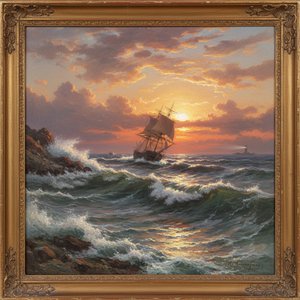
The Sea and the Shore
Vartan Makhokhian began his days in Trabzon, within the Ottoman Empire, where his father, a merchant, ensured his children received a formal education. His early years were spent in local Armenian schools, and later at Sanasarian College in Erzurum. It was during these years that he first picked up a brush, though his hands were also busy with the violin and the study of music theory. He moved to Berlin in 1891 to study at the Academy of Arts, training under Eugen Bracht and Hans Gude. This period of formal instruction shaped how he looked at the water.
In 1894, his travels led him to Crimea. In Feodosia, he encountered Ivan Aivazovsky. Watching the sea in this region left a mark on his approach to marine painting. He returned to Trabzon in 1895, a time marked by the Hamidian massacres, an event that eventually forced him to flee first to Batum and then into Europe. His life became one of movement, settling briefly in Capri, Italy, before returning to Germany.
His work often focused on the sea. He spent much of his later life in Nice, France, after moving there in 1914. The salt and light of the Mediterranean coast found their way onto his canvases. His paintings were not about grand theories but about the movement of nature and the way light hits a wave.
Exhibitions and Recognition
Makhokhian’s work traveled as he did. He showed his pieces in several cities, including:
- Berlin
- Munich
- Düsseldorf
- Cairo and Alexandria
- London
- Paris
- Nice
- Monaco
In 1904, he was accepted into the Berlin Artists' Association. Later, in 1925, he received the Legion of Honour with the degree of Chevalier. He became a French citizen in 1927. His presence in the Paris Salon during the 1920s helped establish his place among the painters of that era.
A Life of Sound and Color
The connection between his music and his painting remained present throughout his life. Between 1915 and 1917, he composed a symphony titled The Sobbing of Armenia, a piece written in response to the loss of his family during the Armenian genocide. The work was first heard in Monte Carlo in 1918.
His paintings are held in various collections, such as the National Gallery of Armenia and the Musée des Beaux-Arts de Nice. He died in Nice on 10 February 1937. His canvases remain as records of the coasts he visited, from the Black Sea to the Mediterranean.
Pitanja i odgovori
Koja raspoloženja izražavaju dela umetnika Vartan Makhokhian?
Na stranici Soba po raspoloženju umetnik Vartan Makhokhian prikazuje svoja dela poređana prema njihovoj atmosferi.
Gde se mogu pronaći dela umetnika Vartan Makhokhian grupisanja po paleti boja?
Radove umetnika Vartan Makhokhian možete pregledati prema paleti boja na Preko palete boja stranici umetnika.
Kako mogu da pronađem sva dela umetnika Vartan Makhokhian prema određenom mediju?
Radove umetnika Vartan Makhokhian možete pregledati prema tehnici na stranici Svi mediji.
Mogu li da pregledam dela umetnika Vartan Makhokhian prema umetničkom pravcu?
Umetnički pravci u kojima je Vartan Makhokhian stvarao možete videti na stranici Svi umetnički pravci, koja grupiše dela prema pokretu.