Portret Пјер Бонар

100 najpoznatijih slika umetnika Пјер Бонар, svaka potpuno jedinstvena

Ažurirano: октобар 2026 · rangirano prema našem koeficijentu popularnosti (pretrage, posete i porudžbine za svako delo) · 612 dela Пјер Бонар u našem katalogu

Ukratko

Nudež (1920) je slika autora Пјер Бонар koja privlači najviše pogleda. Nakon toga, pogled se seli na La toilette, ca Private (1932) i The almond tree in blossom. Među 612 dela umetnika Пјер Бонар u našem katalogu, ovih 100 su najpoznatija, od kojih je svako jedinstveni original predstavljen sa godinom nastanka, muzejom i razlogom zbog kojeg je i danas neprocenjivo.

1867 – 1947, Фонтне о Роз Postimpresionizam Najviše dela: Metropoliten музеј у Њујорку

Top 10 slika umetnika Пјер Бонар, iz ugla galerije

1
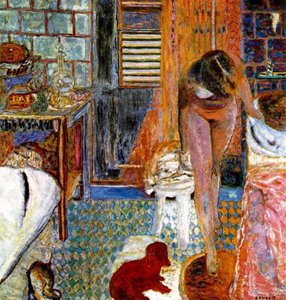
Nudež (1920) čiji je Пјер Бонар

Nudež

1920 · Ulje na platnu

Subjekat i kompozicija Ovo očaravajuće umetničko delo predstavlja intimni portret nage ženske figure, prikazane uz nežnu ravnotežu između realizma i stilizacije. Opuštena, ali dostojanstvena poza figure poziva posmatrače u trenutak tihe introspekcije, naglašavajući teme ranjivosti, unutrašnje snage i ličnog promišljanja. Kompozicija postavlja figuru u centar, suptilno uokrečenu bogato teksturisanom pozadinom koja pojačava njeno prisustvo i poziva na dublje istraživanje njenog emocionalnog stanja. Umetnički stil i tehnika Spajajući elemente postimpresionizma i…

2
La toilette, ca Private (1932) čiji je Пјер Бонар

La toilette, ca Private

1932 · Oil On Canvas

Pierre Bonnard’s La toilette, ca Private transports us into a moment suspended in time—a private ritual unfolding within the soft embrace of a sunlit bedroom. The scene is less a mere depiction and more an immersion into memory itself. We find ourselves observing a woman near a window, her lower form anchoring the composition while the surrounding elements whisper tales of domestic life. Bonnard masterfully captures the interplay between the…

3
The almond tree in blossom čiji je Пјер Бонар

The almond tree in blossom

Oil On Canvas

The painting features a tree with branches and leaves in the foreground. This tree is in blossom, with many flowers appearing on its branches. Several birds are perched on the branches. In the background, there are two smaller trees: one is located towards the left side of the painting, and another is positioned further back on the right side. The composition is balanced, with the foreground tree occupying a significant…

4
Le placard rouge (The Red Cupboard), (1939) čiji je Пјер Бонар

Le placard rouge (The Red Cupboard),

1939 · Oil On Canvas

To gaze upon Pierre Bonnard's Le placard rouge (The Red Cupboard) is to step directly into a moment suspended in time—a warm, intimate glimpse into the heart of a French kitchen from the early decades of the twentieth century. This painting transcends a mere depiction of household objects; it is an immersion into color, light, and the quiet poetry of domestic life. The overwhelming presence of the red walls and…

5
Summer in Normandy (1912) čiji je Пјер Бонар

Summer in Normandy

1912 · Oil On Canvas · Pushkin State Museum, Moskva

Pierre Bonnard’s “Summer in Normandy,” painted in 1912, isn't merely a depiction of a landscape; it’s an embodiment of Impressionism’s lingering influence and Bonnard’s distinctive approach to capturing the essence of domestic serenity. Currently residing at the Pushkin State Museum in Moscow, Russia, this oil on panel masterpiece transcends its physical dimensions, inviting viewers into a realm of muted hues and subtle textures that speak volumes about the artist's vision.

6
Woman with a Parrot čiji je Пјер Бонар

Woman with a Parrot

Oil On Canvas

The canvas invites the viewer into a quiet domestic tableau, where a woman stands before a tree, her gaze drifting beyond the frame as she cradles a bright parrot on her shoulder. Two other figures linger in the background—one near the left edge, another further back to the right—adding depth and narrative intrigue. Scattered objects—a bowl in the lower‑right corner, a chair toward the top‑left, a banana near the center,…

7
Young Girl Sitting with a Rabbit (1891) čiji je Пјер Бонар

Young Girl Sitting with a Rabbit

In this 1891 composition, we find a young girl nestled within a dense, organic environment. She sits with a quiet stillness, her form integrated into a lush landscape of deep greens and earthy ochres. A rabbit rests near her, adding to the sense of a private, undisturbed moment. The scene is not one of grand drama, but of a soft, intimate connection between a child and the natural world. There…

8
The Palm (1926) čiji je Пјер Бонар

The Palm

1926 · Acrylic On Canvas · The Phillips Collection, Vašington, D.C.

The painting depicts a cityscape viewed from an elevated perspective, featuring a woman standing in the foreground. She is positioned toward the center of the composition, looking out over the urban landscape. The scene is characterized by a large building in the background and several smaller buildings scattered throughout the area. Spindly palm fronds encircle the view, and the landscape includes coral-tiled roofs. The color palette includes a sea of…

9
Bunch of Mimosa (1945) čiji je Пјер Бонар

Bunch of Mimosa

1945 · Oil On Canvas

Subject and Composition The painting presents a radiant bouquet of mimosa flowers, their golden petals spilling from a humble bowl onto a wooden table. The arrangement is centered, drawing the eye into a warm, almost tactile space that feels both intimate and inviting. Two chairs flank the scene, one on the right, one on the left, suggesting a quiet domestic moment paused in time. A potted plant in the background…

10
Woman with Dog (1922) čiji je Пјер Бонар

Woman with Dog

1922 · Oil On Canvas · The Phillips Collection, Vašington, D.C.

The room feels still, held in a soft, suspended moment of domestic life. A woman sits at a table, her presence anchoring the composition with a gentle, steady weight. She wears a striped shirt of deep reds and oranges, a sudden pulse of warmth against the cooler, muted tones of the surrounding space. On her lap, a small dark dog rests, its form blending into the intimate shadows of the…

Čuvena dela umetnika Пјер Бонар, od 11 do 100

11Carafe, Marthe Bonnard with Her Dog (1915) čiji je Пјер БонарCarafe, Marthe Bonnard with Her Dog1915 · Villa Flora 12Almond Tree in Blossom čiji je Пјер БонарAlmond Tree in BlossomMusée d'Orsay 13The Windows (1925) čiji je Пјер БонарThe Windows1925 14L'escalier du jardin (the garden steps) private (1940) čiji je Пјер БонарL'escalier du jardin (the garden steps) private1940 · Pola Museum of Art 15The Cherry Pie čiji je Пјер БонарThe Cherry Pie 16Interior: The Terrasse Children (1899) čiji je Пјер БонарInterior: The Terrasse Children1899 · Dallas Museum of Art 17The Family of Claude Terrasse (1899) čiji je Пјер БонарThe Family of Claude Terrasse1899 · Metropoliten музеј у Њујорку 18The Dressing Room (1914) čiji je Пјер БонарThe Dressing Room1914 · Metropoliten музеј у Њујорку 19After the Shower (1914) čiji je Пјер БонарAfter the Shower1914 · Philadelphia Museum of Art 20La revue blanche čiji je Пјер БонарLa revue blancheDetroit Institute of Arts 21Afternoon bourgeois čiji je Пјер БонарAfternoon bourgeois 22Afternoon in París čiji je Пјер БонарAfternoon in ParísErmitaž 23Woman with Mimosa (1924) čiji je Пјер БонарWoman with Mimosa1924 · Metropoliten музеј у Њујорку 24The Children's Meal (1895) čiji je Пјер БонарThe Children's Meal1895 · Metropoliten музеј у Њујорку 25Nude by the Bath Tub (1931) čiji je Пјер БонарNude by the Bath Tub1931 26Portrait of Doctor Maurice Girardin (1917) čiji je Пјер БонарPortrait of Doctor Maurice Girardin1917 · Petit Palais 27Morning in the Garden at Vernonnet (1917) čiji je Пјер БонарMorning in the Garden at Vernonnet1917 · Metropoliten музеј у Њујорку 28Grandmother with a Child (1894) čiji je Пјер БонарGrandmother with a Child1894 · Szépművészeti Múzeum 29The Lodge (1908) čiji je Пјер БонарThe Lodge1908 30The Letter (1906) čiji je Пјер БонарThe Letter1906 · National Gallery of Art 31The Little Laundress čiji je Пјер БонарThe Little Laundress 32Nude at the Fireplace (1913) čiji je Пјер БонарNude at the Fireplace1913 · Centre Pompidou 33The Artist's Studio (1900) čiji je Пјер БонарThe Artist's Studio1900 · National Gallery of Art 34Village Scene, Grasse (1912) čiji je Пјер БонарVillage Scene, Grasse1912 · Metropoliten музеј у Њујорку 35View of Le Cannet, Roofs (1942) čiji je Пјер БонарView of Le Cannet, Roofs1942 36Madame Reine Thadée Natanson with the pearl necklace (1921) čiji je Пјер БонарMadame Reine Thadée Natanson with the pearl necklace1921 · Musée d'Orsay 37Lady Before the Mirror (1905) čiji je Пјер БонарLady Before the Mirror1905 · Bavarske državne slikopisne kolekcije 38Children and Cat (1909) čiji je Пјер БонарChildren and Cat1909 · The Phillips Collection 39Woman with ducks (1892) čiji je Пјер БонарWoman with ducks1892 · Clemens Sels Museum Neuss 40The Dining Room in the countryside čiji je Пјер БонарThe Dining Room in the countryside 41Cannet landscape, view of the roofs čiji je Пјер БонарCannet landscape, view of the roofs 42Flowers on a Red Carpet (1928) čiji je Пјер БонарFlowers on a Red Carpet1928 43Woman Putting on Her Stockings (1893) čiji je Пјер БонарWoman Putting on Her Stockings1893 · Cleveland Museum of Art 44Café Terrace (1898) čiji je Пјер БонарCafé Terrace1898 · Cleveland Museum of Art 45Reclining Nude (1897) čiji je Пјер БонарReclining Nude1897 · MoMA - Muzej moderne umetnosti 46The Claude Terrace Family in the garden (1896) čiji je Пјер БонарThe Claude Terrace Family in the garden1896 · Alte Nationalgalerie 47La Chanson du Grand-pere (1893) čiji je Пјер БонарLa Chanson du Grand-pere1893 48The Cab Horse (1895) čiji je Пјер БонарThe Cab Horse1895 · National Gallery of Art 49Nannies' promenade, frieze of carriages (1896) čiji je Пјер БонарNannies' promenade, frieze of carriages1896 50By the Sea, Under the Pines (1921) čiji je Пјер БонарBy the Sea, Under the Pines1921 51Nude Facing Forward (1905) čiji je Пјер БонарNude Facing Forward1905 · Petit Palais 52Misia Sert on Edward's boat (1905) čiji je Пјер БонарMisia Sert on Edward's boat1905 · Collection Bemberg 53Nu debout, de profil (1905) čiji je Пјер БонарNu debout, de profil1905 54Woman at Her Toilet (1905) čiji je Пјер БонарWoman at Her Toilet1905 · Foundation E.G. Bührle Collection 55Interior Scene (1905) čiji je Пјер БонарInterior Scene1905 · Foundation E.G. Bührle Collection 56The Painter's Studio (1905) čiji je Пјер БонарThe Painter's Studio1905 · Muzej fine umetnosti u Hjustonu 57Nude (1903) čiji je Пјер БонарNude1903 · Gothenburg Museum of Art 58Model in Armchair (1903) čiji je Пјер БонарModel in Armchair1903 · Gothenburg Museum of Art 59Nude, Red Chair (1905) čiji je Пјер БонарNude, Red Chair1905 60Untitled (Woman on balcony) (1900) čiji je Пјер БонарUntitled (Woman on balcony)1900 61The Luncheon (1899) čiji je Пјер БонарThe Luncheon1899 · Foundation E.G. Bührle Collection 62Man and Woman (1900) čiji je Пјер БонарMan and Woman1900 · Musée d'Orsay 63IN A BOAT (1907) čiji je Пјер БонарIN A BOAT1907 64The Woman with the Dog (1906) čiji je Пјер БонарThe Woman with the Dog1906 · Musée des Beaux-Arts 65Nude (1906) čiji je Пјер БонарNude1906 66Fishermen in a Boat, Brittany (1907) čiji je Пјер БонарFishermen in a Boat, Brittany1907 · Galerie Rosengart 67Reclining Nude against a White and Blue Plaid (1909) čiji je Пјер БонарReclining Nude against a White and Blue Plaid1909 · Städel Museum 68Nu assis, jambe pliée (1909) čiji je Пјер БонарNu assis, jambe pliée1909 69Movement of the Street (1907) čiji je Пјер БонарMovement of the Street1907 · The Phillips Collection 70In a boat (1907) čiji je Пјер БонарIn a boat1907 · Musée d'Orsay 71Le Café (1907) čiji je Пјер БонарLe Café1907 72Nude sitting, Flowers in hair (1907) čiji je Пјер БонарNude sitting, Flowers in hair1907 73After the Bath (1910) čiji je Пјер БонарAfter the Bath1910 · Metropoliten музеј у Њујорку 74Young Girls with the Seagull (1917) čiji je Пјер БонарYoung Girls with the Seagull1917 · Petit Palais 75Indoor (By lamp light) (1912) čiji je Пјер БонарIndoor (By lamp light)1912 76Woman Picking Flowers (1916) čiji je Пјер БонарWoman Picking Flowers1916 · Dixon Gallery and Gardens 77Woman in a Landscape (1914) čiji je Пјер БонарWoman in a Landscape1914 · National Museum of Art, Architecture and Design 78Painting (1917) čiji je Пјер БонарPainting1917 · National Museum of Art, Architecture and Design 79Woman leaning on her Elbow with a Dog and a Still Life (1917) čiji je Пјер БонарWoman leaning on her Elbow with a Dog and a Still Life1917 80Portrait of woman in large hat (1917) čiji je Пјер БонарPortrait of woman in large hat1917 81Pont de la Concorde (1913) čiji je Пјер БонарPont de la Concorde1913 82Girl in blue, with rose (1916) čiji je Пјер БонарGirl in blue, with rose1916 83Cats on the Railing (1909) čiji je Пјер БонарCats on the Railing1909 · Ohara Museum of Art 84Lignite Mine (1919) čiji je Пјер БонарLignite Mine1919 · Bavarske državne slikopisne kolekcije 85The Abduction of Europa (1919) čiji je Пјер БонарThe Abduction of Europa1919 · Toledo Museum of Art 86Torso of woman, profile (1918) čiji je Пјер БонарTorso of woman, profile1918 · Chapelle des pénitents blancs 87Interior with a Woman in a Wicker Chair (1920) čiji je Пјер БонарInterior with a Woman in a Wicker Chair1920 · Nationalmuseum 88A Woman with a White Corsage (1922) čiji je Пјер БонарA Woman with a White Corsage1922 89The Striped Blouse (1922) čiji je Пјер БонарThe Striped Blouse1922 90Interior at antibes (1920) čiji je Пјер БонарInterior at antibes1920 91IN A BOAT. THE PROMENADE AT SEA (1924) čiji je Пјер БонарIN A BOAT. THE PROMENADE AT SEA1924 92Le Déjeuner (1923) čiji je Пјер БонарLe Déjeuner1923 · National Gallery of Ireland 93Sleeping woman (1928) čiji je Пјер БонарSleeping woman1928 94The terrace of Vernon (1928) čiji je Пјер БонарThe terrace of Vernon1928 · Kunstsammlung Nordrhein-Westfalen 95Young Girl with Umbrella (1894) čiji je Пјер БонарYoung Girl with Umbrella1894 96Boat Ride (En bateau) (1930) čiji je Пјер БонарBoat Ride (En bateau)1930 · Collection Bemberg 97Blond Nude Seated (1931) čiji je Пјер БонарBlond Nude Seated1931 98Portrait of Madame Henri Jean Arthur Fontaine (1930) čiji je Пјер БонарPortrait of Madame Henri Jean Arthur Fontaine1930 · Musée d'Orsay 99Landing Stage (1939) čiji je Пјер БонарLanding Stage1939 100The Dessert (1921) čiji je Пјер БонарThe Dessert1921 · Cleveland Museum of Art

Čuvena dela Пјер Бонар po periodima

Motivi koji su privlačili pažnju Пјер Бонар

Četiri teme koje se najčešće ponavljaju u ovim originalima, svaka sa svojim vrhunskim primerom.

Muzeji u kojima se čuvaju originalna dela umetnika Пјер Бонар

8 muzeja u kojima se nalazi najviše slika sa ove stranice.

Muzej Grad Radovi umetnika Пјер Бонар Slike iz ovog spiska
Metropoliten музеј у Њујорку, ЊујоркMetropoliten музеј у Њујорку Њујорк 23 The Family of Claude Terrasse, The Dressing Room, Woman with Mimosa
Musée d'Orsay, ParizMusée d'Orsay Pariz 17 Almond Tree in Blossom, Madame Reine Thadée Natanson with the pearl necklace, Man and Woman
The Phillips Collection, Vašington, D.C.The Phillips Collection Vašington, D.C. 15 The Palm, Woman with Dog, Children and Cat
National Gallery of Art, WashingtonNational Gallery of Art Washington 12 The Letter, The Artist's Studio, The Cab Horse
Petit Palais, ParizPetit Palais Pariz 6 Portrait of Doctor Maurice Girardin, Nude Facing Forward, Young Girls with the Seagull
Cleveland Museum of Art, KlivlendCleveland Museum of Art Klivlend 5 Woman Putting on Her Stockings, Café Terrace, The Dessert
Foundation E.G. Bührle Collection, ZrichFoundation E.G. Bührle Collection Zrich 4 Woman at Her Toilet, Interior Scene, The Luncheon
Collection Bemberg, ToulouseCollection Bemberg Toulouse 11 Misia Sert on Edward's boat, Boat Ride (En bateau)

Пјер Бонар kroz decenije: jedan jedinstveni original za svaku

Radovi po decenijama

Izaberite deceniju da biste videli original koji je definiše.

Slike umetnika Пјер Бонар: pitanja za galeriju

Koje je najpoznatije delo umetnika Пјер Бонар?Otkrij odgovor

Nudež (1920). Slede La toilette, ca Private (1932) i The almond tree in blossom.

U kojoj je godini Пјер Бонар stvorio/la Nudež?Otkrij odgovor

53 godina: Nudež datira iz 1920, a Пјер Бонар je rođen/a 1867.

Koji je deset najpoznatijih slika autora Пјер Бонар?Otkrij odgovor

Nudež, La toilette, ca Private, The almond tree in blossom, Le placard rouge (The Red Cupboard),, Summer in Normandy, Woman with a Parrot, Young Girl Sitting with a Rabbit, The Palm, Bunch of Mimosa i Woman with Dog. Gornji rang pokazuje godinu i muzej za svako od njih.

Koliko je poznatih dela umetnika Пјер Бонар?Otkrij odgovor

Naš katalog sadrži 612 dela umetnika Пјер Бонар, datiranih od 1891 do 1945.

Gde se mogu videti najpoznatiji originali umetnika Пјер Бонар?Otkrij odgovor

Većinom u Metropoliten музеј у Њујорку (Њујорк), Musée d'Orsay (Pariz) i The Phillips Collection (Vašington, D.C.). Tabela muzeja iznad sadrži njih sve.

U kom periodu je Пјер Бонар stvorio/la svoje najpoznatije slike?Otkrij odgovor

U 1900s: 27 od 100 dela na ovoj stranici nastalo je tada, od čega je The Lodge.

Ko je najraniji, a koje je najkasnije čuveno delo umetnika Пјер Бонар?Otkrij odgovor

Na ovoj stranici, najstarije delo je iz Young Girl Sitting with a Rabbit (1891), a najnovije iz Bunch of Mimosa (1945).

Koje su teme Пјер Бонар preferirao/la?Otkrij odgovor

Woman (11), Domestic scene (10) i Flowers (7), kroz svih 100 dela na ovoj stranici.

Sa kojim materijalima je Пјер Бонар najčešće slikao?Otkrij odgovor

Oil On Canvas, za 27 od 100 dela na ovoj stranici.

Kojem umetničkom pravcu pripada delo umetnika Пјер Бонар?Otkrij odgovor

Postimpresionizam, sudeći po originalima na ovoj stranici.

Koja originalna dela Пјер Бонар mogu videti u Metropoliten музеј у Њујорку?Otkrij odgovor

The Family of Claude Terrasse, The Dressing Room i Woman with Mimosa: Metropoliten музеј у Њујорку, Њујорк čuva 7 dela sa ove stranice.

Gde mogu da naručim ručno oslikanu reprodukciju Пјер Бонар?Otkrij odgovor

Da, kao reprodukcija: original ostaje u svom muzeju, ali svaku sliku sa ove stranice može se ručno naslikati za vas, po vašoj narudžbi, pojedinačno, direktno sa stranice te slike.

Пјер Бонар: portret umetnika

Pierre Bonnard (1867-1947): A Life Bathed in Light

Pierre Bonnard, geboren 1867 in der Pariser Vorstadt Fontenay-aux-Roses, war kein Mann für ein Leben voller künstlerischer Ausdruckskraft. Sein Vater, ein hochrangiger Beamter im französischen Verteidigungsministerium, sah seinem Sohn eine juristische Karriere vor. Junge Pierre verfolgte diese Ausbildung ernsthaft und erhielt seinen Abschluss im Jahr 1888, doch sein Herz lag anders – in der faszinierenden Welt von Farbe und Form. Diese Dichotomie, dieser Spannungsbogen zwischen Erwartung und Leidenschaft würde subtil Einfluss auf seine künstlerische Reise haben und ihm eine einzigartige Nähe zu seinem Werk verleihen. Er begann zunächst mit Karikaturen und entwickelte damit eine Beobachtungsgabe, die später zu exquisit wiedergegebenen häuslichen Szenen aufblühte. Allerdings fand Bonnard in der Académie Julian seinen Weg und begegnete dort Gleichgesinnten, die sich von akademischen Konventionen abwanderten und den Avantgarde Geist einfuhren, der durch Paris zog. Diese Begegnung führte ihn zu den Nabis – einer Gruppe von Künstlern, darunter Maurice Denis, Paul Sérusier und Édouard Vuillard –, die Kunst mit Spiritualität und Symbolismus erfüllten und über reine Darstellung hinaus eine Erforschung innerer Erfahrung suchten.

Die Nabi Jahre und die Pflege der Intimität

Die Zusammenarbeit mit den Nabis stellte Bonnards künstlerische Entwicklung entscheidend sicher. Die Gruppens Betonung von flachen Formen, kräftigen Farbpaletten und einer Ablehnung perspektivistischer Tradition resonierte tief in seinen künstlerischen Sensibilitäten. Inspiriert von japanischen Drucken – ihren eleganten Linien und harmonischen Kompositionen – und der Symbolismus Bewegung’s Erforschung subjektiver Emotionen entwickelte Bonnard seinen unverwechselbaren Stil weiter. Er interessierte sich nicht für große Erzählungen oder historische Allegorien; stattdessen wandte er sich innerlich zu und konzentrierte sich auf die ruhigen Momente des Alltagsliebes: Eine Frau beim Baden, eine Familie zum Abendessen versammelt, ein sonnenbeschienenes Gartenstück. Diese Szenen waren nicht nur Darstellungen von Ereignissen, sondern Destillationen von Gefühl – Erinnerungen und Atmosphäre gefiltert durch das Prisma persönlicher Erfahrung. Dieser Fokus auf häusliche Intimität erhielt ihm den Titel „Intimist“ – ein Begriff, der perfekt die emotionale Resonanz seines Werkes einfängt. Seine Gemälde erzählen nicht *was* dargestellt wird, sondern *wie* es sich anfühlt, präsent zu sein in diesen Momenten. Er arbeitete von Erinnerung aus und zeichnete umfassend auf und übersetzte diese Eindrücke dann mit außergewöhnlicher Sensibilität für Licht und Farbe auf die Leinwand.

Farbe als Emotion: Ein Meister Farbist

Bonnards Meisterhafte Verwendung von Farbe ist zweifellos sein prägendstes Merkmal. Er verwendete Farbe nicht einfach; er *fühlte* sie, ließ sie den Ton und die Atmosphäre seiner Gemälde bestimmen. Seine Palette war lebendig und doch nuanciert und setzte oft unerwartete Kombinationen ein, die einen Eindruck von schimmernder Luminosität erzeugten. Er würde seine fertigen Leinwände wiederholt besuchen und korrigierte Farben über mehrere Werke hinweg, um perfekte Harmonie zu erreichen – ein Beweis für seine obsessive Hingabe zum chromatischen Gleichgewicht. Das ging nicht um eine realistische Darstellung; es ging darum, die subjektive Erfahrung von Farbe einzufangen – ihre Fähigkeit, Emotionen und Erinnerungen hervorzurufen. Er wandte sich von direkter Beobachtung ab und bevorzugte stattdessen das Malen aus der Erinnerung heraus, was ihm ermöglichte, seine Szenen mit einer traumhaften Qualität zu erfüllen. Seine Landschaftsbilder waren nicht nur Darstellungen von Orten, sondern emotionale Antworten darauf – gefiltert durch das Prisma persönlicher Erfahrung.

Späteres Leben und Erblegende Bedeutung

Mit zunehmendem Alter verschob sich Bonnards künstlerischer Fokus noch stärker auf die Erforschung von Farbe und Licht. Er verbrachte immer mehr Zeit im südlichen Frankreich und ließ sich von der mediterranen Landschaft und ihrer intensiven Luminosität faszinieren. Seine Beziehung zu Marthe de Meligny, seiner Frau und lebenslangen Muse, blieb zentral für sein Leben und Werk. Sie erschien häufig in seinen Gemälden und wurde oft beim Baden oder bei alltäglichen Aktivitäten dargestellt – ihre Präsenz strahlte eine ruhige Anmut und Intimität aus. Im Jahr 1912 erwarb er „La Roulotte“ in Vernonnet, nahe Giverny, und gründete eine enge Freundschaft mit Claude Monet. Diese Nähe zum Meister des Impressionismus förderte Bonnards weitere Erforschung von Licht und Farbe weiter – obwohl er stets seinen eigenen unverwechselbaren künstlerischen Blick bewahrte. Er malte bis kurz vor seinem Tod im Jahr 1947 fort und hinterließ ein Werkkörper, das weiterhin fasziniert und inspiriert.

Bekannte Werke & Sammlungen

  • Frau in Schachbrettmuster (1890): Ein frühes Beispiel seines Nabi-inspirierten Stils, der flache Formen und kräftige Farbkompositionen zeigt.
  • Das Esszimmer (1913): Eine quintessenzielle Intimist Szene, die Wärme und Intimität des häuslichen Lebens einfängt.
  • Schüssel mit Früchten (ca. 1933): Demonstriert seine Meisterschaft der Stilllebenmalerei mit lebendigen Farben und einem Eindruck von lichtdurchfluteter Tiefe.
  • Die Mandelbaumblüte (1947): Eines seiner letzten Gemälde, das kurz vor seinem Tod fertiggestellt wurde und seine kontinuierliche Erforschung von Farbe und Licht zeigte.
Seine Werke finden sich in renommierten Museen weltweit, darunter:
  • Musée Marmottan Monet, Paris
  • Kunstmuseum Chicago
  • Museum of Modern Art, New York City
  • Tate Modern, London
Seine Erblegende Bedeutung besteht darin, dass er die Kraft von Farbe, Licht und der dauerhaften Schönheit des Alltagsliebes demonstriert. Er zeigte, dass Schönheit nicht in großen Gesten oder heroischen Erzählungen zu finden ist, sondern in den ruhigen Momenten des Lebens – gefiltert durch das Prisma persönlicher Erfahrung.

Sva 612 dela umetnika Пјер Бонар →