Portrait of Егон Шиле

The 100 Most Famous Егон Шиле Paintings, Each One of a Kind

Updated октобар 2026 · ranked by our popularity score (searches, visits and orders for each work) · 649 works by Егон Шиле in our catalogue

In short

Portret Valli (1912) is the Егон Шиле painting that draws the most eyes; the original belongs to the Leopold Museum, Beč. After it, the eye goes to Smrt i Devica (1915) and Самовидци II (Смрт и човек) (1911). Among the 649 works of Егон Шиле in our catalog, these 100 are the most famous, each a unique original presented with its year, its museum and the reason it endures.

1890 – 1918, Тулин на Дунаву Ekspresionizam Most works: Leopold Museum

Top 10 paintings by Егон Шиле, through the gallery's eye

1
Portret Valli (1912) by Егон Шиле

Portret Valli

1912 · Ulje na platnu · Leopold Museum, Beč

„Portret Vale Neuzil“ Egona Šijela, nastao 1912. godine, nije samo slika žene; to je produbljeno istraživanje ljudske pshe i uznemirenosti vremena koja se menja. Ovaj remek-delo austrijskog ekspresionizma, izložen u Leopoldovom muzeju u Beču, ostavlja neizbrisiv utisak na svakoga ko ga pogleda. Valburga „Vali“ Neuzil, Šijelova ljubavnica i često muza, predstavljena je ovde ne kao idealizovana lepota, već kao figura koja se direktno suočava sa posmatračem – izazov konvencijama portreture…

2
Smrt i Devica (1915) by Егон Шиле

Smrt i Devica

1915 · Akril na platnu · Austrian Gallery Belvedere, Beč

Egon Schiele i "Smrt i Devica": Utisak Apokalipse na Paleti Emocija Egon Schieleova “Smrt i Devica” nije samo slika; ona je iskripljenje duše, izraz najdubljih ljudskih strahova i želja. Kreirana 1915. godine u epicentru ekspresionizma, ova radostička scena, na prvi pogled, otkriva sloj kompleksnosti koji se širi kao mračna mreža oko gledalca. Schiele, mlad i talentiran, ali trpjeli bol od bolesti i gubitka, usudio se da oslika ono što drugi…

3
Самовидци II (Смрт и човек) (1911) by Егон Шиле

Самовидци II (Смрт и човек)

1911 · Ulje na platnu · Leopold Museum, Beč

U mračnom i prodornom svetu umetnosti Egona Schiela, "Samoprikazivači II (Smrt i Čovek)," nastao 1911. godine, zauzima posebno mesto. Ovo nije samo portret; to je visceralna eksplozija unutrašnje borbe, duboko psihološka studija o životu, smrti i ljudskom stanju, smeštena u vrtlog ekspresionističke vizije. Delo odiše neizrecenom tugom i osećajem neodoljive sudbine, pozivajući nas da se suočimo sa sopstvenim smrtnošću.

4
Majka sa Dvema Decima (1917) by Егон Шиле

Majka sa Dvema Decima

1917 · Ulje na platnu · Austrian Gallery Belvedere, Beč

Egon Schieleova *Majka sa Dve Deče­sti* (1917) nije samo portret; to je duboko emotivno iskušenje, izraz umetnickog genijuśa ovog pesimisticnog i inovativnog umetnika. Umetnicki rad se nalazi u Österreichische Galerie Belvedere u Beču i predstavlja ključni primer ekspresionizma, perioda u kome Schiele je razvio svoj jedinstveni stil, prepoznatljiv po izrazitoj emociji i psiholoskoj dubini. Ova slika, sa svojim mračnim tonovima i složenim kompozicijom, govori o bolima i strahovanjima koje su…

5
Porodica (1917) by Егон Шиле

Porodica

1917 · Akril na platnu · Austrian Gallery Belvedere, Beč

Egon Šilejev "Porodični" portret, nastao 1917. godine, predstavlja duboko resonujući rad koji prevazilazi jednostavnu sliku porodičnih veza. To je emotivno surovo i psihološki prodirajuća eksploracija povezanosti, ranjivosti i anđela koje prate ljudski odnosi – dokaz Šilejevog umeha u ekspresionizmu. Ovo nije samo portret; to je vizuelna priča o strahu, nadi i kompleksnosti ljudskog iskustva.

6
Lovers: Man and Woman I (1914) by Егон Шиле

Lovers: Man and Woman I

1914 · Oil On Canvas

Egon Schiele's 1914 painting, *Lovers: Man and Woman I*, isn’t merely a depiction of two figures; it’s a visceral exploration of human connection, vulnerability, and the unsettling beauty of mortality. Created during a period of intense personal struggle for the artist – marked by illness, loss, and a profound awareness of his own precarious existence – this work embodies the core tenets of Expressionism, translating raw emotion directly onto the…

7
Self Portrait with Hands on Chest (1910) by Егон Шиле

Self Portrait with Hands on Chest

1910 · Akril na platnu

A Window into the Soul: Egon Schiele’s ‘Self Portrait with Hands on Chest’ (1910) This striking self-portrait by Austrian Expressionist master Egon Schiele is more than just a likeness; it's a raw and unflinching exploration of inner turmoil, vulnerability, and the search for identity. Created in 1910, at a pivotal moment in both his artistic development and personal life, this work embodies the core tenets of Expressionism while establishing Schiele’s…

8
Zagrljaj (Seos-II) - - , (1917) by Егон Шиле

Zagrljaj (Seos-II) - - ,

1917 · Akril na platnu

Zasnočen zagrljaj: Dekodiranje Šileovog „Zagrljaja II” Egon Šileov „Zagrljaj (Seos-II)” (1917) nije samo prikaz intimnosti; to je visceralno istraživanje čovekovog stanja, izraženo sirovom emocionalnošću koja definiše ekspresionizam. Ovo moćno delo, dimenzija 100 x 170 cm, prevazilazi puku reprezentaciju kako bi postalo simbolički pejzaž ranjivosti, želje, a možda čak i anksioznosti.Subjekat i kompozicija: Proučavanje isprepletenih formi Ova slika prikazuje ogoljeno par u čvrstom zagrljaju. Muška figura dominira kompozicijom, smeštena iznad žene,…

9
Žena u žalosti (1912) by Егон Шиле

Žena u žalosti

1912 · Leopold Museum, Beč

Zakoračite bliže i možda ćete se naći zarobljeni u teškim, suznim očima ove žene. Ovde vlada duboka tišina, mada ona nipošto nije mirna. Lice je bledo, gotovo skeletno, sa tamnim senkama koje se skupljaju oko očne duplje, sugerišući duboko, fizičko iscrpljenost. Glava joj je prekrivena tamnom tkaninom, detaljem koji posmatrača uvlači u njenu privatnu tugu. Iza nje, iz mutne pozadine, izranja drugo, još spektralnije lice – muškarac čije prisustvo deluje…

10
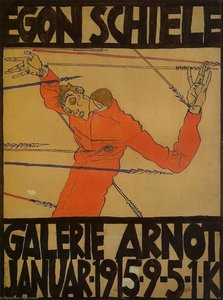
Autoportret kao Sveti Sebastian (poster) (1914) by Егон Шиле

Autoportret kao Sveti Sebastian (poster)

1914 · Grafika

Ovo umetničko delo je nedvosmisleno ukorenjeno u pokretu ekspresionizma. Karakterišan izobličenim oblicima, živopisnim, ali uznemirujućim bojama i odvažnim linijama, Šileov stil daje prednost subjektivnom emocionalnom iskustvu u odnosu na realističku reprezentaciju. Izdužena figura, prikazana sa nervoznom energijom, dominira kompozicijom. Obratite pažnju kako crveno odelo—svesno odabran detalj—pojačava osećaj drame i predosećaja nesreće. Ovde nije reč o anatomskoj preciznosti; reč je o prenošenju unutrašnjeg stanja.

Егон Шиле's famous paintings, numbers 11 to 100

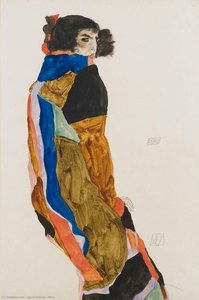
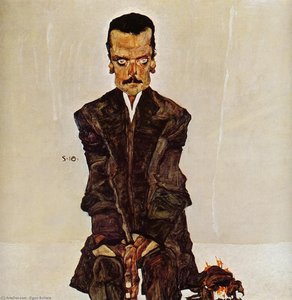
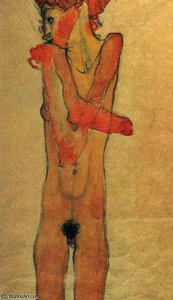
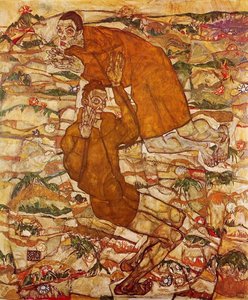
11Portrait of a Woman (1912) by Егон ШилеPortrait of a Woman1912 12Moa (1911) by Егон ШилеMoa1911 · Leopold Museum 13Agony (1912) by Егон ШилеAgony1912 14Kompozicija sa tri muške nage (1910) by Егон ШилеKompozicija sa tri muške nage1910 · Leopold Museum 15Портрет са тракама (1910) by Егон ШилеПортрет са тракама1910 · Leopold Museum 16Self Portrait with Arm Twisting above Head (1910) by Егон ШилеSelf Portrait with Arm Twisting above Head1910 17Mother and Child (Madonna) (1908) by Егон ШилеMother and Child (Madonna)1908 18Two Women Embracing (1915) by Егон ШилеTwo Women Embracing1915 · Szépművészeti Múzeum 19The Artist's Mother, Sleeping (1911) by Егон ШилеThe Artist's Mother, Sleeping1911 20Селфипортрет (1912) by Егон ШилеСелфипортрет1912 21Couple Embracing by Егон ШилеCouple Embracing 22Self-Portrait with Bare Shoulder (1912) by Егон ШилеSelf-Portrait with Bare Shoulder1912 · Leopold Museum 23Secession 49. Exhibition (1918) by Егон ШилеSecession 49. Exhibition1918 24Self-Portrait with Splayed Fingers (1911) by Егон ШилеSelf-Portrait with Splayed Fingers1911 · Leopold Museum 25Prophets (also known as Double Self Portrait) (1911) by Егон ШилеProphets (also known as Double Self Portrait)1911 · Staatsgalerie Stuttgart 26Žrtva i trudnoća (1911) by Егон ШилеŽrtva i trudnoća1911 · Nacionalna galerija u Pragu 27Crouching Woman with Green Headscarf (1914) by Егон ШилеCrouching Woman with Green Headscarf1914 · Leopold Museum 28Girl Nude with Folded Arms, 1910 (1910) by Егон ШилеGirl Nude with Folded Arms, 19101910 · Albertina 29Шиле Гертi Шиле by Егон ШилеШиле Гертi Шиле 30Seated Woman with Bent Knee (1917) by Егон ШилеSeated Woman with Bent Knee1917 31Planinski torrent (1918) by Егон ШилеPlaninski torrent1918 32Autumn Trees (1911) by Егон ШилеAutumn Trees1911 33Portret izdavača Edvarda Kosmaka (1910) by Егон ШилеPortret izdavača Edvarda Kosmaka1910 · Austrian Gallery Belvedere 34untitled (938) by Егон Шилеuntitled (938) 35Schiele's Room in Neulengbach (1911) by Егон ШилеSchiele's Room in Neulengbach1911 · Kunsthistorisches Museum 36Self-Portrait with Lowered Head (1912) by Егон ШилеSelf-Portrait with Lowered Head1912 · Leopold Museum 37Kneeling Girl, Resting on Both Elbows (1917) by Егон ШилеKneeling Girl, Resting on Both Elbows1917 · Leopold Museum 38Portrait of Herbert Reiner (1910) by Егон ШилеPortrait of Herbert Reiner1910 39Кућа на реци (такође позната као Стара кућа I) (1915) by Егон ШилеКућа на реци (такође позната као Стара кућа I)1915 · Leopold Museum 40Густав Климт на кревету смрти (1918) by Егон ШилеГустав Климт на кревету смрти1918 · Wien Museum 41Sitting Nude Young Naked Viennese Woman by Егон ШилеSitting Nude Young Naked Viennese Woman 42Self Portrait with Raised Arms, Back View (1912) by Егон ШилеSelf Portrait with Raised Arms, Back View1912 43The truth unveiled - - (1913) by Егон ШилеThe truth unveiled - -1913 44Ivice grada (takođe poznato kao Krumau Town Crescent III) (1918) by Егон ШилеIvice grada (takođe poznato kao Krumau Town Crescent III)1918 45Street in Krumau (1917) by Егон ШилеStreet in Krumau1917 46Wally with a Red Blouse (1913) by Егон ШилеWally with a Red Blouse1913 47Self-Portrait with Outstretched Arms1911 by Егон ШилеSelf-Portrait with Outstretched Arms1911 48Portrait of an Old Man (also known as Johann Harms) (1916) by Егон ШилеPortrait of an Old Man (also known as Johann Harms)1916 · Solomon R. Guggenheim Museum 49self-portrait (1913) by Егон Шилеself-portrait1913 50Portret Viktora Ritera fon Bauera (1918) by Егон ШилеPortret Viktora Ritera fon Bauera1918 · Austrian Gallery Belvedere 51schiele agonia 1912 by Егон Шилеschiele agonia 1912 52Portrait of Leopold Czihaczek (1907) by Егон ШилеPortrait of Leopold Czihaczek1907 53schiele sebastian by Егон Шилеschiele sebastian 54pregnant woman death by Егон Шилеpregnant woman death 55Portrait of Leopold Czihaczek, Standing (1907) by Егон ШилеPortrait of Leopold Czihaczek, Standing1907 56Sunflowers (1911) by Егон ШилеSunflowers1911 57Man with Blue Headband and Hand on Cheek (1909) by Егон ШилеMan with Blue Headband and Hand on Cheek1909 58Portrait of the Artist's Wife Seated, Holding Her Right Leg by Егон ШилеPortrait of the Artist's Wife Seated, Holding Her Right Leg 59untitled (2447) by Егон Шилеuntitled (2447) 60Boy with Hand to Face (1910) by Егон ШилеBoy with Hand to Face1910 61Self Portrait (1911) by Егон ШилеSelf Portrait1911 62seated couple (Egon And Edih Schiele) 1915 by Егон Шилеseated couple (Egon And Edih Schiele) 1915 63I Will Gladly Endure for Art and My Loved Ones, 1912 (1912) by Егон ШилеI Will Gladly Endure for Art and My Loved Ones, 19121912 · Albertina 64Black-Haired Girl with Lifted Skirt (1911) by Егон ШилеBlack-Haired Girl with Lifted Skirt1911 · Leopold Museum 65Study of hands (1913) by Егон ШилеStudy of hands1913 66scornful woman 1910 by Егон Шилеscornful woman 1910 67Standing Nude, Facing Right by Егон ШилеStanding Nude, Facing Right 68Reclining Female Nude (1917) by Егон ШилеReclining Female Nude1917 69Autumn Sun (1912) by Егон ШилеAutumn Sun1912 70Conversion (1912) by Егон ШилеConversion1912 71Kneeling Young Man (1908) by Егон ШилеKneeling Young Man1908 72Prostitute (Dirne) by Егон ШилеProstitute (Dirne) 73femme à demi nue étendue 1911 by Егон Шилеfemme à demi nue étendue 1911 74Levitation (1915) by Егон ШилеLevitation1915 75Two young girls by Егон ШилеTwo young girls 76Woman Undressing (1914) by Егон ШилеWoman Undressing1914 77Two Kneeling Figures (also known as Parallelogram) (1913) by Егон ШилеTwo Kneeling Figures (also known as Parallelogram)1913 78Lovemaking (1915) by Егон ШилеLovemaking1915 · Leopold Museum 79Reclining Female Nude (1908) by Егон ШилеReclining Female Nude1908 80Seated Woman in Corset and Boots by Егон ШилеSeated Woman in Corset and Boots 81Moa (1911) by Егон ШилеMoa1911 82untitled (5287) by Егон Шилеuntitled (5287) 83The Bridge (1913) by Егон ШилеThe Bridge1913 84untitled (7272) by Егон Шилеuntitled (7272) 85Reclining Girl, with Round Head by Егон ШилеReclining Girl, with Round Head 86Autumn Tree with Fuchsias (1909) by Егон ШилеAutumn Tree with Fuchsias1909 87Torso of a Seated Woman with Boots by Егон ШилеTorso of a Seated Woman with Boots 88untitled (6044) by Егон Шилеuntitled (6044) 89Two Girls Lying Entwined (1915) by Егон ШилеTwo Girls Lying Entwined1915 90City on the Blue River (1910) by Егон ШилеCity on the Blue River1910 91Nude with Blue Stockings, Bending Forward (1912) by Егон ШилеNude with Blue Stockings, Bending Forward1912 · Leopold Museum 92Seated Couple, 1915 (1915) by Егон ШилеSeated Couple, 19151915 · Albertina 93Nude Self-Portrait (1910) by Егон ШилеNude Self-Portrait1910 · Leopold Museum 94Krumau Town Crescent I (1915) by Егон ШилеKrumau Town Crescent I1915 · Izraelski muzej 95Kneeling Female in Orange-Red Dress (1910) by Егон ШилеKneeling Female in Orange-Red Dress1910 · Leopold Museum 96untitled (1348) by Егон Шилеuntitled (1348) 97Female nude (1910) by Егон ШилеFemale nude1910 98Self-Portrait in Yellow Vest, 1914 (1914) by Егон ШилеSelf-Portrait in Yellow Vest, 19141914 · Albertina 99Procession (1911) by Егон ШилеProcession1911 100Sitting Woman in a Green Blouse (1913) by Егон ШилеSitting Woman in a Green Blouse1913

Егон Шиле's famous paintings, period by period

The subjects that held Егон Шиле's eye

The four subjects that come back most often in these originals, each with its finest example.

The museums that keep Егон Шиле's originals

The 8 museums that hold the most of the paintings on this page.

Museum City Works by Егон Шиле Paintings from this list
Leopold Museum, BečLeopold Museum Beč 46 Portret Valli, Самовидци II (Смрт и човек), Žena u žalosti
Austrian Gallery Belvedere, BečAustrian Gallery Belvedere Beč 10 Smrt i Devica, Majka sa Dvema Decima, Porodica
Albertina, BečAlbertina Beč 10 Girl Nude with Folded Arms, 1910, I Will Gladly Endure for Art and My Loved Ones, 1912, Seated Couple, 1915
Kunsthistorisches Museum, BečKunsthistorisches Museum Beč 4 Schiele's Room in Neulengbach
Wien Museum, BečWien Museum Beč 2 Густав Климт на кревету смрти
Szépművészeti Múzeum, BudimpeštaSzépművészeti Múzeum Budimpešta 1 Two Women Embracing
Staatsgalerie Stuttgart, ŠtutgartStaatsgalerie Stuttgart Štutgart 1 Prophets (also known as Double Self Portrait)
Nacionalna galerija u Pragu, PragNacionalna galerija u Pragu Prag 1 Žrtva i trudnoća

Егон Шиле across the years: the unique originals of each

12 years separate Егон Шиле's first and last dated originals shown here, 1907 and 1918: each year has its place below.

Works per year

Pick a year to see its originals.

Егон Шиле's paintings: questions for the gallery

What is the single most famous work of Егон Шиле?Reveal the answer

Portret Valli (1912), Leopold Museum, Beč. Smrt i Devica (1915) and Самовидци II (Смрт и човек) (1911) come next.

At what age did Егон Шиле create Portret Valli?Reveal the answer

22 years old: Portret Valli dates from 1912, and Егон Шиле was born in 1890.

Which ten paintings by Егон Шиле are the most famous?Reveal the answer

Portret Valli, Smrt i Devica, Самовидци II (Смрт и човек), Majka sa Dvema Decima, Porodica, Lovers: Man and Woman I, Self Portrait with Hands on Chest, Zagrljaj (Seos-II) - - ,, Žena u žalosti and Autoportret kao Sveti Sebastian (poster). The ranking above gives each one's year and museum.

How many works by Егон Шиле are known?Reveal the answer

Our catalog holds 649 works by Егон Шиле, dated from 1907 to 1918.

Where can the most famous Егон Шиле originals be seen?Reveal the answer

Mostly in Leopold Museum (Beč), Austrian Gallery Belvedere (Beč) and Albertina (Beč). The museum table above lists them all.

During which period did Егон Шиле create the best-known paintings?Reveal the answer

In 1911: 13 of the 100 works on this page were made then, Самовидци II (Смрт и човек) among them.

Which famous Егон Шиле painting is the earliest, and which the latest?Reveal the answer

On this page, the earliest is Portrait of Leopold Czihaczek (1907) and the latest Secession 49. Exhibition (1918).

What subjects did Егон Шиле favour?Reveal the answer

Mortality (25), Vienna (16) and Anxiety (14), across the 100 works on this page.

What materials did Егон Шиле paint with most?Reveal the answer

Acrylic On Canvas, for 29 of the 100 works on this page.

Which movement does the work of Егон Шиле belong to?Reveal the answer

Ekspresionizam, judging by the originals on this page.

What Егон Шиле originals can I see at the Leopold Museum?Reveal the answer

Portret Valli, Самовидци II (Смрт и човек) and Žena u žalosti: the Leopold Museum, Beč holds 17 of the works on this page.

Where can I order a hand-painted Егон Шиле reproduction?Reveal the answer

Yes, as a reproduction: the original stays in its museum, but any painting on this page can be painted by hand for you, made to order one at a time, from the painting's own page.

Егон Шиле: a portrait of the artist

A Life Forged in Expression

Born in 1890 in the Austrian town of Tulln an der Donau, Egon Schiele’s life was a tempestuous journey marked by both extraordinary artistic vision and profound personal hardship. His early years were shadowed by illness and loss; his father succumbed to syphilis when Egon was just fourteen, a tragedy that would deeply resonate within his work, fueling an obsession with mortality and the fragility of existence. Raised initially by his mother and then under the somewhat controlling guardianship of his uncle Leopold Czihaczek, Schiele’s childhood lacked conventional stability but fostered a fiercely independent spirit. Even as a boy, he displayed an intense fascination with trains—a motif that subtly reappeared in later paintings—and a burgeoning talent for drawing, though this was initially met with disapproval from his father who saw it as a distraction from more practical pursuits. The early death of his sister Elvira also cast a long shadow over the young artist’s psyche. These formative experiences instilled within him a sensitivity and an emotional rawness that would become hallmarks of his artistic expression, a constant grappling with themes of life, death, and the human condition.

The Crucible of Vienna: Artistic Development

Schiele's formal artistic training began at the Kunstgewerbeschule (School of Arts and Crafts) in Vienna, but he quickly found himself stifled by its conservative approach. He transferred to the Akademie der bildenden Künste (Academy of Fine Arts), only to become further disillusioned with its rigid academic traditions. This dissatisfaction led him to abandon formal training altogether, choosing instead to forge his own path, a testament to his unwavering artistic conviction. The influence of Gustav Klimt was pivotal during these early years; Schiele admired Klimt’s decorative style and exploration of symbolism, even receiving mentorship from the established artist. However, Schiele soon diverged from Klimt's aesthetic, developing a distinctly individual voice characterized by its stark honesty and psychological intensity. He co-founded the Neues Wiener Kunstgruppe (New Viennese Art Group) in 1909, aligning himself with other progressive artists who challenged the prevailing artistic norms. His early works, often unsettling portraits and self-portraits, began to emerge as powerful statements of emotional turmoil, featuring distorted figures and a palpable sense of vulnerability. These paintings were not merely representations of physical form but explorations of the inner landscape—the anxieties, desires, and fears that haunted the human psyche.

Raw Emotion and Unflinching Truth

Egon Schiele’s art is immediately recognizable for its raw honesty and psychological depth. He fearlessly confronted themes often considered taboo – sexuality, death, anxiety, isolation – with an unflinching gaze. His distinctive style features elongated figures, contorted poses, and expressive lines that convey a sense of unease and emotional intensity. The human form, particularly the nude, became his primary subject, not as an object of idealized beauty but as a vessel for exploring the complexities of human experience. Self-portraits constitute a significant portion of his oeuvre, offering intimate glimpses into his inner world—a world often marked by loneliness and self-doubt. He didn’t shy away from depicting himself in unflattering or vulnerable poses, revealing a profound level of self-awareness and introspection. Beyond self-portraiture, Schiele created numerous portraits of others, capturing their likenesses with an unsettling realism that seemed to penetrate beneath the surface. His landscapes, while less central to his work than his figurative paintings, demonstrate his mastery of form and color, often reflecting the same emotional intensity as his portraits. The use of line is particularly striking in Schiele’s work; it's not merely a tool for defining shape but an expressive force that conveys emotion and psychological tension. Recurring motifs like the *Physalis plant* – symbolizing death and transience with its delicate, papery husk – further underscore this preoccupation with mortality.

A Legacy Cut Short: Achievements & Significance

Despite facing censorship and legal challenges – including a brief imprisonment for allegedly corrupting minors with his art – Schiele gained recognition within Vienna’s avant-garde circles. His work challenged the conventions of the time, provoking both admiration and outrage. By the time of his untimely death during the Spanish flu pandemic in 1918 at the age of twenty-eight, he had established himself as a leading figure in Austrian Expressionism. Significant works such as Self-Portrait with Physalis, Couple Embracing, and Field Landscape (Kreuzberg near Krumau) stand as testaments to his artistic genius. His influence on subsequent generations of artists is undeniable, particularly those interested in exploring psychological themes and challenging conventional artistic norms. Schiele’s bold approach to form and subject matter continues to resonate with audiences today, making him one of the most important and influential figures in early 20th-century art. His paintings are now held in major museum collections worldwide, including the Leopold Museum in Vienna and the Egon Schiele Art Centrum in Český Krumlov, ensuring his artistic legacy endures. He left behind a body of work that is not merely aesthetically compelling but profoundly human—a testament to the power of art to confront the complexities of existence with honesty, courage, and unwavering vision.

  • Key Themes: Mortality, sexuality, isolation, psychological turmoil.
  • Influences: Gustav Klimt, Viennese Secession, personal trauma.
  • Style Characteristics: Elongated figures, contorted poses, expressive lines, raw emotion.

All 649 works by Егон Шиле →