1


Ažurirano: новембар 2026 · rangirano prema našem koeficijentu popularnosti (pretrage, posete i porudžbine za svako delo) · 20 dela Пјер Алечински u našem katalogu
Ukratko
Od svih originala koje je Пјер Алечински ostavio, najpoznatiji je The Hairdresser (Le coiffeur) (1948), koji se nalazi u kolekciji Tate Britain, London. Odmah za njima slede Night and Day (Nuit et jour) (1964) i Musicians Without Instruments (1965). Naš katalog sadrži 20 dela umetnika Пјер Алечински; galerija je čuvala 18 dela koja svet najviše admira, od kojih je svako prikazano sa svojim datumom, muzejom i pričom.


4 muzeja u kojima se nalazi najviše slika sa ove stranice.
| Muzej | Grad | Radovi umetnika Пјер Алечински | Slike iz ovog spiska |
|---|---|---|---|
 Izraelski muzej |
Jerusalim | 4 | Night and Day (Nuit et jour), Musicians Without Instruments, Particular Gravitation (Gravitation particuliero) |
 Tate Britain |
London | 2 | The Hairdresser (Le coiffeur), Jumbled Ephemerides |
 Statens Museum For Kunst |
Kopenhagen | 1 | In the Forest |
 Musée national des beaux-arts du Québec |
Kvebek Siti | 1 | Trouée |
Izaberite deceniju da biste videli original koji je definiše.
The Hairdresser (Le coiffeur) (1948), Tate Britain, London. Slede Night and Day (Nuit et jour) (1964) i Musicians Without Instruments (1965).
21 godina: The Hairdresser (Le coiffeur) datira iz 1948, a Пјер Алечински je rođen/a 1927.
The Hairdresser (Le coiffeur), Night and Day (Nuit et jour), Musicians Without Instruments, Harpo, The Theatre and Its Double, In the Forest, Jumbled Ephemerides, Particular Gravitation (Gravitation particuliero), Trouée i Mad Years. Gornji rang pokazuje godinu i muzej za svako od njih.
Naš katalog sadrži 20 dela umetnika Пјер Алечински, datiranih od 1948 do 1988.
Većinom u Izraelski muzej (Jerusalim), Tate Britain (London) i Statens Museum For Kunst (Kopenhagen). Tabela muzeja iznad sadrži njih sve.
U 1960s: 3 od 18 dela na ovoj stranici nastalo je tada, od čega je Night and Day (Nuit et jour).
Na ovoj stranici, najstarije delo je iz The Hairdresser (Le coiffeur) (1948), a najnovije iz Trouée (1988).
Night and Day (Nuit et jour), Musicians Without Instruments i Particular Gravitation (Gravitation particuliero): Izraelski muzej, Jerusalim čuva 4 dela sa ove stranice.
In the vibrant, turbulent landscape of postwar European art, few figures command as much expressive power as Pierre Alechinsky. Born in 1927 in Schaerbeek, Belgium, to a Russian Jewish father and a Belgian Walloon mother, Alechinsky emerged from a heritage of cultural complexity that would later inform his profound fascination with the intersection of East and West. His early artistic training at the École Nationale Supérieure d'Architecture et des Arts Décoratifs de la Cambre provided him with a rigorous technical foundation in illustration, printing, and photography—tools that would eventually serve as the scaffolding for his more spontaneous, gestural explorations. As he navigated the intellectual ferment of the mid-20th century, Alechinsky became a central protagonist in the CoBrA movement, a group of avant-garde rebels dedicated to spontaneity, myth, and the rejection of academic rigidity.
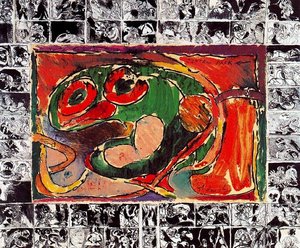
The essence of Alechinsky’s work lies in its rhythmic, almost musical quality, a trait deeply rooted in his mastery of Tachisme and lyrical abstraction. His artistic language is not merely painted but inscribed, drawing heavily from the fluid elegance of Oriental calligraphy. This fascination was not a superficial adoption of style but a deep, spiritual engagement with the way ink moves across a surface. During his time as a correspondent for the Japanese journal Bokubi (the Beauty of Ink), he immersed himself in the traditions of Japan, an experience that fundamentally reshaped his perception of line and space. To witness an Alechinsky canvas is to see a dance of characters and symbols that seem to float within a chaotic yet controlled universe, where the weight of a single stroke can anchor a composition of swirling, abstract forms.
Alechinsky’s career is marked by an extraordinary versatility that transcends the boundaries of traditional media. While he is celebrated for his monumental paintings, his expertise in printmaking—honed under the legendary Stanley William Hayter at Atelier 17—allowed him to explore the nuances of texture and layering with unparalleled precision. His work often functions as a visual dialogue between different eras and geographies; one might find the raw, visceral energy of Abstract Expressionism colliding with the playful, narrative elements of comic book aesthetics or pop art. This unique synthesis creates a sense of "unsettling beauty," where motifs such as skulls, boats, or even bold, transformative creatures emerge from a sea of gestural marks.
The evolution of his style can be viewed through several key developmental pillars:
Beyond the aesthetic allure of his canvases, Pierre Alechinsky holds a position of immense historical significance within the canon of modern art. He represents a bridge between the radical, often destructive impulses of postwar abstraction and a more constructive, communicative form of expressionism. By reclaiming the line as a vessel for both personal emotion and universal symbol, he helped move abstraction away from pure formlessness toward a new kind of lyrical literacy. His work remains a testament to the idea that art can be simultaneously chaotic and deeply structured, much like the human experience itself.
Today, Alechinsky’s influence continues to resonate through the global art community, reminding us that the most profound artistic breakthroughs often occur at the crossroads of different cultures. His legacy is not found merely in museums or galleries, but in the enduring power of the gesture—a reminder that every stroke of the brush is an act of profound, unrepeatable creation.