


1

The Grand Canal near the Salute
The Grand Canal near the Salute is an oil on canvas painting created by Michele Marieschi in 1733. This artwork is currently housed at the Musée du Louvre in Paris, France.

Ažurirano: новембар 2026 · rangirano prema našem koeficijentu popularnosti (pretrage, posete i porudžbine za svako delo) · 46 dela Michele Marieschi u našem katalogu
Ukratko
The Grand Canal near the Salute (1733) je slika autora Michele Marieschi koja privlači najviše pažnje; original se nalazi u muzeju Luvr, Pariz. Nakon toga, pogled se seli na Capriccio with Classical Arch and Goats (1741) i The Grand Canal with the Ca' Rezzonico and the Campo San Samuele (1742). Među 46 dela umetnika Michele Marieschi u našem katalogu, ovih 39 su najpoznatija, od kojih je svako jedinstveni original predstavljen sa godinom nastanka, muzejom i razlogom zbog kojeg je i danas neprocenjivo.
The Grand Canal near the Salute is an oil on canvas painting created by Michele Marieschi in 1733. This artwork is currently housed at the Musée du Louvre in Paris, France.

The composition centers on the intersection of human architecture and the persistent force of the natural world. Crumbling stone arches and weathered columns, once symbols of structural precision, now lie partially reclaimed by thick foliage and creeping vines. In the foreground, a man, a boy, and a dog move through the ruins, providing a sense of scale against the heavy, decaying masonry. Beyond this immediate scene, a body of water…

The oil on canvas titled The Grand Canal with the Ca' Rezzonico and the Campo San Samuele captures a specific slice of Venetian life. Painted by Michele Marieschi, the work dates to about 1742. It presents a wide view of the waterways that define the city, focusing on the intersection of grand architecture and the constant movement of the canals.

Courtyard with a Staircase is an oil on canvas work by Michele Marieschi, executed in 1735. The composition functions as an architectural fantasy, presenting a structured arrangement of a staircase within a courtyard setting. This work belongs to the Venetian School, reflecting the topographical and imaginative traditions of 18th-century Italy.

In the heart of the eighteenth century, Venice was not merely a city but a stage, a shimmering spectacle of light and water where every canal served as a corridor for drama and commerce. Michele Marieschi, a master of the veduta, captures this ephemeral magic in his breathtaking work, The Grand Canal in Venice. This painting serves as a portal to a bygone era, inviting the viewer to step onto…

Michele Marieschi: A Venetian Visionary Capturing Urban Life Michele Giovanni Marieschi (1710 – 18 January 1744) stands as a singular figure in the artistic landscape of Venice during the Rococo era, renowned primarily for his breathtaking landscapes and cityscapes—vedute—that captured the spirit of his time with remarkable vibrancy and innovation. Though biographical details remain scarce, Marieschi’s legacy rests on his ability to transform ordinary views into extraordinary canvases brimming with…

The oil on canvas depicts the Grand Canal in Venice, Italy, as it appeared in 1730. At the terminus of the waterway, the Santa Maria della Salute church occupies the central focus. The structure features a prominent dome and smaller domes situated on either side. The building's architecture is characterized by its position at the end of the canal, which directs the eye toward the church's facade. Numerous gondolas and…

An Architectural Capriccio with Figures beside a River is an 18th-century architectural capriccio executed in the Veduta style. The work is attributed to the Venetian artist Michele Marieschi. This composition presents a romanticized, imaginary landscape where crumbling classical ruins are integrated with rustic dwellings. The scene depicts a tranquil river and distant mountains, populated by several small figures engaged in various activities near the water's edge.

In this 1740 oil on canvas, we find ourselves observing a specific, quiet moment within the Venetian cityscape. The composition centers on the Rialto Bridge, its structural arches spanning the waterway with a sense of permanence amidst the constant movement of the Grand Canal. There is a particular attention paid to the boats floating below the stone spans and the figures gathered along the water's edge, suggesting a city that…

Fantastic Architecture of a Prison Courtyard is a work by Michele Marieschi, an artist born in Venice in 1710. Created about 1730, the piece belongs to the tradition of 18th-century architectural capriccios. Marieschi, the son of a woodcarver, brought a specific understanding of structure and texture to his depictions of built environments.
 Fantastic Architecture of a Palace Courtyard1730 · Nacionalni muzej u Varšavi
12
 Riva degli Schiavoni1730 · Nacionalni muzej u Varšavi
13
 Coastal Landscape1730 · Nacionalni muzej u Varšavi
14
 Fantastic Landscape with Ruins1730 · Nacionalni muzej u Varšavi
15
 Italian scenery with figures1727
16
 View of the Piazzetta dei Leoni1734 · Bavarske državne slikopisne kolekcije
17
 Saint Mark's Church and the Square in Venice1739
18
 View of the Grand Canal near Cà Pesaro1734 · Bavarske državne slikopisne kolekcije
19
 Landscape Capriccio1735 · Minneapolis Institute of Art
20
 The Church of Santa Maria della Salute, Venice1740 · Art Institute of Chicago
21
 Courtyard in a Renaissance House1742 · Nationalmuseum
22
 Stairwell in a Renaissance Palace1742 · Nationalmuseum
23
 Architectural fantasy featuring a palace courtyard1738 · Nacionalni muzej u Varšavi
24
 The Grand Canal with the Fishmarket (detail)1740
25
 The Grand Canal at San Geremia1740
26
 The Grand Canal with the Fishmarket1740
27
 View of the Rio di Cannareggio1740
28
 The Grand Canal at San Geremia (detail)1740
29
 The Grand Canal with the Palazzo Labia and Entry to the Cannareggio1742 · Staatliche Museen zu Berlin
30
 Capriccio with Gothic Building and Obelisk1741 · Gallerie dell'Accademia di Venezia
31
 Piazza San Marco, Venice, with Saint Mark's Basilica, the Campanile and the Procuratie NuoveNational Gallery of Ireland
32
 View of the Dogana and Santa Maria della SaluteMuzej fine umetnosti u Hjustonu
33
 View of Canale Grande in Venice with the Rialto BridgeStatens Museum For Kunst
34
 View of Canale Grande in VeniceStatens Museum For Kunst
35
 Landscape with ruins and a bridgeNacionalni muzej u Varšavi
36
 Landscape with ruinsNacionalni muzej u Varšavi
37
 Architectural fantasy featuring a prison courtyardNacionalni muzej u Varšavi
38
 Imaginative View with Obelisk
39
 View of Campo SS. Giovanni e Paolo, Venice
Četiri teme koje se najčešće ponavljaju u ovim originalima, svaka sa svojim vrhunskim primerom.
8 muzeja u kojima se nalazi najviše slika sa ove stranice.
| Muzej | Grad | Radovi umetnika Michele Marieschi | Slike iz ovog spiska |
|---|---|---|---|
 Nacionalni muzej u Varšavi |
Varšava | 10 | Ponte di Rialto, Fantastic Architecture of a Prison Courtyard, Fantastic Architecture of a Palace Courtyard |
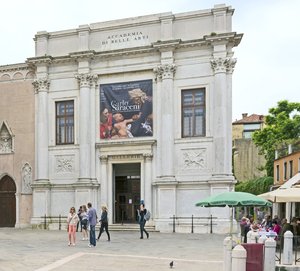 Gallerie dell'Accademia di Venezia |
Venecija | 2 | Capriccio with Classical Arch and Goats, Capriccio with Gothic Building and Obelisk |
 Staatliche Museen zu Berlin |
Berlin | 2 | The Grand Canal with the Ca' Rezzonico and the Campo San Samuele, The Grand Canal with the Palazzo Labia and Entry to the Cannareggio |
 Ermitaž |
Sankt Peterburg | 2 | Courtyard with a Staircase, Мост Риальто из Рива дел Вин |
 Bavarske državne slikopisne kolekcije |
Minhen | 2 | View of the Piazzetta dei Leoni, View of the Grand Canal near Cà Pesaro |
 Nationalmuseum |
Стокхолм | 2 | Courtyard in a Renaissance House, Stairwell in a Renaissance Palace |
 Statens Museum For Kunst |
Kopenhagen | 2 | View of Canale Grande in Venice with the Rialto Bridge, View of Canale Grande in Venice |
 Luvr |
Pariz | 1 | The Grand Canal near the Salute |
Izaberite deceniju da biste videli original koji je definiše.

The artwork titled Italian scenery with figures is a work by the Venetian painter Michele Marieschi. Born in Venice, Italy, in 1710, the artist spent his life capturing the architectural essence of his home city. This specific piece, executed about 1727, offers a glimpse into the structured world of the eighteenth century through its focus on stone and human presence.
The Grand Canal near the Salute is an oil on canvas painting created by Michele Marieschi in 1733. This artwork is currently housed at the Musée du Louvre in Paris, France.
The composition centers on the intersection of human architecture and the persistent force of the natural world. Crumbling stone arches and weathered columns, once symbols of structural precision, now lie partially reclaimed by thick foliage and creeping vines. In the foreground, a man, a boy, and a dog move through the ruins, providing a sense of scale against the heavy, decaying masonry. Beyond this immediate scene, a body of water…
The Grand Canal near the Salute (1733), Luvr, Pariz. Slede Capriccio with Classical Arch and Goats (1741) i The Grand Canal with the Ca' Rezzonico and the Campo San Samuele (1742).
23 godina: The Grand Canal near the Salute datira iz 1733, a Michele Marieschi je rođen/a 1710.
The Grand Canal near the Salute, Capriccio with Classical Arch and Goats, The Grand Canal with the Ca' Rezzonico and the Campo San Samuele, Courtyard with a Staircase, The Grand Canal in Venice, Мост Риальто из Рива дел Вин, The Grand Canal with Santa Maria della Salute, An Architectural Capriccio with Figures beside a River, Ponte di Rialto i Fantastic Architecture of a Prison Courtyard. Gornji rang pokazuje godinu i muzej za svako od njih.
Naš katalog sadrži 46 dela umetnika Michele Marieschi, datiranih od 1727 do 1742.
Većinom u Nacionalni muzej u Varšavi (Varšava), Gallerie dell'Accademia di Venezia (Venecija) i Staatliche Museen zu Berlin (Berlin). Tabela muzeja iznad sadrži njih sve.
U 1730s: 14 od 39 dela na ovoj stranici nastalo je tada, od čega je The Grand Canal near the Salute.
Na ovoj stranici, najstarije delo je iz Italian scenery with figures (1727), a najnovije iz The Grand Canal with the Ca' Rezzonico and the Campo San Samuele (1742).
Architecture (18), Water (14) i Sky (12), kroz svih 39 dela na ovoj stranici.
Oil On Canvas, za 20 od 39 dela na ovoj stranici.
Rococo, sudeći po originalima na ovoj stranici.
Ponte di Rialto, Fantastic Architecture of a Prison Courtyard i Fantastic Architecture of a Palace Courtyard: Nacionalni muzej u Varšavi, Varšava čuva 10 dela sa ove stranice.
U zlatnom dobu venecijanskog Rokoa, malo je umetnika uspelo da uhvati efemernu magiju Serenissime sa toliko vitalnosti kao Michele Marieschi. Rođen u Veneciji 1710. godine, Marieschi je potao iz tradicije vrhunskog zanatstva, kao sin drvorezca—što je verovatno u njemu podstaklo duboko poštovanje prema strukturi, teksturi i fizičkoj esenciji objekata koje je prikazivao. Iako je njegov život bio relativno kratak, trajan samo do njegove smrti početkom 1744. godine, njegov uticaj na tradiciju vedute ostaje neizbrisiv. On nije samo dokumentovao arhitekturu Venecije; on je odisao život u njen kamen i vodu, pretvarajući statične gradske pejzaže u žive, luminousne narative svetlosti i pokreta.
Razvoj jedinstvenog stila koji je nosio Michele Marieschi duboko je ukorenjen u umetničkim strujama koje su proticale kroz Italiju 18. veka. Istoričari često ukazuju na uticaj majstora kao što su Gaspare Diziani i legendarni Canaletto, čija su dela pružila nacrt za prikazivanje veličine urbanih sredina. Međutim, dok je Canaletto težio određenoj topografskoj preciznosti i suzdržanoj, klasičnoj jasnoći, Marieschi je svoj glas pronašao u odvažnijem, emotivnijem pristupu. On je prihvatio paletu koja je pulsirala bojom i potez četkice koji je delovao spontano i energično. Ova stilska razlika omogućila mu je da prevaziđe puku arhitektonsku dokumentaciju, prožimajući svoje pejzaže osećajem teatralnosti i atmosfere koji je sugerisao sam puls venecijanskog života.
Marieschi-jev doprinos veduti—žanru visoko detaljnih, velikih topografskih slika—karakteriše izuzetna kontrola perspektive i svetlosti. Njegova dela često prikazuju kultne znamenitosti kao što su Veliki kanal, Salute i razne veličanstvene palate, ali su daleko od običnih razglednica tog doba. Umesto toga, koristio je tehniku koja je spajala precizne detalje sa maštovitim ukrašavanjem, stvarajući scene koje su delovale istovremeno stvarno i onirično. Kroz njegove oči, voda kanala postaje ogledalo za promenljivo nebo, a senke koje bacaju drevne crkve postaju posude za misteriju i dubinu.
Njegovo tehničko umeće je možda najočiglednije u njegovoj sposobnosti da manipuliše svetlošću kako bi izazvao specifična raspoloženja:
Istorijski značaj koji nosi Michele Marieschi leži u njegovoj sposobnosti da premosti jaz između rigidne dokumentacije ranog 18. veka i ekspresivnijih, emotivnijih pejzaža koji će uslediti. Bio je ključna figura u tranziciji venecijanskog pogleda iz čisto opservacionog medija u umetničku formu sposobnu da prenese duboki emocionalni odjek. Njegovo delo služi kao vitalni prozor u nestali svet, čuvajući sjaj Venecije pre nego što su seizmičke promene kasnog 18. veka zauvek izmenile njen društveni i politički pejzaž.
Danas, Marieschi-jeva platna nastavljaju da očaravaju kolekcionare i istoričare. Bilo da je reč o zadivljujućem pogledu na Veliki kanal blizu Salute ili njegovim intimnijim arhitektonskim studijama, njegove slike ostaju remek-dela Rokoa. On ostaje slavna figura za one koji žele da iskušaju vibrantnu energiju, luminousnu svetlost i neprolaznu eleganciju Venecije koja nastavlja da prožima kolektivnu maštu sveta umetnosti.


