Portret Michael Erhart

4 najpoznatijih slika umetnika Michael Erhart, izbor iz galerije

Ažurirano: октобар 2026 · rangirano prema našem koeficijentu popularnosti (pretrage, posete i porudžbine za svako delo) · 4 dela Michael Erhart u našem katalogu

Ukratko

Od svih originala koje je Michael Erhart ostavio, najpoznatiji je Ravensburg Madonna of Mercy (1480), koji se nalazi u kolekciji Staatliche Museen zu Berlin, Berlin. Odmah za njima slede Altarpiece (central section) (1493) i The Libyan Sibyl (1469). Naš katalog sadrži 4 dela umetnika Michael Erhart; galerija je čuvala 4 dela koja svet najviše admira, od kojih je svako prikazano sa svojim datumom, muzejom i pričom.

1442 – 1522 Najviše dela: Benedictine Abbey Church

Top 10 slika umetnika Michael Erhart: izbor galerije

1
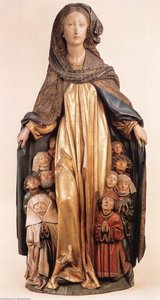
Ravensburg Madonna of Mercy (1480) čiji je Michael Erhart

Ravensburg Madonna of Mercy

1480 · Wood · Staatliche Museen zu Berlin, Berlin

In the quiet presence of this 1480 sculpture, one feels the weight of late Gothic devotion. The Ravensburg Madonna of Mercy is a work of profound stillness, carved from wood and brought to life through the delicate application of polychromy. The central figure of the Virgin Mary rises with a verticality that draws the eye upward, her form draped in heavy, meticulously detailed clothing. She is surrounded by smaller figures,…

2
Altarpiece (central section) (1493) čiji je Michael Erhart

Altarpiece (central section)

1493 · Tempera On Panel · Benedictine Abbey Church, Blaubeuren

Gold leaf clings to the carved wood, catching the light like a sudden sunbeam in a dim cathedral. In this central panel, the Virgin Mary stands upon a silvered sickle moon, her form a pillar of quiet grace. Beside her, the infant Jesus rests, a small weight of divinity held within the curve of her arm. The architecture behind them recedes into a structured, gilded depth, creating a space that…

Muzeji u kojima se čuvaju originalna dela umetnika Michael Erhart

3 muzeja u kojima se nalazi najviše slika sa ove stranice.

Muzej Grad Radovi umetnika Michael Erhart Slike iz ovog spiska
Benedictine Abbey Church, BlaubeurenBenedictine Abbey Church Blaubeuren 2 Altarpiece (central section), Altarpiece
Staatliche Museen zu Berlin, BerlinStaatliche Museen zu Berlin Berlin 1 Ravensburg Madonna of Mercy
Cathedral, UlmCathedral Ulm 1 The Libyan Sibyl

Michael Erhart deceniju po deceniju: original koji definiše svaku od njih

Radovi po decenijama

Izaberite deceniju da biste videli original koji je definiše.

Pitanja kolekcionara o slikama umetnika Michael Erhart

Po kojem delu je Michael Erhart najpoznatiji/a?Otkrij odgovor

Ravensburg Madonna of Mercy (1480), Staatliche Museen zu Berlin, Berlin. Slede Altarpiece (central section) (1493) i The Libyan Sibyl (1469).

Koliko je godina imao/la Michael Erhart kada je nastalo delo Ravensburg Madonna of Mercy?Otkrij odgovor

38 godina: Ravensburg Madonna of Mercy datira iz 1480, a Michael Erhart je rođen/a 1442.

Koliko je slika ostavio Michael Erhart?Otkrij odgovor

Naš katalog sadrži 4 dela umetnika Michael Erhart, datiranih od 1469 do 1493.

U kojim muzejima se nalaze remek-dela umetnika Michael Erhart?Otkrij odgovor

Većinom u Benedictine Abbey Church (Blaubeuren), Staatliche Museen zu Berlin (Berlin) i Cathedral (Ulm). Tabela muzeja iznad sadrži njih sve.

U kojim godinama je Michael Erhart naslikao svoja najpoznatija dela?Otkrij odgovor

U 1490s: 2 od 4 dela na ovoj stranici nastalo je tada, od čega je Altarpiece (central section).

Koja su prva i poslednja čuvena originalna dela umetnika Michael Erhart?Otkrij odgovor

Na ovoj stranici, najstarije delo je iz The Libyan Sibyl (1469), a najnovije iz Altarpiece (central section) (1493).

Čija se dela umetnika Michael Erhart nalaze u Benedictine Abbey Church?Otkrij odgovor

Altarpiece (central section) i Altarpiece: Benedictine Abbey Church, Blaubeuren čuva 2 dela sa ove stranice.

Michael Erhart: život i delo

The Sculptural Legacy of Michael Erhart

In the heart of the late Gothic era, within the bustling artistic hub of Ulm, Michael Erhart emerged as a master whose hands breathed life into wood and stone. Born around 1460, Erhart was not merely a craftsman but a pivotal figure in the transition between the medieval devotion of the Middle Ages and the burgeoning humanism of the Renaissance. His life’s work serves as a profound testament to the enduring power of regional German craftsmanship, standing alongside the giants of his age even as he carved a distinct path through the spiritual and aesthetic shifts of the 15th and 16th centuries.

Erhart's artistic journey was deeply rooted in the traditions of his predecessors. His formative years were shaped by the rigorous mentorship of Jörg Syrlin the Elder, a renowned sculptor whose workshop acted as a crucible for innovation. Under Syrlin’s guidance, Erhart mastered the intricate complexities of Gothic carving and the vibrant art of polychromy. This foundation allowed him to contribute significantly to the monumental decorations of the Ulm Cathedral, where his work on choir stalls and altars showcased an unparalleled ability to blend structural grandeur with delicate, emotive detail. His style was a sophisticated synthesis, drawing inspiration from the masterful techniques of Nikolaus Gerhaert while infusing them with a unique, expressive dynamism.

Mastery of Form and Spiritual Expression

The essence of Erhart’s oeuvre lies in its ability to evoke deep spiritual contemplation through physical form. Unlike the more static and rigid sculptures of earlier Gothic periods, Erhart’s figures possess a palpable sense of movement and emotional depth. His works often feature a remarkable interplay of light and shadow, achieved through masterful carving that captures the flowing drapery of robes and the subtle nuances of facial expressions. This expressive dynamism allowed his religious iconography to resonate with the faithful, transforming cold materials into vessels of divine narrative.

His technical prowess is perhaps most evident in works such as the Ravensburg Madonna of Mercy and his magnificent altarpieces. In these pieces, one can observe:

  • Intricate Detail: A meticulous approach to texture, from the delicate folds of fabric to the fine features of holy figures.
  • Symbolic Richness: The use of gold leaf and complex architectural settings to convey theological truths and celestial majesty.
  • Humanist Influence: An emerging focus on naturalism and human emotion that signaled the approaching Renaissance spirit.

A Lasting Impact on German Art

Beyond his individual masterpieces, Michael Erhart played a crucial role in fostering a vibrant artistic lineage. His workshop was more than a place of production; it was an educational sanctuary that attracted apprentices and disseminated his distinctive style throughout Bavaria and beyond. The Erhart name became synonymous with excellence, as his sons, Gregor and Bernhard Erhart, continued his legacy, further cementing the family's influence on German sculpture. Through this lineage, the techniques of Ulm were preserved and evolved, bridging the gap between the late medieval tradition and the new era of artistic exploration.

Today, Erhart is remembered not just as a sculptor of religious icons, but as a vital link in the evolution of European art. His ability to harmonize the rigid conventions of the Gothic style with the emerging warmth of humanism ensures his place in history. As we look upon his surviving works, we see more than mere relics of the past; we witness the moment when the spiritual intensity of the Middle Ages began to embrace the profound humanity of the Renaissance.