Portret Magnus Enkel

100 najpoznatijih slika umetnika Magnus Enkel, izbor iz galerije

Ažurirano: новембар 2026 · rangirano prema našem koeficijentu popularnosti (pretrage, posete i porudžbine za svako delo) · 110 dela Magnus Enkel u našem katalogu

Ukratko

Od svih originala koje je Magnus Enkel ostavio, najpoznatiji je Naken gosse (1892), koji se nalazi u kolekciji Villa Gyllenberg, Helsinki. Odmah za njima slede Adam and Eve (1897) i Adam (Night) (1896). Naš katalog sadrži 110 dela umetnika Magnus Enkel; galerija je čuvala 100 dela koja svet najviše admira, od kojih je svako prikazano sa svojim datumom, muzejom i pričom.

1870 – 1925, Hamina Symbolism Najviše dela: Finnish National Gallery

Top 10 slika umetnika Magnus Enkel: izbor galerije

1
Naken gosse (1892) čiji je Magnus Enkel

Naken gosse

1892 · Oil · Villa Gyllenberg, Helsinki

In Naken gosse, Magnus Enckell presents a solitary nude male figure. Painted about 1892, the work captures a nude youth seated in profile. The vertical composition focuses entirely on this single, quiet presence. A sense of stillness settles over the subject, held within the frame of the canvas.

2
Adam and Eve (1897) čiji je Magnus Enkel

Adam and Eve

1897 · Oil · Finnish National Gallery, Helsinki

In this 1897 oil painting, two figures emerge from a dense, dark thicket. The composition focuses on the upper bodies of a man and a woman, positioned closely within a shallow, enclosed space. On the left, a woman with long, dark hair gazes downward, her expression heavy with melancholy. To her right, a man with short, light hair meets her gaze with a steady, contemplative look. The scene is set…

3
Adam (Night) (1896) čiji je Magnus Enkel

Adam (Night)

1896 · Ink On Paper · Finnish National Gallery, Helsinki

Created about 1896, Adam (Night) by Magnus Enckell presents a somber study of the human form. The subject is a muscular male torso and arms shown in profile. He is positioned against a dark, expansive background that creates a sense of isolation. The figure faces a large area of negative white space, emphasizing a state of solitude or quiet struggle.

4
Expulsion of Adam and Eve, after Masaccio (1898) čiji je Magnus Enkel

Expulsion of Adam and Eve, after Masaccio

1898 · Oil · Finnish National Gallery, Helsinki

In "Expulsion of Adam and Eve, after Masaccio" by Magnus Enckell, the biblical scene of the expulsion unfolds across a divided space. The composition separates the world into two distinct realms: a celestial realm above and a terrestrial realm below. In the upper register, a large, ethereal, reddish-pink winged figure descends through the air, appearing almost translucent as it hovers. This monumental presence watches over the figures below, casting a…

5
Listeners of Music (1897) čiji je Magnus Enkel

Listeners of Music

1897 · Oil · Finnish National Gallery, Helsinki

Listeners of Music is an oil painting by the Finnish symbolist painter Magnus Enckell. Created about 1897, the work emerged from a period when the artist was beginning to move away from the strictures of Naturalism. Enckell, who was born in Hamina, Finland in 1870, brought a specific, inward-looking sensibility to this canvas. The piece captures a crowd of people gathered in a dim space, their faces turned toward an…

6
The Concert (1898) čiji je Magnus Enkel

The Concert

1898 · Oil · Finnish National Gallery, Helsinki

In The Concert, Magnus Enckell constructs a dense, crowded indoor scene, likely a theater or concert hall. The composition utilizes a layered arrangement to establish spatial depth, placing several individuals in the foreground while a large group of figures fills the midground and background. This layering draws the viewer into the assembly, creating a sense of being part of the gathered crowd.

7
Portrait of Sculptor Madeleine Jouvray (1893) čiji je Magnus Enkel

Portrait of Sculptor Madeleine Jouvray

1893 · Oil On Canvas · Finnish National Gallery, Helsinki

The portrait presents a bust-length view of Madeleine Jouvray, positioned centrally against a textured, abstract background of brown tones. The subject is depicted from the torso upward, her gaze directed toward the viewer at eye level. Her dark hair and the voluminous folds of her black garment create organic shapes that dominate the lower and side portions of the frame. A muted color palette defines the work, relying heavily on…

8
Narcissus (1896) čiji je Magnus Enkel

Narcissus

1896 · Oil · Joensuu Art Museum Onni, Joensuu

This oil painting, titled Narcissus, was created by the Finnish artist Magnus Enckell about 1896. It represents a significant moment in the artist's development, emerging from a period when his palette was characterized by a subdued and somber quality. Through this work, we encounter the early sensibilities of a painter who would eventually become a central figure in the Finnish Golden Age.

9
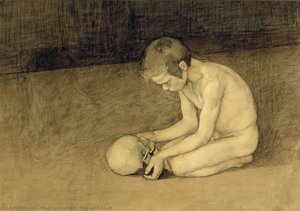
: Boy with Skull (1893) čiji je Magnus Enkel

: Boy with Skull

1893 · Watercolor

In the quiet stillness of 1893, Magnus Enckell brings forth Boy with Skull, a work that captures a profound intersection of existence. The scene unfolds with a heavy, contemplative weight, centering on the presence of a young boy and a human skull. This encounter between the living and the remains of the departed creates a space where the boundaries of the human psyche feel thin and permeable.

Izbor umetnika Magnus Enkel se nastavlja, od 11 do 100

11Portrait of the Poet Otto Manninen (1903) čiji je Magnus EnkelPortrait of the Poet Otto Manninen1903 · Finnish National Gallery 12Reading Room (1899) čiji je Magnus EnkelReading Room1899 · Finnish National Gallery 13Elementary School (1899) čiji je Magnus EnkelElementary School1899 · Finnish National Gallery 14Girl Straightening Her Hair (1902) čiji je Magnus EnkelGirl Straightening Her Hair1902 · Finnish National Gallery 15Gethsemane (1902) čiji je Magnus EnkelGethsemane1902 · Finnish National Gallery 16Portrait of Mrs E. Gadolin-Lagervall (1901) čiji je Magnus EnkelPortrait of Mrs E. Gadolin-Lagervall1901 · Finnish National Gallery 17Portrait of Beda Stjernschantz (1902) čiji je Magnus EnkelPortrait of Beda Stjernschantz1902 · Serlachius Manor 18Theatre Scene (Ida Aalberg as Maria Stuart) (1905) čiji je Magnus EnkelTheatre Scene (Ida Aalberg as Maria Stuart)1905 · Finnish National Gallery 19Resurrection, Full Sketch of the Altarpiece of Tampere Cathedral (1906) čiji je Magnus EnkelResurrection, Full Sketch of the Altarpiece of Tampere Cathedral1906 · Finnish National Gallery 20Girls on the Beach (1910) čiji je Magnus EnkelGirls on the Beach1910 · Finnish National Gallery 21Resurrection, Copy of the Right Half of the Altarpiece in Tampere Cathedral (1907) čiji je Magnus EnkelResurrection, Copy of the Right Half of the Altarpiece in Tampere Cathedral1907 · Finnish National Gallery 22Portrait of Edvard Richter (1908) čiji je Magnus EnkelPortrait of Edvard Richter1908 · Finnish National Gallery 23Nude (1909) čiji je Magnus EnkelNude1909 · Finnish National Gallery 24Portrait of Tyra Hasselblatt (1910) čiji je Magnus EnkelPortrait of Tyra Hasselblatt1910 · HAM Helsinki Art Museum 25Resurrection (1906) čiji je Magnus EnkelResurrection1906 26Pietà (1916) čiji je Magnus EnkelPietà1916 · Finnish National Gallery 27Portrait of Mrs. Agda Vilén (1917) čiji je Magnus EnkelPortrait of Mrs. Agda Vilén1917 · Finnish National Gallery 28Mrs. Esther Cederhvarf with Her Son (1916) čiji je Magnus EnkelMrs. Esther Cederhvarf with Her Son1916 · Finnish National Gallery 29Portrait of A. W. Finch (1915) čiji je Magnus EnkelPortrait of A. W. Finch1915 · Finnish National Gallery 30Lempi  (from Kuorsalo) (1914) čiji je Magnus EnkelLempi (from Kuorsalo)1914 · Finnish National Gallery 31Awakening Faun (1914) čiji je Magnus EnkelAwakening Faun1914 · Finnish National Gallery 32The Dying Adonis (1915) čiji je Magnus EnkelThe Dying Adonis1915 · Villa Gyllenberg 33Reading Girl (1922) čiji je Magnus EnkelReading Girl1922 · Finnish National Gallery 34At the Source (1921) čiji je Magnus EnkelAt the Source1921 · Finnish National Gallery 35Self-Portrait (1918) čiji je Magnus EnkelSelf-Portrait1918 · Finnish National Gallery 36By The Window (1919) čiji je Magnus EnkelBy The Window1919 · Finnish National Gallery 37Portrait of Mrs. Lydia Keirkner (1922) čiji je Magnus EnkelPortrait of Mrs. Lydia Keirkner1922 · Finnish National Gallery 38Diana and Endymion I (1921) čiji je Magnus EnkelDiana and Endymion I1921 · Finnish National Gallery 39Sketch for Stained Glass Windows of Pori Church (1924) čiji je Magnus EnkelSketch for Stained Glass Windows of Pori Church1924 · Finnish National Gallery 40Christus resurrexit, sketch for the stained glass of Pori church (1924) čiji je Magnus EnkelChristus resurrexit, sketch for the stained glass of Pori church1924 · Finnish National Gallery 41Purgatory. Detail of a stained glass composition designed for Turun Tuomiokirkko (1923) čiji je Magnus EnkelPurgatory. Detail of a stained glass composition designed for Turun Tuomiokirkko1923 · Finnish National Gallery 42Come to Me, sketch for a stained glass window in Pori Church (1924) čiji je Magnus EnkelCome to Me, sketch for a stained glass window in Pori Church1924 · Finnish National Gallery 43Portrait of Miss Barbara Lagerborg (1925) čiji je Magnus EnkelPortrait of Miss Barbara Lagerborg1925 · Finnish National Gallery 44Bird of Paradise, sketch (1925) čiji je Magnus EnkelBird of Paradise, sketch1925 · Finnish National Gallery 45Head (1894) čiji je Magnus EnkelHead1894 · Finnish National Gallery 46Angel, copy after Leonardo da Vinci's Virgin Annunciation painting, part (1895) čiji je Magnus EnkelAngel, copy after Leonardo da Vinci's Virgin Annunciation painting, part1895 · Finnish National Gallery 47Boy with Skull (1893) čiji je Magnus EnkelBoy with Skull1893 · Ateneum Art Museum 48Princess and Swineherd (1890) čiji je Magnus EnkelPrincess and Swineherd1890 · Finnish National Gallery 49The Cult of Venus (1895) čiji je Magnus EnkelThe Cult of Venus1895 · Finnish National Gallery 50Baltic Herring (1904) čiji je Magnus EnkelBaltic Herring1904 · Finnish National Gallery 51Seaside View from the Naples Region (1905) čiji je Magnus EnkelSeaside View from the Naples Region1905 · Finnish National Gallery 52Napolinlahti (1905) čiji je Magnus EnkelNapolinlahti1905 · Finnish National Gallery 53From the Naples Region (1905) čiji je Magnus EnkelFrom the Naples Region1905 · Finnish National Gallery 54Seaside Landscape from Suursaari Island (1905) čiji je Magnus EnkelSeaside Landscape from Suursaari Island1905 · Finnish National Gallery 55View of Porvoo (1899) čiji je Magnus EnkelView of Porvoo1899 · Finnish National Gallery 56Seaside Landscape (1905) čiji je Magnus EnkelSeaside Landscape1905 · Finnish National Gallery 57Boy and Sail (1902) čiji je Magnus EnkelBoy and Sail1902 · Finnish National Gallery 58Cliffs on the shore (1902) čiji je Magnus EnkelCliffs on the shore1902 59Midsummer Day Service in Lohja Church (1899) čiji je Magnus EnkelMidsummer Day Service in Lohja Church1899 · Finnish National Gallery 60Study čiji je Magnus EnkelStudyFinnish National Gallery 61Fishermen on the Shore čiji je Magnus EnkelFishermen on the ShoreFinnish National Gallery 62Watercolor Sketch of the Address of Suomen Taideyhdistys čiji je Magnus EnkelWatercolor Sketch of the Address of Suomen TaideyhdistysFinnish National Gallery 63Copy of a Byzantine Icon čiji je Magnus EnkelCopy of a Byzantine IconFinnish National Gallery 64Three Boys čiji je Magnus EnkelThree BoysFinnish National Gallery 65Woman Seated čiji je Magnus EnkelWoman SeatedFinnish National Gallery 66Portrait of a Young Girl čiji je Magnus EnkelPortrait of a Young GirlFinnish National Gallery 67Lost in Thoughts čiji je Magnus EnkelLost in ThoughtsFinnish National Gallery 68Salome (1906) čiji je Magnus EnkelSalome1906 · Serlachius Manor 69Holstentor čiji je Magnus EnkelHolstentor 70Autumn Landscape (1915) čiji je Magnus EnkelAutumn Landscape1915 · Finnish National Gallery 71Shore of Seinäjoki (1912) čiji je Magnus EnkelShore of Seinäjoki1912 · Finnish National Gallery 72Angler (1915) čiji je Magnus EnkelAngler1915 · Finnish National Gallery 73The Park View from San Remo (1913) čiji je Magnus EnkelThe Park View from San Remo1913 · Finnish National Gallery 74Still Life (1912) čiji je Magnus EnkelStill Life1912 · Finnish National Gallery 75Sunny Rocky Shore, Porto Fino (1920) čiji je Magnus EnkelSunny Rocky Shore, Porto Fino1920 · Finnish National Gallery 76View from Kaivopuisto (1919) čiji je Magnus EnkelView from Kaivopuisto1919 · Finnish National Gallery 77Small Lake (1919) čiji je Magnus EnkelSmall Lake1919 · Finnish National Gallery 78Interior View of the Finnish Opera (1919) čiji je Magnus EnkelInterior View of the Finnish Opera1919 · Finnish National Gallery 79Birches in Vääksy (1919) čiji je Magnus EnkelBirches in Vääksy1919 · Finnish National Gallery 80Still life with fruit (1922) čiji je Magnus EnkelStill life with fruit1922 81Man and swan (1918) čiji je Magnus EnkelMan and swan1918 · Serlachius Manor 82Christmas Tree in the Hall of Kilo Mansion (1919) čiji je Magnus EnkelChristmas Tree in the Hall of Kilo Mansion1919 · Serlachius Manor 83Sketch for a Stained Glass Window for the Choir of Turun Tuomiokirkko (1923) čiji je Magnus EnkelSketch for a Stained Glass Window for the Choir of Turun Tuomiokirkko1923 · Finnish National Gallery 84Paradise Bird, Study (1925) čiji je Magnus EnkelParadise Bird, Study1925 · Finnish National Gallery 85Workhorse, Study čiji je Magnus EnkelWorkhorse, StudyFinnish National Gallery 86Seashore Landscape čiji je Magnus EnkelSeashore LandscapeFinnish National Gallery 87Workhorse, Study čiji je Magnus EnkelWorkhorse, StudyFinnish National Gallery 88Boys čiji je Magnus EnkelBoysFinnish National Gallery 89Seashore Landscape čiji je Magnus EnkelSeashore LandscapeFinnish National Gallery 90Maritime Landscape čiji je Magnus EnkelMaritime LandscapeFinnish National Gallery 91The Nude čiji je Magnus EnkelThe NudeFinnish National Gallery 92Landscape čiji je Magnus EnkelLandscapeFinnish National Gallery 93Landscape čiji je Magnus EnkelLandscapeFinnish National Gallery 94River Landscape čiji je Magnus EnkelRiver LandscapeFinnish National Gallery 95Landscape čiji je Magnus EnkelLandscapeFinnish National Gallery 96Landscape čiji je Magnus EnkelLandscapeFinnish National Gallery 97Landscape, Sketch čiji je Magnus EnkelLandscape, SketchFinnish National Gallery 98Fantasia (1895) čiji je Magnus EnkelFantasia1895 · Ateneum Art Museum 99The Variety Theatre in Paris (1912) čiji je Magnus EnkelThe Variety Theatre in Paris1912 · Finnish National Gallery 100Mrs. Anni Lagerborg (1914) čiji je Magnus EnkelMrs. Anni Lagerborg1914 · Finnish National Gallery

Čuvena dela Magnus Enkel po periodima

Motivi koji su privlačili pažnju Magnus Enkel

Četiri teme koje se najčešće ponavljaju u ovim originalima, svaka sa svojim vrhunskim primerom.

Muzeji u kojima se čuvaju originalna dela umetnika Magnus Enkel

6 muzeja u kojima se nalazi najviše slika sa ove stranice.

Muzej Grad Radovi umetnika Magnus Enkel Slike iz ovog spiska
Finnish National Gallery, HelsinkiFinnish National Gallery Helsinki 91 Adam and Eve, Adam (Night), Expulsion of Adam and Eve, after Masaccio
Serlachius Manor, Mänttä-VilppulaSerlachius Manor Mänttä-Vilppula 4 Portrait of Beda Stjernschantz, Salome, Man and swan
Ateneum Art Museum, HelsinkiAteneum Art Museum Helsinki 4 Boy with Skull, Fantasia
Villa Gyllenberg, HelsinkiVilla Gyllenberg Helsinki 2 Naken gosse, The Dying Adonis
Joensuu Art Museum Onni, JoensuuJoensuu Art Museum Onni Joensuu 1 Narcissus
HAM Helsinki Art Museum, HelsinkiHAM Helsinki Art Museum Helsinki 1 Portrait of Tyra Hasselblatt

Magnus Enkel deceniju po deceniju: original koji definiše svaku od njih

Radovi po decenijama

Izaberite deceniju da biste videli original koji je definiše.

Pitanja kolekcionara o slikama umetnika Magnus Enkel

Po kojem delu je Magnus Enkel najpoznatiji/a?Otkrij odgovor

Naken gosse (1892), Villa Gyllenberg, Helsinki. Slede Adam and Eve (1897) i Adam (Night) (1896).

Koliko je godina imao/la Magnus Enkel kada je nastalo delo Naken gosse?Otkrij odgovor

22 godina: Naken gosse datira iz 1892, a Magnus Enkel je rođen/a 1870.

Koja su deset najpoznatijih slika umetnika Magnus Enkel?Otkrij odgovor

Naken gosse, Adam and Eve, Adam (Night), Expulsion of Adam and Eve, after Masaccio, Listeners of Music, The Concert, Portrait of Sculptor Madeleine Jouvray, Narcissus, : Boy with Skull i Boats on the Shore. Gornji rang pokazuje godinu i muzej za svako od njih.

Koliko je slika ostavio Magnus Enkel?Otkrij odgovor

Naš katalog sadrži 110 dela umetnika Magnus Enkel, datiranih od 1890 do 1925.

U kojim muzejima se nalaze remek-dela umetnika Magnus Enkel?Otkrij odgovor

Većinom u Finnish National Gallery (Helsinki), Serlachius Manor (Mänttä-Vilppula) i Ateneum Art Museum (Helsinki). Tabela muzeja iznad sadrži njih sve.

U kojim godinama je Magnus Enkel naslikao svoja najpoznatija dela?Otkrij odgovor

U 1910s: 24 od 100 dela na ovoj stranici nastalo je tada, od čega je Girls on the Beach.

Koja su prva i poslednja čuvena originalna dela umetnika Magnus Enkel?Otkrij odgovor

Na ovoj stranici, najstarije delo je iz Princess and Swineherd (1890), a najnovije iz Portrait of Miss Barbara Lagerborg (1925).

Koje je motive Magnus Enkel najčešće birao/la?Otkrij odgovor

Man (6), Human figure (4) i Woman (4), kroz svih 100 dela na ovoj stranici.

Koju je tehniku najčešće koristio/la Magnus Enkel?Otkrij odgovor

Oil, za 8 od 100 dela na ovoj stranici.

Kojem umetničkom pravcu pripada Magnus Enkel?Otkrij odgovor

Symbolism, sudeći po originalima na ovoj stranici.

Čija se dela umetnika Magnus Enkel nalaze u Finnish National Gallery?Otkrij odgovor

Adam and Eve, Adam (Night) i Expulsion of Adam and Eve, after Masaccio: Finnish National Gallery, Helsinki čuva 85 dela sa ove stranice.

Magnus Enkel: život i delo

Pojava simbolističke vizije

Rođen u obalnom gradu Hamina 1870. godine, Knut Magnus Enkel bio je predodređen da postane kamen temeljac finskog zlatnog doba. Njegov rani put bio je put duboke tranzicije, krećući se od tih pejzaži mladosti ka živopisnim, intelektualnim strujama Pariza. Nakon početnih studija u Helsinkiju pod vodstvom Gunara Berndtsona, Enkel je tražio rigorozno obezbeđivanje u Académie Julian, gde je uticaj majstora kao što su Žul-Žozef Lefevr i Žan-Žozef Bendžamin-Konstant počeo da oblikuje njegovo umetničko oko. Iako je njegovo rano obrazovanje bilo ukorenjeno u tadašnjem preovlađujućem naturalizmu, duboki, introspektivni impuls ubrzo je počeo da se budi u njegovom radu, odvodeći ga od puke reprezentacije ka enigmatičnim i evokativnim sferama simbolizma.

Transformacija svetlosti i boje

Put obrta Magnusa Enkela obeležen je izuzetnom estetskom metamorfozom koja je odjekivala promenljivim talasima evropskog modernizma. Tokom njegovih formativnih godina, njegova platna karakterisala je prigušena, gotovo mračna paleta koja je dočaravala melankolijne dubine ljudske psihe. Međutim, od 1902. godine pa nadalje, došlo je do dramatičnog preokreta; senke su se povukle kako bi napravile mesta sve svetlijem i luminističnijem kolorizmu. Kao vodeća figura grupe Septem, Enkel je prihvatio novi jezik svetlosti, pomerajući granice finske umetnosti kroz odvažne i vibrirajuće nijanse. Ova evolucija nije bila samo tehnička, već i duhovna, jer mu je upotreba blistavih boja omogućila da istražuje teme koje su prethodno bile skrivene u utišanim tonovima, unoseći novu vitalnost u simbolistički pokret.

Tkanina mita i psihe

Delo Magnusa Enkela predstavlja očaravajući istraživački put ka nevidljivom, gde se mitologija, pozorište i ljudska duša stapaju na platnu. Njegova dela često podsećaju na delirične snove ili šaputane legende, hvatajući trenutke duboke psihološke napetosti i eterične lepote. On je posedovao jedinstvenu sposobnost da stopi opipljivi svet sa podsvesnim, stvarajući scene koje odjekuju istovremeno i misterijom i milošću. Među njegovim najemotivnijim doprinosima izdvajaju se:
  • Fantazija (1895):i neopisivo lepa akvarelna slika koja koristi impresionističke poteze četkice kako bi prikazala mitološku figuru uronjenu u vodu, prizivajući teme prirode i duboke melanholije.
  • Služba na središnji dan letnjeg solsticija u crkvi Lohja (1899): atmosferska slika uljanim bojama koja kroz tople tonove i zamršene gotičke detalje beleži uzvišenost finske religiozne ceremonije.
  • Dečak sa lobanjom: dirljivo istraživanje smrtnosti i mračnijih, egzistencijalnijih aspekata njegovih simbolističkih istraživanja.
Kroz ova dela, Magnus Enkel je premostio jaz između stvarnosti i onog eteričnog, koristeći scenu svog platna da izvede tihe drame ljudskog iskustva.

Trajno nasleđe u finskoj umetnosti


Pored svog tehničkog umeća, Magnus Enkel ostaje figura od ogromnog istorijskog značaja. On je bio mnogo više od običnog slikara; bio je kulturni uticajni autoritet koji je pomogao u redefiniciji identiteta finske umetnosti na međunarodnoj sceni. Njegova sposobnost da oscilira između uloge tradicionaliste i radikalnog reformatora omogućila mu je da ostavi neizbrisiv trag u pejzažu evropske umetnosti početka 20. veka. Danas, njegovo nasleđe čuvaju velike institucije u Finskoj, stojeći kao svedočanstvo života provedenog u potrazi za svetlošću kroz senke ljudskog duha.