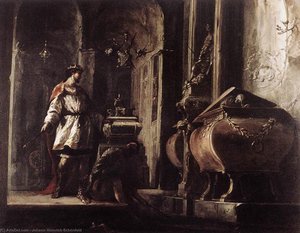
The Flourishing Brushstrokes of Johann Heinrich Schönfeld
To gaze upon the works of Johann Heinrich Schönfeld is to step directly into the vibrant, dramatic heart of the German Baroque period. Born in Biberach (Riss), Germany, in 1609, this painter emerged during an era when art was deeply intertwined with religious fervor and burgeoning classical revivalism. His career spanned a time of immense cultural transformation, allowing him to absorb influences from across the continent while forging a distinctly German voice within the grand tradition of European painting.
Schönfeld’s artistic journey suggests a profound dedication to mastering both narrative grandeur and delicate execution. While his life saw him active through the mid-17th century, it is his surviving body of work that continues to whisper tales of mythological encounters and solemn religious devotion. He was not merely a chronicler of scenes; he seemed intent on capturing the very moment of divine or human epiphany.
Mastering Baroque Drama and Classical Form
The hallmark of Schönfeld’s style lies in its masterful blend of dramatic tension characteristic of the High Baroque, tempered by an adherence to classical compositional structures. His compositions rarely feel static; instead, they pulse with implied movement. Whether depicting a celestial event or a pastoral gathering, one senses the energy coiled just beneath the surface.
His affinity for Italianate landscapes is particularly noteworthy. These backgrounds are never mere backdrops; they are active participants in the drama unfolding before them. Lush, dramatic skies often mirror the emotional turmoil or sublime peace of the figures below. This integration of setting and subject matter elevates his pieces beyond simple portraiture or narrative illustration.
Furthermore, his handling of light is breathtaking. He employed a technique that seems to illuminate key moments—a divine ray piercing through storm clouds, or a single shaft of sunlight catching the folds of drapery—drawing the viewer's eye inexorably toward the central theological or mythological point of focus.
Themes of Piety and Mythology
The thematic scope of Schönfeld’s oeuvre reveals a painter deeply engaged with the grand narratives that shaped European thought. Religious paintings form a significant pillar of his output, reflecting the enduring power of faith during his time. These works invite contemplation on sacrifice, martyrdom, and divine grace.
Equally compelling are his mythological scenes. Here, the classical gods and heroes engage in dramas that echo human passions—love, betrayal, triumph, and fate. He possessed a remarkable ability to imbue these pagan subjects with a sense of profound spiritual weight, making them resonate with contemporary Christian sensibilities.
Allegory painting was a favored vehicle for his deeper commentary. Through the careful arrangement of figures and symbols—a wilting flower representing transience, or an outstretched hand symbolizing divine intervention—he wove complex philosophical arguments into visually accessible narratives for his patrons.
Historical Resonance and Legacy
Johann Heinrich Schönfeld stands as a vital figure in understanding the transition between Mannerist echoes and the full bloom of Baroque naturalism in German art. His commitment to narrative clarity, combined with an undeniable flair for the dramatic, secured his place among painters who helped define the visual language of the 17th century.
While the sheer volume of his work speaks to a prolific career, it is the consistent quality—the ability to balance technical virtuosity with emotional depth—that endures. His legacy invites us not just to admire skill, but to participate in the contemplation of belief, beauty, and the sublime power inherent in both nature and the divine.