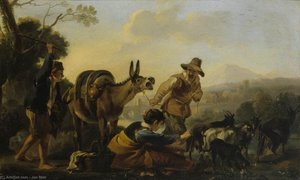
Portret Jan Miel

71 najpoznatijih slika umetnika Jan Miel, svaka potpuno jedinstvena

Ažurirano: новембар 2026 · rangirano prema našem koeficijentu popularnosti (pretrage, posete i porudžbine za svako delo) · 71 dela Jan Miel u našem katalogu

Ukratko

Scene from the Life of Tramps (Lazzaroni) (1650) je slika autora Jan Miel koja privlači najviše pažnje; original se nalazi u muzeju Ermitaž, Sankt Peterburg. Nakon toga, pogled se seli na Hunters at Rest (1650) i Carnival Entertainment (1635). Među 71 dela umetnika Jan Miel u našem katalogu, ovih 71 su najpoznatija, od kojih je svako jedinstveni original predstavljen sa godinom nastanka, muzejom i razlogom zbog kojeg je i danas neprocenjivo.

1599 – 1663, Беверен Baroque Najviše dela: Ermitaž

Top 10 slika umetnika Jan Miel, iz ugla galerije

1
Scene from the Life of Tramps (Lazzaroni) (1650) čiji je Jan Miel

Scene from the Life of Tramps (Lazzaroni)

1650 · Oil On Canvas · Ermitaž, Sankt Peterburg

A heavy, ochre light settles over the crumbling stone of ancient ruins. Here, the shadows are thick and deep, swallowing the corners of a chaotic street scene. Figures move through the haze of smoke and dust, their bodies caught in a sudden, sharp glare of sun. A man gestures with urgency, his hands carving shapes into the air, while others sit in the dirt, anchored by the weight of their…

2
Hunters at Rest (1650) čiji je Jan Miel

Hunters at Rest

1650 · Oil On Canvas · Ermitaž, Sankt Peterburg

is an oil on canvas painting by the Flemish artist Jan Miel. Created about 1650, the work captures a quiet moment within a pastoral scene. It depicts a hunting party finding respite amidst the landscape. The scene is anchored by the presence of horses and the sturdy silhouette of a fortified tower.

3
Carnival Entertainment (1635) čiji je Jan Miel

Carnival Entertainment

1635 · Oil On Canvas · Bavarske državne slikopisne kolekcije, Minhen

In "Carnival Entertainment" by Jan Miel, we find ourselves amidst a dense and dynamic urban scene. The composition is crowded, capturing a street festival where a large group of figures occupies the foreground and middle ground. These individuals—musicians, dancers, and various onlookers—are arranged to create a sense of constant movement. The perspective is a ground-level view, which provides a palpable sense of depth through the careful layering of people and…

4
Sine Cerere et Baccho Friget Venus (1645) čiji je Jan Miel

Sine Cerere et Baccho Friget Venus

1645 · Oil

The oil painting titled Sine Cerere et Baccho Friget Venus presents a mythological scene of abundance. Jan Miel rendered this work in 1645. It captures a moment where classical deities gather amidst the symbols of harvest and intoxication. The figures exist within a lush, Baroque-style arrangement of life and plenty.

5
The Veneration of St. Lambert (1648) čiji je Jan Miel

The Veneration of St. Lambert

1648 · Oil On Canvas · Fitzwilliam Museum

The air in the grand, classical space feels heavy with the scent of incense and the weight of sudden grief. In the center of this dramatic scene, St. Lambert lies in repose, his body a pale, still anchor amidst a sea of movement. Above him, the celestial realm breaks through the gloom; an angel descends with fluid, sweeping drapery that seems to catch a wind from another world. The light…

6
Soothsayer at an inn (1644) čiji je Jan Miel

Soothsayer at an inn

1644 · Oil

The air at the roadside inn feels heavy with the scent of dust and old stone. Under a rugged stone archway, a group of travelers huddles in a moment of quiet tension. A woman in a garment of lapis blue leans toward a man, her presence a cool contrast to the earthy ochre and deep crimson that define the crowd. He is the soothsayer, a figure caught in the flickering…

7
Two hunters resting in a landscape (the standing hunter is a woman in men's clothes) (1639) čiji je Jan Miel

Two hunters resting in a landscape (the standing hunter is a woman in men's clothes)

1639 · Oil On Canvas · New York Historical Society, New York City

The scene unfolds within the oil on canvas work titled Two hunters resting in a landscape (the standing hunter is a woman in men's clothes). This composition emerges from the hand of Jan Miel, a painter who brings a sense of immediate life to the quietude of the hunt. The work is dated 1639, capturing a specific moment of stillness amidst the natural world.

8
Three peasants having fun with music and dance (1639) čiji je Jan Miel

Three peasants having fun with music and dance

1639 · Oil On Panel · Rafael Valls Limited, City of Westminster

Three peasants having fun with music and dance by Jan Miel presents a lively genre scene centered on three figures engaged in rhythmic activity. The composition is dynamic, utilizing an intimate perspective that places the viewer in close proximity to the subjects. Within this shallow space, the central figure is captured mid-motion, a choice that establishes a sense of rhythmic movement throughout the scene. To the left of the main…

9
The Travelers' Dinner. Peasants Eating Near an Inn or Resting (1650) čiji je Jan Miel

The Travelers' Dinner. Peasants Eating Near an Inn or Resting

1650 · Oil On Canvas

The Travelers' Dinner. Peasants Eating Near an Inn or Resting is a genre painting by Jan Miel. This work emerged around 1650, a period when the artist was active within the artistic circles of the seventeenth century. The canvas captures a specific slice of rural life through the eyes of a painter who understood the weight of stone and the texture of coarse cloth.

10
An Italianate Landscape with Peasants Dancing (1650) čiji je Jan Miel

An Italianate Landscape with Peasants Dancing

1650 · Oil On Canvas · Nostell Priory, Wakefield

We are looking at An Italianate Landscape with Peasants Dancing, a work by Jan Miel. This piece dates to about 1650, a period when the artist was deeply engaged with the stylistic shifts occurring within the Italian Baroque. It is a significant example of how Miel navigated the transition from the gritty, everyday observations of the Bamboccianti to more expansive, classical compositions.

Čuvena dela umetnika Jan Miel, od 11 do 71

11Falcon hunters in front of an inn in a ruin (1650) čiji je Jan MielFalcon hunters in front of an inn in a ruin1650 12The beggar (1650) čiji je Jan MielThe beggar1650 13Barber and roulette players (1650) čiji je Jan MielBarber and roulette players1650 14Military resting with a fortune teller (1650) čiji je Jan MielMilitary resting with a fortune teller1650 15Carnival parade in Rome (1660) čiji je Jan MielCarnival parade in Rome1660 16Hannibal's dream (1661) čiji je Jan MielHannibal's dream1661 17Figures in the vicinity of architectural ruins (1650) čiji je Jan MielFigures in the vicinity of architectural ruins1650 18The gathering of the hunters (1660) čiji je Jan MielThe gathering of the hunters1660 · Galleria Sabauda 19Boar hunt (1660) čiji je Jan MielBoar hunt1660 · Palata Venaria Reale 20Bear hunt (1659) čiji je Jan MielBear hunt1659 · Palata Venaria Reale 21Diana the Huntress (1658) čiji je Jan MielDiana the Huntress1658 · Palata Venaria Reale 22Adoration of the Shepherds (1650) čiji je Jan MielAdoration of the Shepherds1650 · Pushkin State Museum 23Serenade with dancers and musician (1650) čiji je Jan MielSerenade with dancers and musician1650 24The Race of the Berber Horses in Rome (1664) čiji je Jan MielThe Race of the Berber Horses in Rome1664 25Traveling theatre (1700) čiji je Jan MielTraveling theatre1700 26Harbour (1652) čiji je Jan MielHarbour1652 · Ermitaž 27La curea - curée - con corte Regale, Carlo Emanuele II e Franesca d (1661) čiji je Jan MielLa curea - curée - con corte Regale, Carlo Emanuele II e Franesca d1661 · Palata Venaria Reale 28Dance in the Trattoria (1647) čiji je Jan MielDance in the Trattoria1647 · Academy of Fine Arts Vienna 29LE BARBIER NAPOLITAIN čiji je Jan MielLE BARBIER NAPOLITAINLuvr 30St John the Baptist Preaching in the Desert čiji je Jan MielSt John the Baptist Preaching in the DesertNationalmuseum 31The Arch of Constantine in Rome (1648) čiji je Jan MielThe Arch of Constantine in Rome1648 · Barber Institute of Fine Arts 32Scene in front of a tavern (1638) čiji je Jan MielScene in front of a tavern1638 · Nacionalni muzej u Varšavi 33Figures Feasting at a Fair in Prati, Outside the Walls of Rome, with the Saint Peter's Basilica and Monte Mario Beyond (1650) čiji je Jan MielFigures Feasting at a Fair in Prati, Outside the Walls of Rome, with the Saint Peter's Basilica and Monte Mario Beyond1650 34Deer hunt (1661) čiji je Jan MielDeer hunt1661 · Palata Venaria Reale 35The death of the deer (1660) čiji je Jan MielThe death of the deer1660 · Palata Venaria Reale 36The Courtyard of Palazzo Nardini in Rome (1650) čiji je Jan MielThe Courtyard of Palazzo Nardini in Rome1650 · Palazzo Barberini 37Hunters at Rest čiji je Jan MielHunters at RestМузеј Прадо 38Architectural Landscape (1638) čiji je Jan MielArchitectural Landscape1638 · Ermitaž 39Carnival Time in Rome (1653) čiji je Jan MielCarnival Time in Rome1653 · Музеј Прадо 40The snack čiji je Jan MielThe snackМузеј Прадо 41Cottage with inhabitants čiji je Jan MielCottage with inhabitantsМузеј Прадо 42The local Barber čiji je Jan MielThe local BarberМузеј Прадо 43Popular scene čiji je Jan MielPopular sceneМузеј Прадо 44The Flight into Egypt čiji je Jan MielThe Flight into EgyptStatens Museum For Kunst 45Soldiers Resting čiji je Jan MielSoldiers RestingNationalmuseum 46Peasants Resting čiji je Jan MielPeasants RestingNationalmuseum 47Hunters Resting čiji je Jan MielHunters RestingNationalmuseum 48Fox hunting čiji je Jan MielFox huntingPalata Venaria Reale 49Jugglers passing – Carnival čiji je Jan MielJugglers passing – CarnivalNacionalni muzej u Varšavi 50MARCHAND D'ESCARGOTS čiji je Jan MielMARCHAND D'ESCARGOTS 51Road in the Roman Campagna čiji je Jan MielRoad in the Roman CampagnaErmitaž 52PAYSAGE AVEC FIGURES čiji je Jan MielPAYSAGE AVEC FIGURES 53Maraudeurs italiens Une halte (autre titre) čiji je Jan MielMaraudeurs italiens Une halte (autre titre) 54Pastorale avec bergère endormie čiji je Jan MielPastorale avec bergère endormie 55The fugitive Erminia asks a fellow countryman for admission čiji je Jan MielThe fugitive Erminia asks a fellow countryman for admission 56The Assembly (1660) čiji je Jan MielThe Assembly1660 · Château de Versailles 57The vihuela player čiji je Jan MielThe vihuela playerМузеј Прадо 58LA DINEE DES VOYAGEURS čiji je Jan MielLA DINEE DES VOYAGEURSLuvr 59Genre Scene (1650) čiji je Jan MielGenre Scene1650 · Ermitaž 60Landscape with herders čiji je Jan MielLandscape with herdersМузеј Прадо 61LA HALTE MILITAIRE čiji je Jan MielLA HALTE MILITAIRELuvr 62Landscape with a Battle between Two Rams (1640) čiji je Jan MielLandscape with a Battle between Two Rams1640 · Metropoliten музеј у Њујорку 63Hunters at Rest čiji je Jan MielHunters at RestErmitaž 64Shepherds and herd in a mountainous landscape čiji je Jan MielShepherds and herd in a mountainous landscapeMusée Calvet 65Carnival in the Piazza Colonna, Rome čiji je Jan MielCarnival in the Piazza Colonna, RomeWadsworth Atheneum 66Roman Lime Kiln with Peasants Gambling čiji je Jan MielRoman Lime Kiln with Peasants Gambling 67Italian Peasants outside a Tavern čiji je Jan MielItalian Peasants outside a TavernRoyal Collection 68Un savetier čiji je Jan MielUn savetier 69The bowls players čiji je Jan MielThe bowls players 70LE MENDIANT čiji je Jan MielLE MENDIANTLuvr 71Charlatan čiji je Jan MielCharlatanErmitaž

Čuvena dela Jan Miel po periodima

Motivi koji su privlačili pažnju Jan Miel

Četiri teme koje se najčešće ponavljaju u ovim originalima, svaka sa svojim vrhunskim primerom.

Muzeji u kojima se čuvaju originalna dela umetnika Jan Miel

8 muzeja u kojima se nalazi najviše slika sa ove stranice.

Muzej Grad Radovi umetnika Jan Miel Slike iz ovog spiska
Ermitaž, Sankt PeterburgErmitaž Sankt Peterburg 8 Scene from the Life of Tramps (Lazzaroni), Hunters at Rest, Harbour
Музеј Прадо, МадридМузеј Прадо Мадрид 8 Hunters at Rest, Carnival Time in Rome, The snack
Palata Venaria Reale, Venaria RealePalata Venaria Reale Venaria Reale 7 Boar hunt, Bear hunt, Diana the Huntress
Luvr, ParizLuvr Pariz 4 LE BARBIER NAPOLITAIN, LA DINEE DES VOYAGEURS, LA HALTE MILITAIRE
Nationalmuseum, СтокхолмNationalmuseum Стокхолм 4 St John the Baptist Preaching in the Desert, Soldiers Resting, Peasants Resting
Nacionalni muzej u Varšavi, VaršavaNacionalni muzej u Varšavi Varšava 2 Scene in front of a tavern, Jugglers passing – Carnival
Bavarske državne slikopisne kolekcije, MinhenBavarske državne slikopisne kolekcije Minhen 1 Carnival Entertainment
Fitzwilliam MuseumFitzwilliam Museum 1 The Veneration of St. Lambert

Jan Miel kroz decenije: jedan jedinstveni original za svaku

Radovi po decenijama

Izaberite deceniju da biste videli original koji je definiše.

Slike umetnika Jan Miel: pitanja za galeriju

Koje je najpoznatije delo umetnika Jan Miel?Otkrij odgovor

Scene from the Life of Tramps (Lazzaroni) (1650), Ermitaž, Sankt Peterburg. Slede Hunters at Rest (1650) i Carnival Entertainment (1635).

U kojoj je godini Jan Miel stvorio/la Scene from the Life of Tramps (Lazzaroni)?Otkrij odgovor

51 godina: Scene from the Life of Tramps (Lazzaroni) datira iz 1650, a Jan Miel je rođen/a 1599.

Koji je deset najpoznatijih slika autora Jan Miel?Otkrij odgovor

Scene from the Life of Tramps (Lazzaroni), Hunters at Rest, Carnival Entertainment, Sine Cerere et Baccho Friget Venus, The Veneration of St. Lambert, Soothsayer at an inn, Two hunters resting in a landscape (the standing hunter is a woman in men's clothes), Three peasants having fun with music and dance, The Travelers' Dinner. Peasants Eating Near an Inn or Resting i An Italianate Landscape with Peasants Dancing. Gornji rang pokazuje godinu i muzej za svako od njih.

Koliko je poznatih dela umetnika Jan Miel?Otkrij odgovor

Naš katalog sadrži 71 dela umetnika Jan Miel, datiranih od 1635 do 1661.

Gde se mogu videti najpoznatiji originali umetnika Jan Miel?Otkrij odgovor

Većinom u Ermitaž (Sankt Peterburg), Музеј Прадо (Мадрид) i Palata Venaria Reale (Venaria Reale). Tabela muzeja iznad sadrži njih sve.

U kom periodu je Jan Miel stvorio/la svoje najpoznatije slike?Otkrij odgovor

U 1650s: 18 od 71 dela na ovoj stranici nastalo je tada, od čega je Scene from the Life of Tramps (Lazzaroni).

Ko je najraniji, a koje je najkasnije čuveno delo umetnika Jan Miel?Otkrij odgovor

Na ovoj stranici, najstarije delo je iz Carnival Entertainment (1635), a najnovije iz Hannibal's dream (1661).

Koje su teme Jan Miel preferirao/la?Otkrij odgovor

People (21), Landscape (15) i Architecture (14), kroz svih 71 dela na ovoj stranici.

Sa kojim materijalima je Jan Miel najčešće slikao?Otkrij odgovor

Oil On Canvas, za 34 od 71 dela na ovoj stranici.

Kojem umetničkom pravcu pripada delo umetnika Jan Miel?Otkrij odgovor

Baroque, sudeći po originalima na ovoj stranici.

Koja originalna dela Jan Miel mogu videti u Ermitaž?Otkrij odgovor

Scene from the Life of Tramps (Lazzaroni), Hunters at Rest i Harbour: Ermitaž, Sankt Peterburg čuva 8 dela sa ove stranice.

Jan Miel: portret umetnika

Jan Miel: Most između holandskog realizma i baroknog veličanstva

Jan Miel (1599–1663) predstavlja ključnu figuru u umetničkom pejzažu sedamnaestog veka, oličavajući fascinantni spoj flamanske tradicije i italijanske inovacije. Rođen u Beverenu, u Belgiji—iako su Antverpen i ’s-Hertogenbosch i dalje kandidati za njegovo rodno mesto—Mielov rani život ostaje prekriven relativnom nepoznaticom, ostavljajući biografske detalje oskudnim. Ipak, ono što se iz naučnih istraživanja izdvaja jeste izuzetan umetnički put obeležen stilskom evolucijom i zajedničkim poduhvatima koji su mu osigurali mesto unutar živopisnog kulturnog okruženja Rima i Turina.

Svoje formativne godine proveo je usavršavajući zanat prvenstveno u Antverpenu, gde je upijao uticaje istaknutih flamanskih majstora poput Anthonyja van Dycka. Iako precizni obim njegovog obrazovanja ostaje neuhvatljiv, on je nesumnjivo u njemu usadio poštovanje prema pedantnom posmatrananju i profinjenoj tehnici—kvalitetima koji će karakterisati veći deo njegovog kasnijeg delatnog opusa. Ovakvo temeljno utemeljivanje u klasičnom crtaštvu i portretizmu pružilo je neophodan alat za karijeru koja će na kraju prevazići regionalne granice.

Rimska transformacija i duh Bamboccianti pokreta

Mielov dolazak u Rim oko 1636. godine označio je transformativni trenutak u njegovoj umetničkoj trajektoriji. Brzo se pridružio Bentvueghels, uticajnom udruženju holandskih i flamanskih umetnika koji su boravili u Večnom gradu. Unutar ovog bratstva, usvojio je nezaboravno ime ‘bieco’, nadimak koji odražava njegov specifičan, smrkašnji pogled—karakteristiku koja će postati sinonim za njegovu umetničku ličnost. Ova pripadnost podstakla je duboke veze unutar šire umetničke zajednice na koju je snažno uticao stil Bamboccianti Pietera van Laera.

Ovaj pokret bio je posvećen prikazivanju scena iz svakodnevnog života nižih slojeva društva u Rimu i njegovoj okolini, izbegavajući idealizovano veličanstvo umetnosti visoke renesanse zarad nečeg mnogo visceralnijeg i neposrednijeg. Miel je svim srcem prihvatio ovaj trend, stvarajući očaravajuće žanrovske slike koje su sa izuzetnim realizmom i senzibilitetom beležile duh urbanog postojanja. Njegova dela su često sadržala:

  • Živopisne ulične scene ispunjene putnicima, trgovcima i radnicima.
  • Majstorsko korišćenje svetlosti kako bi se dočarala prašnjava, suncem okupana atmosfera rimskih ulica.
  • Suptilnu igru ljudskih emocija unutar prepunih i haotičnih okruženja.
  • Pedantnu pažnju posvećenu teksturama tkanine, kamena i zemlje.

Evolucija ka klasicizmu i dvoranskom sjaju

Kako je njegova karijera napredovala, Mielova umetnička vizija prošla je kroz značajnu metamorfozu. Iako je ostao majstor žanrovske scene, počeo je da se udaljava od grubog realizma Bamboccianti stilova ka klasicističkim istorijskim slikama. Ovaj pomak odražavao je širi trend u evropskoj umetnosti, gde je sirova energija baroka sve više bila ublažena željom za redom, plemenitošću i klasičnom alegorijom.

Ova evolucija ga je na kraju dovela do prestižnih imenovanja, a najznačajnije je bilo služenje kao dvoranski umetnik Charlesu Emanuelu II, vojvodi od Savoje. U službi turinskog dvora, Mielovo delo je dobilo formalniji i veličanstveniji karakter. Intimnost njegovih ranijih rimskih scena ustupila je mesto kompozicijama većeg obima i složenosti, osmišljenim da odražavaju moć i prestiž njegovog kraljevskog pokrovitelja. Ovaj period predstavlja vrhunac njegovog profesionalnog dostignuća, gde su se njegove flamanske koreni u detaljima susreli sa grandioznim, sveobuhvatnim narativima koje je zahtevala evropska aristokratija.

Istorijski značaj Jana Miela leži u njegovoj sposobnosti da navigira ovim različitim svetovima. Bio je umetnik koji je mogao pronaći lepotu u skromnoj borbi rimskog uličnog siročeta i dostojanstvo u epskim pričama antike. Premošćavajući jaz između pedantnog realizma Severa i dramatičnog klasicizma Juga, Miel je ostavio neizbrisiv trag u kanonu sedamnaestog veka, osiguravajući svoje nasleđe kao istinskog kosmopolite barokne ere.