Portret Džejkob Lorens

100 najpoznatijih slika umetnika Džejkob Lorens, izbor iz galerije

Ažurirano: новембар 2026 · rangirano prema našem koeficijentu popularnosti (pretrage, posete i porudžbine za svako delo) · 157 dela Džejkob Lorens u našem katalogu

Ukratko

Od svih originala koje je Džejkob Lorens ostavio, najpoznatiji je The Library (1960), koji se nalazi u kolekciji Smithsonian American Art Museum, Vašington, D.C.. Odmah za njima slede Genesis Creation Sermon V: And God Created All the Fowls of the Air and Fishes of the Seas (1989) i Bar and Grill (1941). Naš katalog sadrži 157 dela umetnika Džejkob Lorens; galerija je čuvala 100 dela koja svet najviše admira, od kojih je svako prikazano sa svojim datumom, muzejom i pričom.

1917 – 2000, Атлантик Сити Najviše dela: The Phillips Collection

Top 10 slika umetnika Džejkob Lorens: izbor galerije

1
The Library (1960) čiji je Džejkob Lorens

The Library

1960 · Tempera · Smithsonian American Art Museum, Vašington, D.C.

In the vibrant tapestry of twentieth-century American art, few works capture the pulse of communal aspiration as poignantly as Jacob Lawrence’s “The Library.” Completed in 1960, this masterpiece serves as much more than a mere depiction of a reading room; it is a profound window into the enduring spirit of the Harlem Renaissance. As one gazes upon the canvas, they are immediately swept into a bustling sanctuary of knowledge, where…

2
Genesis Creation Sermon V: And God Created All the Fowls of the Air and Fishes of the Seas (1989) čiji je Džejkob Lorens

Genesis Creation Sermon V: And God Created All the Fowls of the Air and Fishes of the Seas

1989 · Painting · SCAD Museum of Art, Savana

To stand before a piece from Jacob Lawrence’s Genesis Creation Sermon series is to be enveloped in a vibrant confluence of scripture, social history, and raw artistic energy. This particular panel, depicting "And God Created All the Fowls of the Air and Fishes of the Seas," transcends mere religious illustration; it is a monumental cultural document rendered in paint. Lawrence, whose life story was so deeply intertwined with the evolving…

3
Bar and Grill (1941) čiji je Džejkob Lorens

Bar and Grill

1941 · Painting · Smithsonian American Art Museum, Vašington, D.C.

Jacob Lawrence’s powerful 1941 work, "Bar and Grill," is far more than a mere depiction of an American social scene; it is a searing document etched in paint, capturing the suffocating reality of Jim Crow segregation. The painting plunges the viewer into the interior of a café, yet the atmosphere is anything but convivial. Lawrence masterfully uses composition to confront us with the visible, yet deeply ingrained, artificiality of racial…

4
Genesis Creation Sermon IV: And God Created the Day and the Night and God Creatied and Put Stars in the Skies (1989) čiji je Džejkob Lorens

Genesis Creation Sermon IV: And God Created the Day and the Night and God Creatied and Put Stars in the Skies

1989 · Painting · SCAD Museum of Art, Savana

In the profound depths of Jacob Lawrence’s 1989 masterpiece, Genesis Creation Sermon IV: And God Created the Day and the Night and God Created and Put Stars in the Skies, we find a breathtaking intersection between the divine and the earthly. This work is not merely a depiction of a biblical event; it is a visceral, rhythmic experience that captures the very moment light pierces the darkness. Lawrence, a master…

6
Taboo (1963) čiji je Džejkob Lorens

Taboo

1963 · Painting · Philadelphia Museum of Art, Filadelfija

In 1963, Jacob Lawrence presented Taboo, a work that speaks with a clarity that belies its heavy subject matter. The painting captures two pairs of newlyweds, posed with the formal dignity of a traditional wedding portrait. On one side, a Black bride stands beside a white groom; on the other, the roles are reversed. They are dressed in full wedding regalia, their presence a calm assertion of existence in a…

7
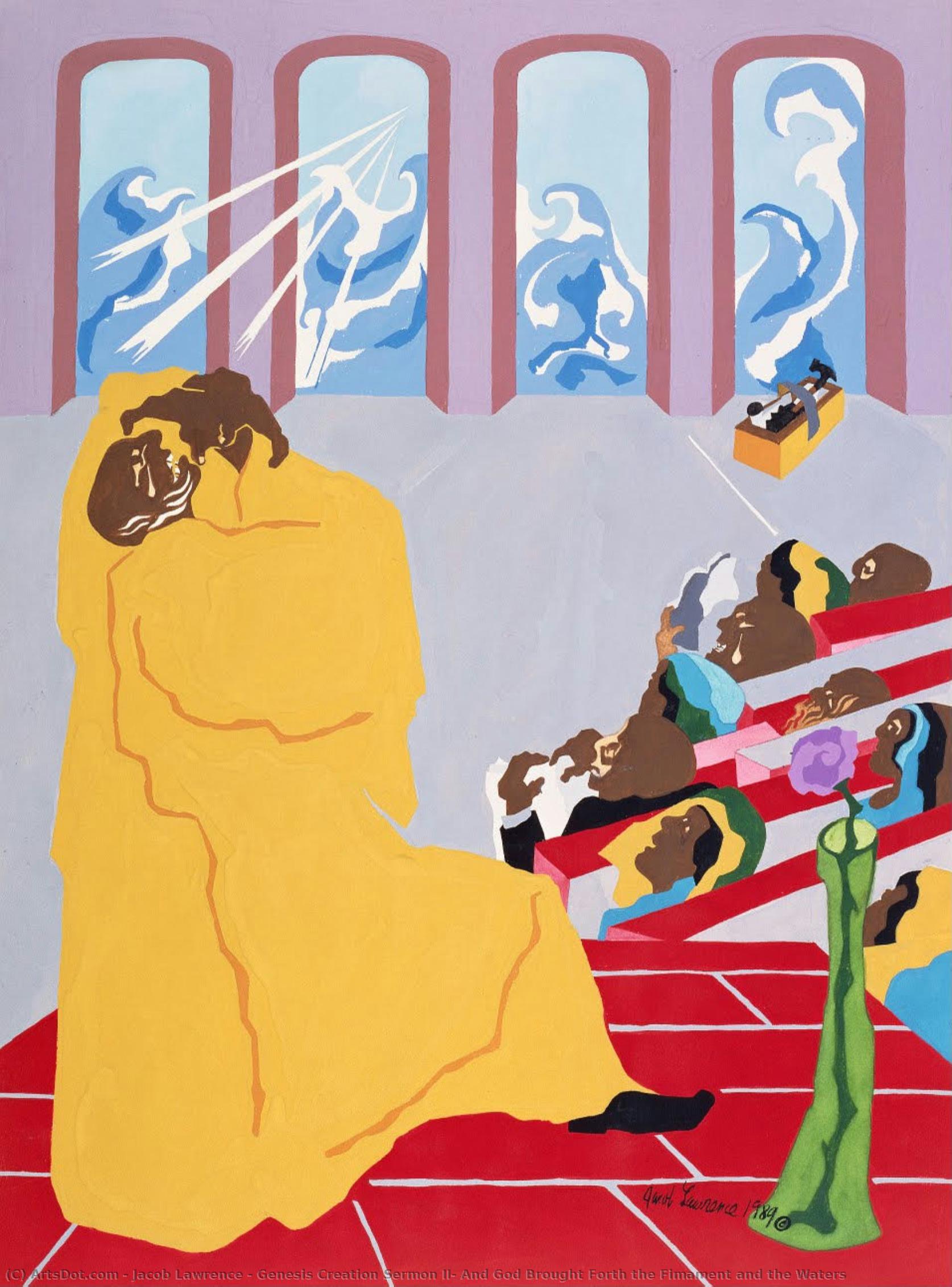
Genesis Creation Sermon II: And God Brought Forth the Fimament and the Waters (1989) čiji je Džejkob Lorens

Genesis Creation Sermon II: And God Brought Forth the Fimament and the Waters

1989 · Oil On Canvas · SCAD Museum of Art, Savana

Jacob Lawrence’s Genesis Creation Sermon II: And God Brought Forth the Fimament and the Waters is far more than a depiction of biblical scripture; it is a vibrant, deeply personal sermon rendered in paint. Inspired by the powerful oratory of Rev. Adam Clayton Powell Sr., this work channels the electrifying energy of Harlem’s cultural heart into an epic moment of cosmic genesis. The scene pulses with divine activity, capturing that…

8
Tombstones (1942) čiji je Džejkob Lorens

Tombstones

1942 · Tempera · Whitney Museum of American Art, Njujork

In the somber, evocative landscape of Jacob Lawrence’s 1942 masterpiece, Tombstones, we are invited into a profound visual dialogue between life and death. Painted during the turbulent era following Pearl Harbor, this work serves as much more than a mere depiction of a graveyard; it is a soulful testament to the collective experience of African Americans in Harlem. Lawrence, a master of narrative storytelling, utilizes his signature dynamic cubism to…

9
War Series: The Letter (1946) čiji je Džejkob Lorens

War Series: The Letter

1946 · Acrylic On Canvas · Whitney Museum of American Art, Njujork

Jacob Lawrence’s “The Letter,” part of his monumental “War Series” created in 1946, is not merely a depiction of sorrow; it’s an embodiment of profound human experience distilled into its most potent form. This work, rendered with the artist's signature flattened planes and stark geometry, immediately commands attention with its emotionally charged atmosphere. The central figure, hunched and isolated within a confined space, speaks volumes about the devastating impact of…

10
Migration Series No.57: The female workers were the last to arrive north (1941) čiji je Džejkob Lorens

Migration Series No.57: The female workers were the last to arrive north

1941 · Tempera On Panel · The Phillips Collection, Vašington, D.C.

A single, vertical line of reddish-brown cuts through the center of the frame, acting as a steady axis for the scene. Around this pole, the world feels flattened and heavy, composed of large, overlapping geometric planes that strip away unnecessary detail to reveal the essence of a moment. A figure, draped in a white cloth that obscures the face, leans into the work. Only dark hands are visible, gripping the…

Izbor umetnika Džejkob Lorens se nastavlja, od 11 do 100

11Genesis Creation Sermon VIII: And Creation Was Done and All Was Well (1989) čiji je Džejkob LorensGenesis Creation Sermon VIII: And Creation Was Done and All Was Well1989 · SCAD Museum of Art 12Migration Series No.39: Railroad platforms were piled high with luggage (1941) čiji je Džejkob LorensMigration Series No.39: Railroad platforms were piled high with luggage1941 · The Phillips Collection 13Genesis Creation Sermon I: In the Beginning All Was Void (1989) čiji je Džejkob LorensGenesis Creation Sermon I: In the Beginning All Was Void1989 · SCAD Museum of Art 14Genesis Creation Sermon VI: And God Created All the Beasts of the Earth (1989) čiji je Džejkob LorensGenesis Creation Sermon VI: And God Created All the Beasts of the Earth1989 · SCAD Museum of Art 15Genesis Creation Sermon VII: And God Created Man and Woman (1989) čiji je Džejkob LorensGenesis Creation Sermon VII: And God Created Man and Woman1989 · SCAD Museum of Art 16Migration Series No.23: The migration spread (1941) čiji je Džejkob LorensMigration Series No.23: The migration spread1941 · The Phillips Collection 17Migration Series No.31: The migrants found improved housing when they arrived north (1941) čiji je Džejkob LorensMigration Series No.31: The migrants found improved housing when they arrived north1941 · The Phillips Collection 18Migration Series No.37: Many migrants found work in the steel industry (1941) čiji je Džejkob LorensMigration Series No.37: Many migrants found work in the steel industry1941 · The Phillips Collection 19Migration Series No.59: In the North they had the freedom to vote (1941) čiji je Džejkob LorensMigration Series No.59: In the North they had the freedom to vote1941 · The Phillips Collection 20The Migration Series, Panel no. 13: The crops were left to dry and rot.  There was no one to tend them. čiji je Džejkob LorensThe Migration Series, Panel no. 13: The crops were left to dry and rot. There was no one to tend them.The Phillips Collection 21Genesis Creation Sermon III: And God Said (1989) čiji je Džejkob LorensGenesis Creation Sermon III: And God Said1989 · SCAD Museum of Art 22The Migration Series, Panel no. 57: The female workers were the last to arrive north. čiji je Džejkob LorensThe Migration Series, Panel no. 57: The female workers were the last to arrive north.The Phillips Collection 23The Migration Series, Panel no. 43: In a few sections of the South leaders of both Black and White communities met to discuss ways of making the South a good place to live. čiji je Džejkob LorensThe Migration Series, Panel no. 43: In a few sections of the South leaders of both Black and White communities met to discuss ways of making the South a good place to live.The Phillips Collection 24The Card Game (1953) čiji je Džejkob LorensThe Card Game1953 · SCAD Museum of Art 25The Wedding (1948) čiji je Džejkob LorensThe Wedding1948 · Art Institute of Chicago 26Migration Series No.49: They found discrimination in the North. It was a different kind (1941) čiji je Džejkob LorensMigration Series No.49: They found discrimination in the North. It was a different kind1941 27Migration Series No.45: The migrants arrived in Pittsburgh, one of the great industrial centers of the North (1941) čiji je Džejkob LorensMigration Series No.45: The migrants arrived in Pittsburgh, one of the great industrial centers of the North1941 28Migration Series No.43: In a few sections of the South leaders of both Black and White communities met to discuss ways of making the South a good place to live (1941) čiji je Džejkob LorensMigration Series No.43: In a few sections of the South leaders of both Black and White communities met to discuss ways of making the South a good place to live1941 29Migration Series No.35: They left the South in great numbers. They arrived in the North in great numbers (1941) čiji je Džejkob LorensMigration Series No.35: They left the South in great numbers. They arrived in the North in great numbers1941 30Migration Series No.33: Letters from relatives in the North told of the better life there (1941) čiji je Džejkob LorensMigration Series No.33: Letters from relatives in the North told of the better life there1941 31Migration Series No.29: The labor agent recruited unsuspecting laborers as strike breakers for northern industries (1941) čiji je Džejkob LorensMigration Series No.29: The labor agent recruited unsuspecting laborers as strike breakers for northern industries1941 32Migration Series No.28: The labor agent sent south by northern industry was a familiar presence in the Black communities (1941) čiji je Džejkob LorensMigration Series No.28: The labor agent sent south by northern industry was a familiar presence in the Black communities1941 33Migration Series No.17: Tenant farmers received harsh treatment at the hands of the planter (1941) čiji je Džejkob LorensMigration Series No.17: Tenant farmers received harsh treatment at the hands of the planter1941 34Migration Series No.14: For African Americans there was no justice in the southern courts (1941) čiji je Džejkob LorensMigration Series No.14: For African Americans there was no justice in the southern courts1941 35Painting the Bilges (1944) čiji je Džejkob LorensPainting the Bilges1944 36Watchmaker (1946) čiji je Džejkob LorensWatchmaker1946 37Cabinet Makers (1946) čiji je Džejkob LorensCabinet Makers1946 38Sedation (1950) čiji je Džejkob LorensSedation1950 39Vaudeville (1951) čiji je Džejkob LorensVaudeville1951 40...if we fail, let us fail like men, and expire together in one common strugge... -Henry Clay, 1813 (1956) čiji je Džejkob Lorens...if we fail, let us fail like men, and expire together in one common strugge... -Henry Clay, 18131956 41The Cue and the Ball (1956) čiji je Džejkob LorensThe Cue and the Ball1956 42Pool (1954) čiji je Džejkob LorensPool1954 43Street Shadows (1959) čiji je Džejkob LorensStreet Shadows1959 44Through Forest, Through Rivers, Up Mountains (1967) čiji je Džejkob LorensThrough Forest, Through Rivers, Up Mountains1967 45Struggle Series - No. 10: Washington Crossing the Delaware (1954) čiji je Džejkob LorensStruggle Series - No. 10: Washington Crossing the Delaware1954 · Metropoliten музеј у Њујорку 46...is life so dear or peace so sweet as to be purchased at the prices of chains and slavery? Patrick Henry-1775 (1955) čiji je Džejkob Lorens...is life so dear or peace so sweet as to be purchased at the prices of chains and slavery? Patrick Henry-17751955 47The Migration Series, Panel no. 53: African American, long-time residents of northern cities met the migrants with aloofness and disdain. čiji je Džejkob LorensThe Migration Series, Panel no. 53: African American, long-time residents of northern cities met the migrants with aloofness and disdain.The Phillips Collection 48The Migration Series, Panel no. 27: Many men stayed behind until they could take their families north with them. čiji je Džejkob LorensThe Migration Series, Panel no. 27: Many men stayed behind until they could take their families north with them.The Phillips Collection 49The Migration Series, Panel no. 21: Families arrived at the station very early.  They did not wish to miss their trains north. čiji je Džejkob LorensThe Migration Series, Panel no. 21: Families arrived at the station very early. They did not wish to miss their trains north.The Phillips Collection 50Frederick Douglass listened to William Lloyd Garrison denounce slavery čiji je Džejkob LorensFrederick Douglass listened to William Lloyd Garrison denounce slavery 51Race riots were very numerous all over the North because of the antagonism that was caused between the Negro and white workers čiji je Džejkob LorensRace riots were very numerous all over the North because of the antagonism that was caused between the Negro and white workers 52Migration Series No.58: In the North the African American had more educational opportunities (1941) čiji je Džejkob LorensMigration Series No.58: In the North the African American had more educational opportunities1941 53Migration Series No.55: The migrants, having moved suddenly into a crowded and unhealthy environment, soon contracted tuberculosis. The death rate rose (1941) čiji je Džejkob LorensMigration Series No.55: The migrants, having moved suddenly into a crowded and unhealthy environment, soon contracted tuberculosis. The death rate rose1941 54Migration Series No.54: For the migrants, the church was the center of life (1941) čiji je Džejkob LorensMigration Series No.54: For the migrants, the church was the center of life1941 55Migration Series No.53: African Americans, long-time residents of northern cities, met the migrants with aloofness and disdain (1941) čiji je Džejkob LorensMigration Series No.53: African Americans, long-time residents of northern cities, met the migrants with aloofness and disdain1941 56Migration Series No.51: African Americans seeking to find better housing attempted to move into new areas. This resulted in the bombing of their new homes (1941) čiji je Džejkob LorensMigration Series No.51: African Americans seeking to find better housing attempted to move into new areas. This resulted in the bombing of their new homes1941 57Migration Series No.47: As the migrant population grew, good housing became scarce. Workers were forced to live in overcrowded and dilapidated tenement houses (1941) čiji je Džejkob LorensMigration Series No.47: As the migrant population grew, good housing became scarce. Workers were forced to live in overcrowded and dilapidated tenement houses1941 58Migration Series No.46: Industries boarded their workers in unhealthy quarters. Labor camps were numerous (1941) čiji je Džejkob LorensMigration Series No.46: Industries boarded their workers in unhealthy quarters. Labor camps were numerous1941 59Migration Series No.44: But living conditions were better in the North (1941) čiji je Džejkob LorensMigration Series No.44: But living conditions were better in the North1941 60Migration Series No.42: To make it difficult for the migrants to leave, they were arrested en masse. They often missed their trains (1941) čiji je Džejkob LorensMigration Series No.42: To make it difficult for the migrants to leave, they were arrested en masse. They often missed their trains1941 61Migration Series No.41: The South was desperate to keep its cheap labor. Northern labor agents were jailed or forced to operate in secrecy (1941) čiji je Džejkob LorensMigration Series No.41: The South was desperate to keep its cheap labor. Northern labor agents were jailed or forced to operate in secrecy1941 62Migration Series No.30: In every southern home people met to decide whether or not to go north (1941) čiji je Džejkob LorensMigration Series No.30: In every southern home people met to decide whether or not to go north1941 63Migration Series No.27: Many men stayed behind until they could take their families north with them (1941) čiji je Džejkob LorensMigration Series No.27: Many men stayed behind until they could take their families north with them1941 64Migration Series No.25: They left their homes. Soon some communities were left almost empty (1941) čiji je Džejkob LorensMigration Series No.25: They left their homes. Soon some communities were left almost empty1941 65Migration Series No.22: Migrants left. They did not feel safe. It was not wise to be found on the streets late at night. They were arrested on the slightest provocation (1941) čiji je Džejkob LorensMigration Series No.22: Migrants left. They did not feel safe. It was not wise to be found on the streets late at night. They were arrested on the slightest provocation1941 66Migration Series No.21: Families arrived at the station very early. They did not wish to miss their trains north (1941) čiji je Džejkob LorensMigration Series No.21: Families arrived at the station very early. They did not wish to miss their trains north1941 67Migration Series No.19: There had always been discrimination (1941) čiji je Džejkob LorensMigration Series No.19: There had always been discrimination1941 · The Phillips Collection 68Migration Series No.15: There were lynchings (1941) čiji je Džejkob LorensMigration Series No.15: There were lynchings1941 · The Phillips Collection 69Migration Series No.13: The crops were left to dry and rot. There was no one to tend them (1941) čiji je Džejkob LorensMigration Series No.13: The crops were left to dry and rot. There was no one to tend them1941 70Migration Series No.9: They left because the boll weevil had ravaged the cotton crop (1941) čiji je Džejkob LorensMigration Series No.9: They left because the boll weevil had ravaged the cotton crop1941 · The Phillips Collection 71Migration Series No.7: The migrant, whose life had been rural and nurtured by the earth, was now moving to urban life dependent on industrial machinery (1941) čiji je Džejkob LorensMigration Series No.7: The migrant, whose life had been rural and nurtured by the earth, was now moving to urban life dependent on industrial machinery1941 72Migration Series No.5: Migrants were advanced passage on the railroads, paid for by northern industry. Northern industry was to be repaid by the migrants out of their future wages (1941) čiji je Džejkob LorensMigration Series No.5: Migrants were advanced passage on the railroads, paid for by northern industry. Northern industry was to be repaid by the migrants out of their future wages1941 73Migration Series No.3: From every southern town migrants left by the hundreds to travel north (1941) čiji je Džejkob LorensMigration Series No.3: From every southern town migrants left by the hundreds to travel north1941 74Migration Series No.1: During World War I there was a great migration north by southern African Americans (1941) čiji je Džejkob LorensMigration Series No.1: During World War I there was a great migration north by southern African Americans1941 75Bar and Grill (1941) čiji je Džejkob LorensBar and Grill1941 · Smithsonian American Art Museum 76Harriet Tubman Series (Panel -4) (1940) čiji je Džejkob LorensHarriet Tubman Series (Panel -4)1940 · Hampton University Museum 77When It Is Warm the Parks Are Filled with People (1943) čiji je Džejkob LorensWhen It Is Warm the Parks Are Filled with People1943 78This is Harlem (1943) čiji je Džejkob LorensThis is Harlem1943 79Captain Skinner (1944) čiji je Džejkob LorensCaptain Skinner1944 80War Series: Shipping Out (1947) čiji je Džejkob LorensWar Series: Shipping Out1947 · Whitney Museum of American Art 81War Series: Prayer (1947) čiji je Džejkob LorensWar Series: Prayer1947 · Whitney Museum of American Art 82African Gold Miners (1946) čiji je Džejkob LorensAfrican Gold Miners1946 83Defeat (1954) čiji je Džejkob LorensDefeat1954 84I alarmed almost every house till I got to Lexington-Paul Revere (1954) čiji je Džejkob LorensI alarmed almost every house till I got to Lexington-Paul Revere1954 85Trappers (1956) čiji je Džejkob LorensTrappers1956 86Victory and Defeat (1955) čiji je Džejkob LorensVictory and Defeat1955 87We, the people of the United States, in order to form a more perfect Union, establish justice, insure domestic tranquility (1955) čiji je Džejkob LorensWe, the people of the United States, in order to form a more perfect Union, establish justice, insure domestic tranquility1955 88...for freedom we want and will have, for we have served this cruel land long enuff... -a Georgia slave, 1810 (1956) čiji je Džejkob Lorens...for freedom we want and will have, for we have served this cruel land long enuff... -a Georgia slave, 18101956 89I cannot speak sufficiently in praise of the firmness and deliberation with which my whole line received their approach... -Andrew Jackson, New Orleans, 1815 (1956) čiji je Džejkob LorensI cannot speak sufficiently in praise of the firmness and deliberation with which my whole line received their approach... -Andrew Jackson, New Orleans, 18151956 90Untitled (D2X9VM) (1955) čiji je Džejkob LorensUntitled (D2X9VM)1955 91Thousands of American citizens have been torn from their country and from everying dear to them: they have been dragged on board ships of ward of a foreign nation. -Madison, 1 June 1812 (1956) čiji je Džejkob LorensThousands of American citizens have been torn from their country and from everying dear to them: they have been dragged on board ships of ward of a foreign nation. -Madison, 1 June 18121956 92120.9.14.286.9.33-ton 290.9.27 be at 153.9.28.110.8.17.255.9.29 evening 178.9.8... -an informer's coded message (1955) čiji je Džejkob Lorens120.9.14.286.9.33-ton 290.9.27 be at 153.9.28.110.8.17.255.9.29 evening 178.9.8... -an informer's coded message1955 93Listen, Father! The Americans have not yet defeated us by land; neither are we sure they have done so by water--we therefore wish to remain here and fight our enemy... Tecumseh to the British, Tippecanoe, 1811 (1956) čiji je Džejkob LorensListen, Father! The Americans have not yet defeated us by land; neither are we sure they have done so by water--we therefore wish to remain here and fight our enemy... Tecumseh to the British, Tippecanoe, 18111956 94Fulton and Nostrand (1958) čiji je Džejkob LorensFulton and Nostrand1958 · Cleveland Museum of Art 95Fruits and Vegetables (1959) čiji je Džejkob LorensFruits and Vegetables1959 · Cincinnati Art Museum 96The Visitors (1959) čiji je Džejkob LorensThe Visitors1959 · Dallas Museum of Art 97Magic Man (1958) čiji je Džejkob LorensMagic Man1958 98Parade (1960) čiji je Džejkob LorensParade1960 99Pool Parlor (1942) čiji je Džejkob LorensPool Parlor1942 100Firewood 55 (1942) čiji je Džejkob LorensFirewood 551942

Čuvena dela Džejkob Lorens po periodima

Motivi koji su privlačili pažnju Džejkob Lorens

Četiri teme koje se najčešće ponavljaju u ovim originalima, svaka sa svojim vrhunskim primerom.

Muzeji u kojima se čuvaju originalna dela umetnika Džejkob Lorens

8 muzeja u kojima se nalazi najviše slika sa ove stranice.

Muzej Grad Radovi umetnika Džejkob Lorens Slike iz ovog spiska
The Phillips Collection, Vašington, D.C.The Phillips Collection Vašington, D.C. 35 Migration Series No.11: Food had doubled in price because of the war, Migration Series No.57: The female workers were the last to arrive north, Migration Series No.39: Railroad platforms were piled high with luggage
SCAD Museum of Art, SavanaSCAD Museum of Art Savana 10 Genesis Creation Sermon V: And God Created All the Fowls of the Air and Fishes of the Seas, Genesis Creation Sermon IV: And God Created the Day and the Night and God Creatied and Put Stars in the Skies, Genesis Creation Sermon II: And God Brought Forth the Fimament and the Waters
Whitney Museum of American Art, NjujorkWhitney Museum of American Art Njujork 4 Tombstones, War Series: The Letter, War Series: Shipping Out
Smithsonian American Art Museum, Vašington, D.C.Smithsonian American Art Museum Vašington, D.C. 3 The Library, Bar and Grill, Bar and Grill
Philadelphia Museum of Art, FiladelfijaPhiladelphia Museum of Art Filadelfija 1 Taboo
Art Institute of Chicago, ČikagoArt Institute of Chicago Čikago 1 The Wedding
Metropoliten музеј у Њујорку, ЊујоркMetropoliten музеј у Њујорку Њујорк 1 Struggle Series - No. 10: Washington Crossing the Delaware
Hampton University Museum, HamptonHampton University Museum Hampton 1 Harriet Tubman Series (Panel -4)

Džejkob Lorens deceniju po deceniju: original koji definiše svaku od njih

Radovi po decenijama

Izaberite deceniju da biste videli original koji je definiše.

Pitanja kolekcionara o slikama umetnika Džejkob Lorens

Po kojem delu je Džejkob Lorens najpoznatiji/a?Otkrij odgovor

The Library (1960), Smithsonian American Art Museum, Vašington, D.C.. Slede Genesis Creation Sermon V: And God Created All the Fowls of the Air and Fishes of the Seas (1989) i Bar and Grill (1941).

Koliko je godina imao/la Džejkob Lorens kada je nastalo delo The Library?Otkrij odgovor

43 godina: The Library datira iz 1960, a Džejkob Lorens je rođen/a 1917.

Koja su deset najpoznatijih slika umetnika Džejkob Lorens?Otkrij odgovor

The Library, Genesis Creation Sermon V: And God Created All the Fowls of the Air and Fishes of the Seas, Bar and Grill, Genesis Creation Sermon IV: And God Created the Day and the Night and God Creatied and Put Stars in the Skies, Migration Series No.11: Food had doubled in price because of the war, Taboo, Genesis Creation Sermon II: And God Brought Forth the Fimament and the Waters, Tombstones, War Series: The Letter i Migration Series No.57: The female workers were the last to arrive north. Gornji rang pokazuje godinu i muzej za svako od njih.

Koliko je slika ostavio Džejkob Lorens?Otkrij odgovor

Naš katalog sadrži 157 dela umetnika Džejkob Lorens, datiranih od 1940 do 1989.

U kojim muzejima se nalaze remek-dela umetnika Džejkob Lorens?Otkrij odgovor

Većinom u The Phillips Collection (Vašington, D.C.), SCAD Museum of Art (Savana) i Whitney Museum of American Art (Njujork). Tabela muzeja iznad sadrži njih sve.

U kojim godinama je Džejkob Lorens naslikao svoja najpoznatija dela?Otkrij odgovor

U 1940s: 56 od 100 dela na ovoj stranici nastalo je tada, od čega je Bar and Grill.

Koja su prva i poslednja čuvena originalna dela umetnika Džejkob Lorens?Otkrij odgovor

Na ovoj stranici, najstarije delo je iz Harriet Tubman Series (Panel -4) (1940), a najnovije iz Genesis Creation Sermon V: And God Created All the Fowls of the Air and Fishes of the Seas (1989).

Koje je motive Džejkob Lorens najčešće birao/la?Otkrij odgovor

People (8), Harlem renaissance (6) i Figures (6), kroz svih 100 dela na ovoj stranici.

Koju je tehniku najčešće koristio/la Džejkob Lorens?Otkrij odgovor

Painting, za 10 od 100 dela na ovoj stranici.

Čija se dela umetnika Džejkob Lorens nalaze u The Phillips Collection?Otkrij odgovor

Migration Series No.11: Food had doubled in price because of the war, Migration Series No.57: The female workers were the last to arrive north i Migration Series No.39: Railroad platforms were piled high with luggage: The Phillips Collection, Vašington, D.C. čuva 16 dela sa ove stranice.

Džejkob Lorens: život i delo

Život iscrtan pričom: Svet Jakoba Lorensa

Jakob Armsted Lorens, rođen u Atlantič Sitiju, u Nju Džerziju, 1917. godine, istaknuo se kao jedan od najznačajnijih američkih umetnika 20. veka. Njegova životna priča neraskidivo je isprepletana sa njegovom umetnošću—to je moćna naracija oblikovana realnostima afroameričkog iskustva tokom perioda dubokih društvenih promena. Nakon razvoda roditelja 1elog 1924. godine, Lorens je prošao kroz detinjstvo obeleženo kretanjem i prilagođavanjem, provodeći vreme u hranitelničkim porodicama u Filadelfiji pre nego što je konačno pronašao dom sa majkom u Harlemu, tokom vibrantnih godina Harlem Renesanse. Ovo uranjanje u kulturno srce crne Amerike postalo bi izvor njegove umetničke vizije. Upravo su u užurbanim ulicama i zajedničkom duhu Harlema Lorens prvi put susreo umetnost, pohađajući časove u dečjem domu Utopia, a kasnije studirajući pod vođstvom Čarlsa Alstona u Harlem Art Workshop-u—što je bilo formativno iskustvo koje ga je usmerilo na put da postane vizuelni pripovedač neprevaziđene dubine.

Dinamični kubizam: Stil rođen iz iskustva

Lorens nije jednostavno usvajao umetničke stilove; on ih je sam stvarao, opisujući ih slavno kao „dinamični kubizam“. Ovo nije bilo imitiranje evropske avangarde, već jedinstvena sinteza modernističkih principa i proživljenog iskustva njegove zajednice. Pod uticajem jarkih boja i ravnih formi afričke skulpture i meksičkih muralista—umetnika koji su prioritet davali narativu i društvenoj komentari; Lorens je razvio vizuelni jezik koji je bio istovremeno zapanjujuće moderan i duboko ukorenjen u crnoj kulturi. Njegova dela karakterišu snažni, pojednostavljeni oblici, vibrantne palete boja i namerno odbacivanje tradicionalne perspektive. Ovaj pristup nije bio samo estetski; on je služio da naglasi emocionalnu težinu njegovih motiva i stvori osećaj neposrednosti i pristupačnosti. On nije težio da replicira stvarnost, već da izvadi njenu suštinu, beležeći duh jednog naroda i njihovu istoriju sa nepokolebljivom iskrenošću.

Hronika istorije i svakodnevnog života

Lorensov umetnički opus izuzetno je impresivan po svojoj širini i tematskoj doslednosti. On se nije fokusirao na izolovane portrete ili pejzaže; umesto toga, stvarao je sveobuhvatne serije koje su se bavile monumentalnim istorijskim događajima i nijansama svakodnevnog crnog života. Njegov prelomni trenutak došlo je sa Serijom migracija (The Migration Series), moćnim nizom od šezdeset panela koji prikazuju Veliku migraciju—masovno kretanje Afroamerikanaca iz ruralnog Juga na industrijski Sever u potrazi za boljim životom i bekstvom od segregacije poznate kao Jim Crow zakoni. Ovo delo, započeto 1940-41. godine, lansiralo je Lorensa u nacionalne krugove, donoseći mu priznanja i osiguravajući mu mesto vodećeg glasa u američkoj umetnosti. Ali Serija migracija bila je samo početak. Nastavio je da stvara podjednako upečatljive serije posvećene ličnostima kao što su Tusan L'Ovjer, Frederik Daglas i Henrieta Tambman—pretvarajući istorijske narative u pristupačne vizuelne priče. Pored ovih grandioznih istorijskih ciklusa, Lorens je pronašao lepotu i značaj i u običnom: scene berbernica, restorana i porodičnog života postale su platna za istraživanje tema zajedništva, otpornosti i identiteta. Njegova slika Bar i gril (Bar and Grill), sirova prikaz segregacije unutar kafića u Nju Orleansu, primer je njegove sposobnosti da složene društvene realnosti sažme u snažne vizuelne izjave. Slično tome, Pobeda i poraz (Victory and Defeat), sa svojim impresivnim zidom od topovskih kugli, obeležava ključnu opsadu Jorktauna u Virdžiniji, nudeći nijansiran odraz američke istorije.

Nasleđe i trajni uticaj

Uticaj Jakoba Lorensa proteže se daleko izvan njegovog impresivnog dela. On nije bio samo umetnik, već i posvećeni edukator, predajući znanje na institucijama kao što su Black Mountain College i Univerzitet u Vašingtonu tokom šesnaest godina. Kroz svoje podučavanje, on je negovao generacije umetnika, podstičući ih da pronađu sopstveni glas i istražuju teme relevantne za njihova iskustva. Lorens je utrao put brojnim afroameričkim umetnicima koji su došli posle njega, izazivajući postojeće norme i proširujući granice američke umetnosti. Njegovo delo nastavlja da odjekuje i danas, pokrećući kritičke razgovore o rasi, istoriji i socijalnoj pravdi. Njegove slike, zastupljene u istaknutim muzejima kao što je Smithsonian American Art Museum i kolekcija Univerziteta u Vašingtonu, služe kao trajni dokazi moći umetnosti da osvetli ljudsku sudbinu i inspiriše promene. Za sobom je ostavio nasleđe ne samo prelepih slika, već i hrabre priče—vizuelnu hroniku putovanja jednog naroda ka slobodi i samoodređenju.